Download Mendeley
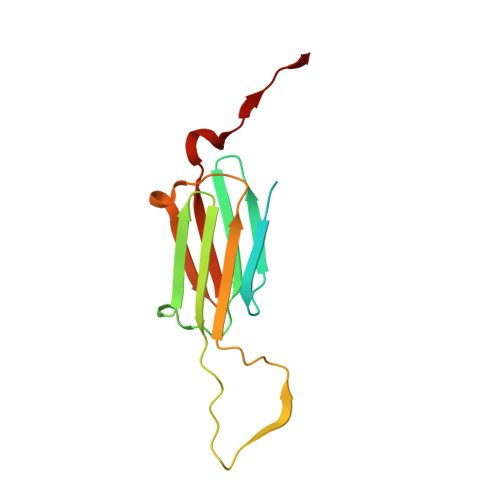
Cryo-EM structure of a 16.5-kDa small heat-shock protein from Methanocaldococcus jannaschii.
Lee, J., Ryu, B., Kim, T., Kim, K.K.(2024) Int J Biol Macromol 258: 128763-128774
- PubMed: 38103675 Search on PubMed
- DOI: https://doi.org/10.1016/j.ijbiomac.2023.128763
- Primary Citation Related Structures:
8WP9 - PubMed Abstract:
The small heat-shock protein (sHSP) from the archaea Methanocaldococcus jannaschii, MjsHSP16.5, functions as a broad substrate ATP-independent holding chaperone protecting misfolded proteins from aggregation under stress conditions. This protein is the first sHSP characterized by X-ray crystallography, thereby contributing significantly to our understanding of sHSPs. However, despite numerous studies assessing its functions and structures, the precise arrangement of the N-terminal domains (NTDs) within this sHSP cage remains elusive. Here we present the cryo-electron microscopy (cryo-EM) structure of MjsHSP16.5 at 2.49-Å resolution. The subunits of MjsHSP16.5 in the cryo-EM structure exhibit lesser compaction compared to their counterparts in the crystal structure. This structural feature holds particular significance in relation to the biophysical properties of MjsHSP16.5, suggesting a close resemblance to this sHSP native state. Additionally, our cryo-EM structure unveils the density of residues 24-33 within the NTD of MjsHSP16.5, a feature that typically remains invisible in the majority of its crystal structures. Notably, these residues show a propensity to adopt a β-strand conformation and engage in antiparallel interactions with strand β1, both intra- and inter-subunit modes. These structural insights are corroborated by structural predictions, disulfide bond cross-linking studies of Cys-substitution mutants, and protein disaggregation assays. A comprehensive understanding of the structural features of MjsHSP16.5 expectedly holds the potential to inspire a wide range of interdisciplinary applications, owing to the renowned versatility of this sHSP as a nanoscale protein platform.
- Department of Precision Medicine, Graduate School of Basic Medical Science (GSBMS), Institute for Antimicrobial Resistance Research and Therapeutics, Sungkyunkwan University School of Medicine, Suwon 16419, Republic of Korea.
Organizational Affiliation: