Download Mendeley
De novo design of transmembrane fluorescence-activating proteins.
Zhu, J., Liang, M., Sun, K., Wei, Y., Guo, R., Zhang, L., Shi, J., Ma, D., Hu, Q., Huang, G., Lu, P.(2025) Nature 640: 249-257
- PubMed: 39972138 Search on PubMedSearch on PubMed Central
- DOI: https://doi.org/10.1038/s41586-025-08598-8
- Primary Citation Related Structures:
8W6E, 8W6F, 9IVK - PubMed Abstract:
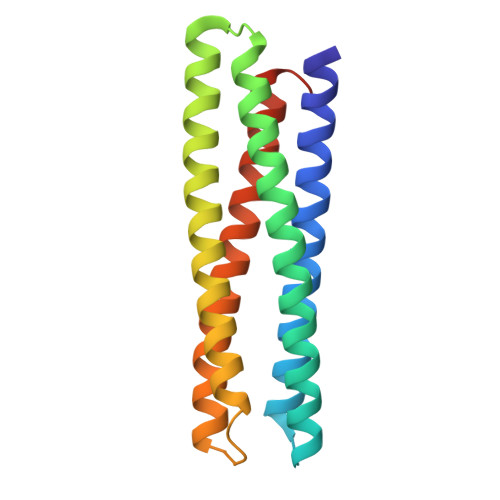
The recognition of ligands by transmembrane proteins is essential for the exchange of materials, energy and information across biological membranes. Progress has been made in the de novo design of transmembrane proteins 1-6 , as well as in designing water-soluble proteins to bind small molecules 7-12 , but de novo design of transmembrane proteins that tightly and specifically bind to small molecules remains an outstanding challenge 13 . Here we present the accurate design of ligand-binding transmembrane proteins by integrating deep learning and energy-based methods. We designed pre-organized ligand-binding pockets in high-quality four-helix backbones for a fluorogenic ligand, and generated a transmembrane span using gradient-guided hallucination. The designer transmembrane proteins specifically activated fluorescence of the target fluorophore with mid-nanomolar affinity, exhibiting higher brightness and quantum yield compared to those of enhanced green fluorescent protein. These proteins were highly active in the membrane fraction of live bacterial and eukaryotic cells following expression. The crystal and cryogenic electron microscopy structures of the designer protein-ligand complexes were very close to the structures of the design models. We showed that the interactions between ligands and transmembrane proteins within the membrane can be accurately designed. Our work paves the way for the creation of new functional transmembrane proteins, with a wide range of applications including imaging, ligand sensing and membrane transport.
- College of Life Sciences, Zhejiang University, Hangzhou, China.
Organizational Affiliation: