Download Mendeley
Reprogrammable RNA-targeting CRISPR systems evolved from RNA toxin-antitoxins.
Zilberzwige-Tal, S., Altae-Tran, H., Kannan, S., Wilkinson, M.E., Vo, S.C., Strebinger, D., Edmonds, K.K., Yao, C.J., Mears, K.S., Shmakov, S.A., Makarova, K.S., Macrae, R.K., Koonin, E.V., Zhang, F.(2025) Cell 188: 1925-1940.e20
- PubMed: 39970912 Search on PubMed
- DOI: https://doi.org/10.1016/j.cell.2025.01.034
- Primary Citation Related Structures:
8VZ6 - PubMed Abstract:
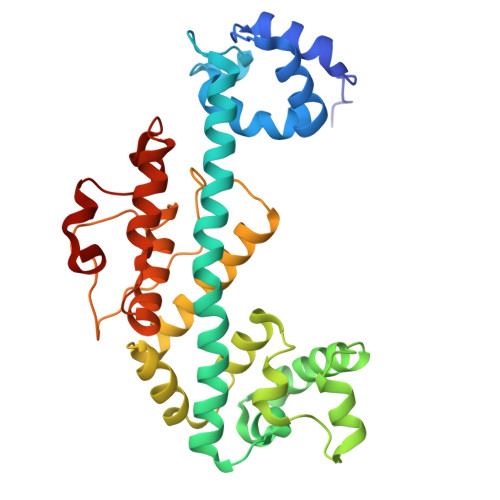
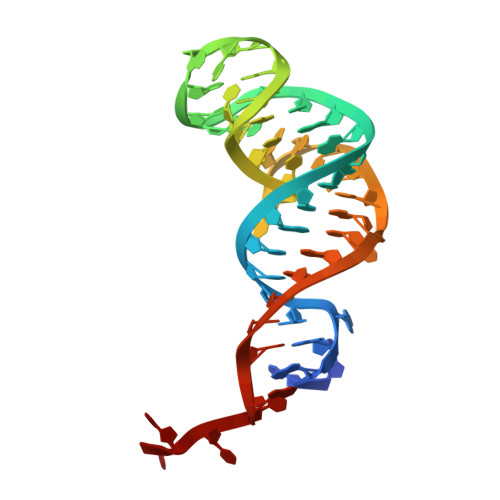
Despite ongoing efforts to study CRISPR systems, the evolutionary origins giving rise to reprogrammable RNA-guided mechanisms remain poorly understood. Here, we describe an integrated sequence/structure evolutionary tracing approach to identify the ancestors of the RNA-targeting CRISPR-Cas13 system. We find that Cas13 likely evolved from AbiF, which is encoded by an abortive infection-linked gene that is stably associated with a conserved non-coding RNA (ncRNA). We further characterize a miniature Cas13, classified here as Cas13e, which serves as an evolutionary intermediate between AbiF and other known Cas13s. Despite this relationship, we show that their functions substantially differ. Whereas Cas13e is an RNA-guided RNA-targeting system, AbiF is a toxin-antitoxin (TA) system with an RNA antitoxin. We solve the structure of AbiF using cryoelectron microscopy (cryo-EM), revealing basic structural alterations that set Cas13s apart from AbiF. Finally, we map the key structural changes that enabled a non-guided TA system to evolve into an RNA-guided CRISPR system.
- Broad Institute of MIT and Harvard, Cambridge, MA 02142, USA; McGovern Institute for Brain Research at MIT, Cambridge, MA 02139, USA; Department of Brain and Cognitive Science, Massachusetts Institute of Technology, Cambridge, MA 02139, USA; Department of Biological Engineering, Massachusetts Institute of Technology, Cambridge, MA 02139, USA; Howard Hughes Medical Institute, Massachusetts Institute of Technology, Cambridge, MA 02139, USA.
Organizational Affiliation: