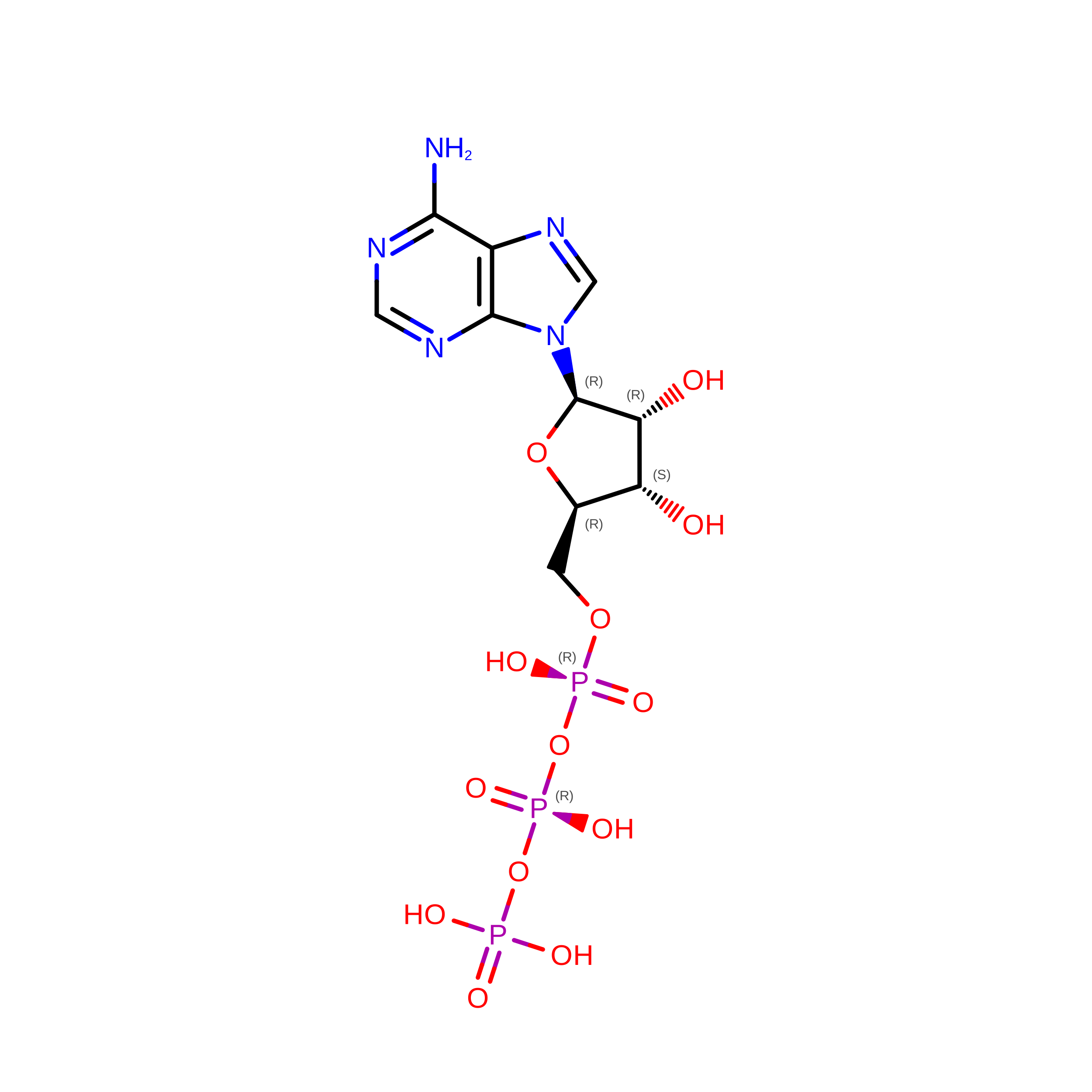
8VW9 | pdb_00008vw9

CryoEM Structure of a FtsH Helical Assembly in the Presence of ATP


Experimental Data Snapshot

  • Method: ELECTRON MICROSCOPY
  • Resolution: 2.60 Å
  • Aggregation State: HELICAL ARRAY 
  • Reconstruction Method: HELICAL 

wwPDB Validation 3D Report Full Report

Validation slider image for 8VW9

This is version 1.2 of the entry. See complete history

Literature

Transforming an ATP-dependent enzyme into a dissipative, self-assembling system.

Li, Y.Zhu, J.Zhang, Z.Wei, J.Wang, F.Meisl, G.Knowles, T.P.J.Egelman, E.H.Tezcan, F.A.

(2025) Nat Chem Biol 21: 883-893

  • DOI: https://doi.org/10.1038/s41589-024-01811-1
  • Primary Citation Related Structures: 
    8VW9, 8VWA, 8VWB, 8VWC

  • PubMed Abstract: 

    Nucleoside triphosphate (NTP)-dependent protein assemblies such as microtubules and actin filaments have inspired the development of diverse chemically fueled molecular machines and active materials but their functional sophistication has yet to be matched by design. Given this challenge, we asked whether it is possible to transform a natural adenosine 5'-triphosphate (ATP)-dependent enzyme into a dissipative self-assembling system, thereby altering the structural and functional mode in which chemical energy is used. Here we report that FtsH (filamentous temperature-sensitive protease H), a hexameric ATPase involved in membrane protein degradation, can be readily engineered to form one-dimensional helical nanotubes. FtsH nanotubes require constant energy input to maintain their integrity and degrade over time with the concomitant hydrolysis of ATP, analogous to natural NTP-dependent cytoskeletal assemblies. Yet, in contrast to natural dissipative systems, ATP hydrolysis is catalyzed by free FtsH protomers and FtsH nanotubes serve to conserve ATP, leading to transient assemblies whose lifetimes can be tuned from days to minutes through the inclusion of external ATPases in solution.


  • Organizational Affiliation
    • Department of Chemistry and Biochemistry, University of California, San Diego, La Jolla, CA, USA.

Macromolecule Content 

  • Total Structure Weight: 52.09 kDa 
  • Atom Count: 3,112 
  • Modeled Residue Count: 396 
  • Deposited Residue Count: 467 
  • Unique protein chains: 1

Macromolecules

Find similar proteins by:|  3D Structure
Entity ID: 1
MoleculeChains  Sequence LengthOrganismDetailsImage
ATP-dependent zinc metalloprotease FtsH467Thermotoga maritimaMutation(s): 5 
Gene Names: ftsHTM_0580
EC: 3.4.24
UniProt
Find proteins for Q5SI82 (Thermus thermophilus (strain ATCC 27634 / DSM 579 / HB8))
Explore Q5SI82 
Go to UniProtKB:  Q5SI82
Entity Groups
Sequence Clusters30% Identity50% Identity70% Identity90% Identity95% Identity100% Identity
UniProt GroupQ5SI82
Sequence Annotations
Expand
Reference Sequence

Experimental Data & Validation

Experimental Data

  • Method: ELECTRON MICROSCOPY
  • Resolution: 2.60 Å
  • Aggregation State: HELICAL ARRAY 
  • Reconstruction Method: HELICAL 
EM Software:
TaskSoftware PackageVersion
MODEL REFINEMENTPHENIX1.14_3260:
RECONSTRUCTIONcryoSPARC

Structure Validation

View Full Validation Report


Entry History 

& Funding Information

Deposition Data


Funding OrganizationLocationGrant Number
National Science Foundation (NSF, United States)United StatesDMR-2004558
Department of Energy (DOE, United States)United StatesDE-SC0003844
Department of Energy (DOE, United States)United StatesDE-SC0019288

Revision History  (Full details and data files)

  • Version 1.0: 2025-01-15
    Type: Initial release
  • Version 1.1: 2025-01-29
    Changes: Data collection, Database references
  • Version 1.2: 2025-06-11
    Changes: Data collection, Database references