8VQD | pdb_00008vqd

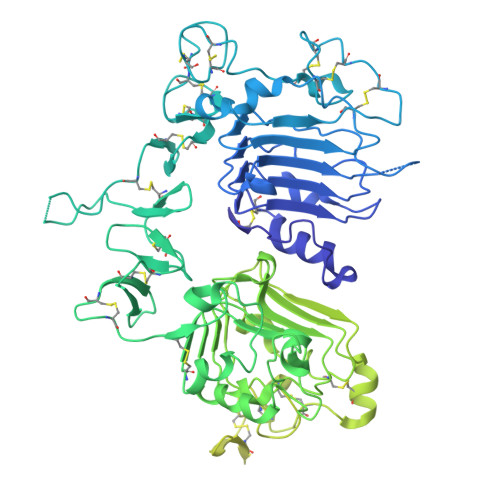
HER2 S310F in complex with TL1 Fab


Experimental Data Snapshot

  • Method: ELECTRON MICROSCOPY
  • Resolution: 2.61 Å
  • Aggregation State: PARTICLE 
  • Reconstruction Method: SINGLE PARTICLE 

Starting Models: experimental, in silico
View more details

wwPDB Validation 3D Report Full Report

Validation slider image for 8VQD

This is version 1.3 of the entry. See complete history

Literature

Selective targeting of oncogenic hotspot mutations of the HER2 extracellular domain.

Bang, I.Hattori, T.Leloup, N.Corrado, A.Nyamaa, A.Koide, A.Geles, K.Buck, E.Koide, S.

(2025) Nat Chem Biol 21: 706-715

  • DOI: https://doi.org/10.1038/s41589-024-01751-w
  • Primary Citation Related Structures: 
    8VQD, 8VQE

  • PubMed Abstract: 

    Oncogenic mutations in the extracellular domain (ECD) of cell-surface receptors could serve as tumor-specific antigens that are accessible to antibody therapeutics. Such mutations have been identified in receptor tyrosine kinases including HER2. However, it is challenging to selectively target a point mutant, while sparing the wild-type protein. Here we developed antibodies selective to HER2 S310F and S310Y, the two most common oncogenic mutations in the HER2 ECD, via combinatorial library screening and structure-guided design. Cryogenic-electron microscopy structures of the HER2 S310F homodimer and an antibody bound to HER2 S310F revealed that these antibodies recognize the mutations in a manner that mimics the dimerization arm of HER2 and thus inhibit HER2 dimerization. These antibodies as T cell engagers selectively killed a HER2 S310F-driven cancer cell line in vitro, and in vivo as a xenograft. These results validate HER2 ECD mutations as actionable therapeutic targets and offer promising candidates toward clinical development.


  • Organizational Affiliation
    • Laura and Isaac Perlmutter Cancer Center, New York University Langone Health, New York, NY, USA.

Macromolecule Content 

  • Total Structure Weight: 150.54 kDa 
  • Atom Count: 5,686 
  • Modeled Residue Count: 736 
  • Deposited Residue Count: 1,366 
  • Unique protein chains: 3

Macromolecules

Find similar proteins by:|  3D Structure
Entity ID: 1
MoleculeChains  Sequence LengthOrganismDetailsImage
Receptor tyrosine-protein kinase erbB-2/hIgG1 Fc domain fusion894Homo sapiensMutation(s): 1 
Gene Names: ERBB2HER2MLN19NEUNGL
EC: 2.7.10.1
UniProt & NIH Common Fund Data Resources
Find proteins for P04626 (Homo sapiens)
Explore P04626 
Go to UniProtKB:  P04626
PHAROS:  P04626
GTEx:  ENSG00000141736 
Entity Groups
Sequence Clusters30% Identity50% Identity70% Identity90% Identity95% Identity100% Identity
UniProt GroupP04626
Glycosylation
Glycosylation Sites: 1Go to GlyGen: P04626-1
Sequence Annotations
Expand
Reference Sequence
Find similar proteins by:|  3D Structure
Entity ID: 2
MoleculeChains  Sequence LengthOrganismDetailsImage
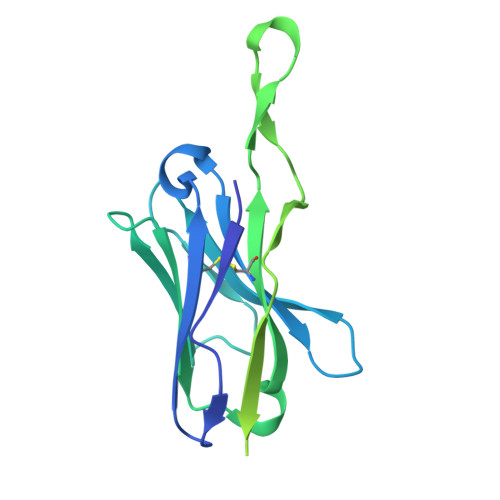
Variable Heavy chain of TL1 FabB [auth C]257Homo sapiensMutation(s): 0 
Find similar proteins by:|  3D Structure
Entity ID: 3
MoleculeChains  Sequence LengthOrganismDetailsImage
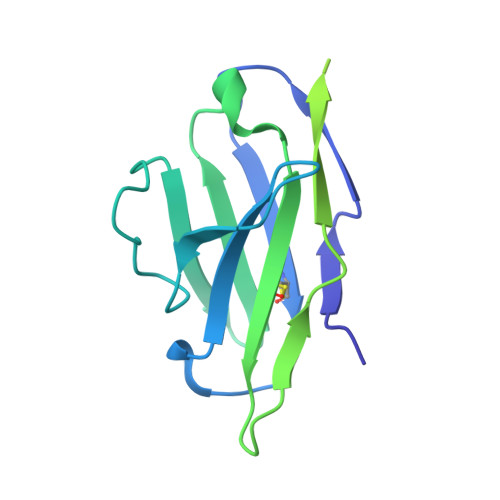
Variable Light chain of TL1 FabC [auth B]215Homo sapiensMutation(s): 0 

Oligosaccharides

Help  
Entity ID: 4
MoleculeChains Length2D Diagram GlycosylationD Interactions
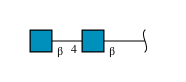
2-acetamido-2-deoxy-beta-D-glucopyranose-(1-4)-2-acetamido-2-deoxy-beta-D-glucopyranose
D
2N-Glycosylation
Glycosylation Resources
GlyTouCan: G42666HT
GlyCosmos: G42666HT
GlyGen: G42666HT

Experimental Data & Validation

Experimental Data

  • Method: ELECTRON MICROSCOPY
  • Resolution: 2.61 Å
  • Aggregation State: PARTICLE 
  • Reconstruction Method: SINGLE PARTICLE 
EM Software:
TaskSoftware PackageVersion
MODEL REFINEMENTPHENIX1.20.1_4487
MODEL REFINEMENTCoot0.9.8.1
RECONSTRUCTIONcryoSPARC4.2.1

Structure Validation

View Full Validation Report


Entry History 

& Funding Information

Deposition Data


Funding OrganizationLocationGrant Number
Not funded--

Revision History  (Full details and data files)

  • Version 1.0: 2024-10-09
    Type: Initial release
  • Version 1.1: 2024-11-06
    Changes: Data collection, Database references
  • Version 1.2: 2024-11-13
    Changes: Data collection
  • Version 1.3: 2025-05-14
    Changes: Data collection, Database references