8VJ7 | pdb_00008vj7

GluA2 bound to GYKI-52466 and Glutamate, Inhibited State 2


Experimental Data Snapshot

  • Method: ELECTRON MICROSCOPY
  • Resolution: 4.85 Å
  • Aggregation State: PARTICLE 
  • Reconstruction Method: SINGLE PARTICLE 

wwPDB Validation 3D Report Full Report

Validation slider image for 8VJ7

This is version 1.4 of the entry. See complete history

Literature

Allosteric competition and inhibition in AMPA receptors.

Hale, W.D.Montano Romero, A.Gonzalez, C.U.Jayaraman, V.Lau, A.Y.Huganir, R.L.Twomey, E.C.

(2024) Nat Struct Mol Biol 31: 1669-1679

  • DOI: https://doi.org/10.1038/s41594-024-01328-0
  • Primary Citation Related Structures: 
    8VJ6, 8VJ7

  • PubMed Abstract: 

    Excitatory neurotransmission is principally mediated by α-amino-3-hydroxy-5-methyl-4-isoxazolepropionic acid (AMPA)-subtype ionotropic glutamate receptors (AMPARs). Negative allosteric modulators are therapeutic candidates that inhibit AMPAR activation and can compete with positive modulators to control AMPAR function through unresolved mechanisms. Here we show that allosteric inhibition pushes AMPARs into a distinct state that prevents both activation and positive allosteric modulation. We used cryo-electron microscopy to capture AMPARs bound to glutamate, while a negative allosteric modulator, GYKI-52466, and positive allosteric modulator, cyclothiazide, compete for control of the AMPARs. GYKI-52466 binds in the ion channel collar and inhibits AMPARs by decoupling the ligand-binding domains from the ion channel. The rearrangement of the ligand-binding domains ruptures the cyclothiazide site, preventing positive modulation. Our data provide a framework for understanding allostery of AMPARs and for rational design of therapeutics targeting AMPARs in neurological diseases.


  • Organizational Affiliation
    • Solomon H. Snyder Department of Neuroscience, Johns Hopkins University School of Medicine, Baltimore, MD, USA.

Macromolecule Content 

  • Total Structure Weight: 358.69 kDa 
  • Atom Count: 25,175 
  • Modeled Residue Count: 3,182 
  • Deposited Residue Count: 3,188 
  • Unique protein chains: 1

Macromolecules

Find similar proteins by:|  3D Structure
Entity ID: 1
MoleculeChains  Sequence LengthOrganismDetailsImage
Isoform Flip of Glutamate receptor 2
A, B, C, D
797Rattus norvegicusMutation(s): 0 
Gene Names: Gria2Glur2
Membrane Entity: Yes 
UniProt
Find proteins for P19491 (Rattus norvegicus)
Explore P19491 
Go to UniProtKB:  P19491
Entity Groups
Sequence Clusters30% Identity50% Identity70% Identity90% Identity95% Identity100% Identity
UniProt GroupP19491
Sequence Annotations
Expand
Reference Sequence

Small Molecules

Ligands 2 Unique
IDChains Name / Formula / InChI Key2D Diagram3D Interactions
A1AB5
(Subject of Investigation/LOI)

Query on A1AB5


Download:Ideal Coordinates CCD File
F [auth A],
H [auth C],
J [auth C],
L [auth D]
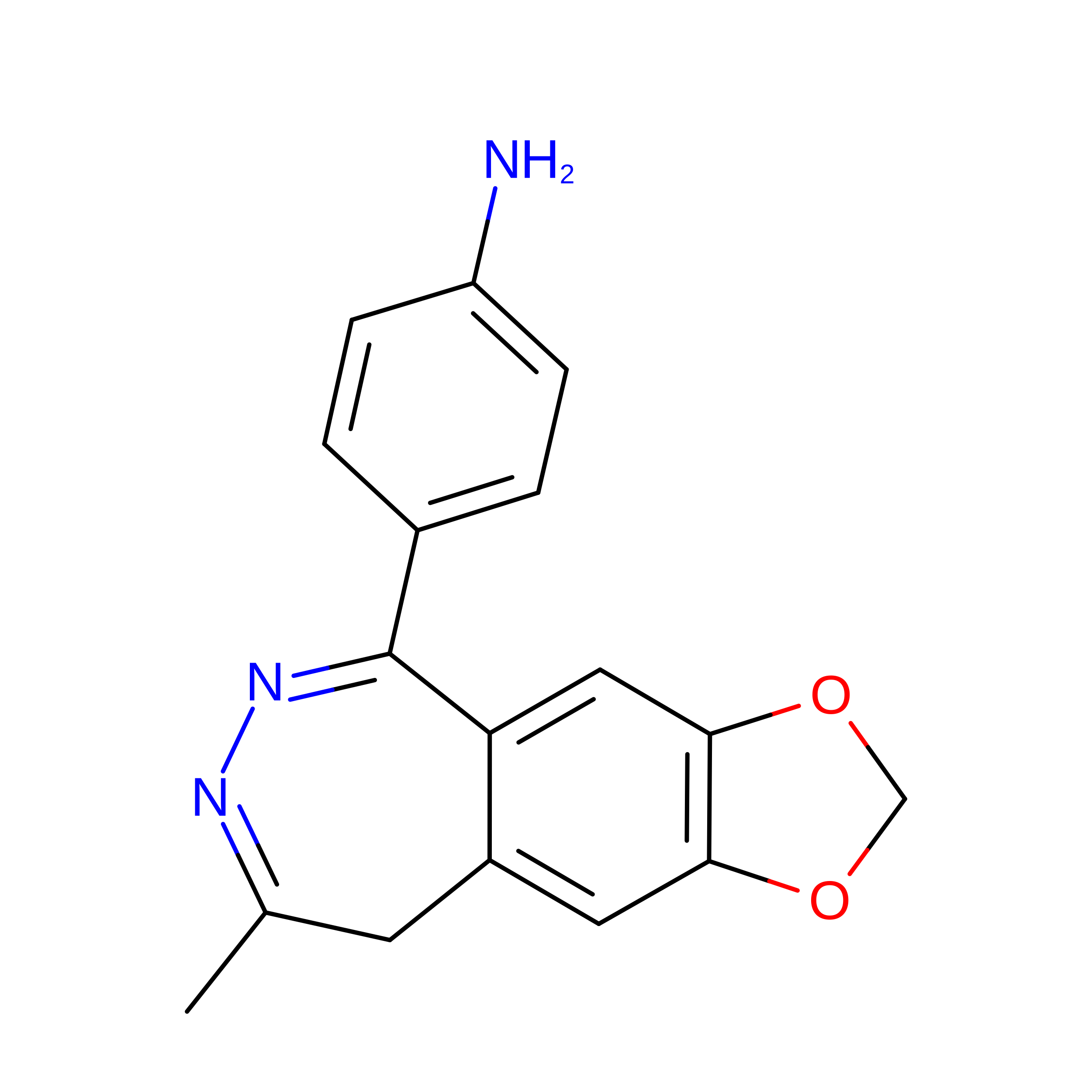
4-[(5S,8R)-8-methyl-6,7,8,9-tetrahydro-2H,5H-[1,3]dioxolo[4,5-h][2,3]benzodiazepin-5-yl]aniline
C17 H15 N3 O2
LFBZZHVSGAHQPP-UHFFFAOYSA-N
GLU

Query on GLU


Download:Ideal Coordinates CCD File
E [auth A],
G [auth B],
I [auth C],
K [auth D]
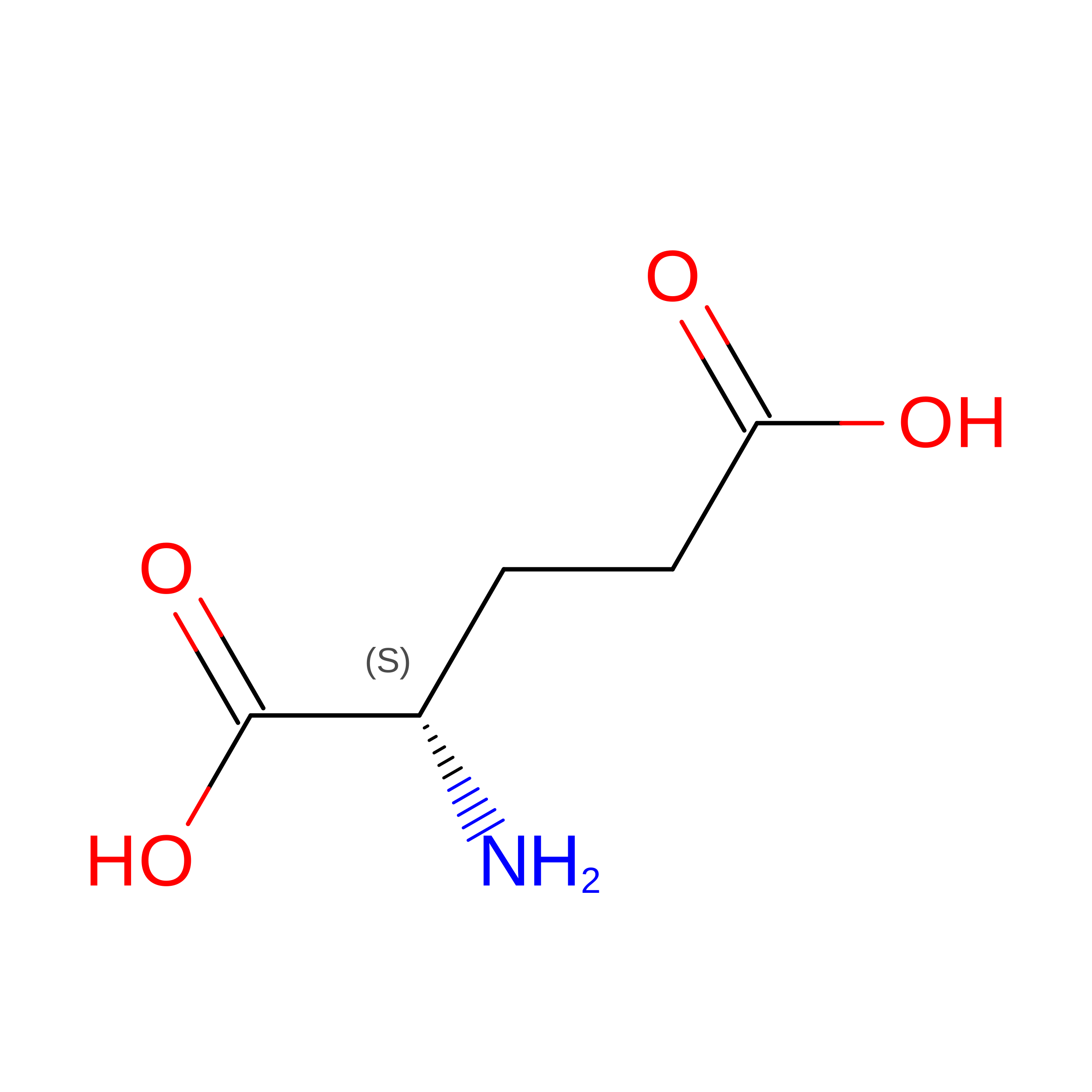
GLUTAMIC ACID
C5 H9 N O4
WHUUTDBJXJRKMK-VKHMYHEASA-N

Experimental Data & Validation

Experimental Data

  • Method: ELECTRON MICROSCOPY
  • Resolution: 4.85 Å
  • Aggregation State: PARTICLE 
  • Reconstruction Method: SINGLE PARTICLE 
EM Software:
TaskSoftware PackageVersion
MODEL REFINEMENTPHENIX
RECONSTRUCTIONcryoSPARC

Structure Validation

View Full Validation Report


Entry History 

& Funding Information

Deposition Data


Funding OrganizationLocationGrant Number
Other privateKinship Foundation 22098168
Other privateDiana Helis Henry Medical Research Foundation 142548
National Institutes of Health/National Institute of Mental Health (NIH/NIMH)United StatesMH112152
National Institutes of Health/National Institute of Neurological Disorders and Stroke (NIH/NINDS)United StatesNS036715
National Institutes of Health/National Institute of Mental Health (NIH/NIMH)United StatesMH132811

Revision History  (Full details and data files)

  • Version 1.0: 2024-06-05
    Type: Initial release
  • Version 1.1: 2024-06-19
    Changes: Database references
  • Version 1.2: 2024-11-13
    Changes: Data collection, Structure summary
  • Version 1.3: 2024-11-27
    Changes: Data collection, Database references
  • Version 1.4: 2025-05-28
    Changes: Data collection