Download Mendeley
Probing effects of site-specific aspartic acid isomerization on structure and stability of GB1 through chemical protein synthesis.
Heath, S.L., Guseman, A.J., Gronenborn, A.M., Horne, W.S.(2024) Protein Sci 33: e4883-e4883
- PubMed: 38143426 Search on PubMedSearch on PubMed Central
- DOI: https://doi.org/10.1002/pro.4883
- Primary Citation Related Structures:
8UM7, 8UM9, 8UMA, 8UMB, 8UMS - PubMed Abstract:
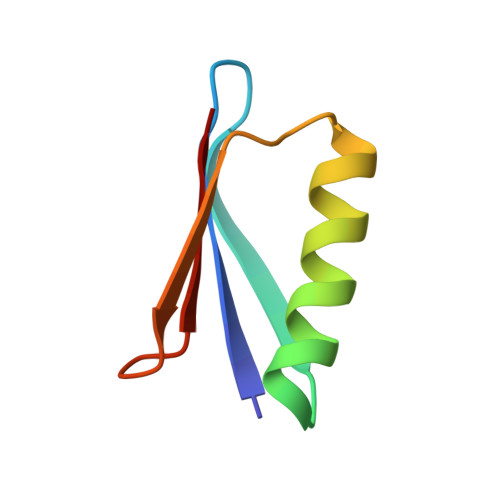
Chemical modifications of long-lived proteins, such as isomerization and epimerization, have been evoked as prime triggers for protein-damage related diseases. Deamidation of Asn residues, which results in formation of a mixture of l- and d-Asp and isoAsp via an intermediate aspartyl succinimide, can result in the disruption of cellular proteostasis and toxic protein depositions. In contrast to extensive data on the biological prevalence and functional implications of aspartyl succinimide formation, much less is known about the impact of the resulting altered backbone composition on properties of individual proteins at a molecular level. Here, we report the total chemical synthesis, biophysical characterization, and NMR structural analysis of a series of variants of the B1 domain of protein G from Streptococcal bacteria (GB1) in which all possible Asp isomers as well as an aspartyl succinimide were individually incorporated at a defined position in a solvent-exposed loop. Subtle local structural effects were observed; however, these were accompanied by notable differences in thermodynamic folded stability. Surprisingly, the noncanonical backbone connectivity of d-isoAsp led to a variant that exhibited enhanced stability relative to the natural protein.
- Department of Chemistry, University of Pittsburgh, Pittsburgh, Pennsylvania, USA.
Organizational Affiliation: