Download Mendeley
Tad and toxin-coregulated pilus structures reveal unexpected diversity in bacterial type IV pili.
Sonani, R.R., Sanchez, J.C., Baumgardt, J.K., Kundra, S., Wright, E.R., Craig, L., Egelman, E.H.(2023) Proc Natl Acad Sci U S A 120: e2316668120-e2316668120
- PubMed: 38011558 Search on PubMedSearch on PubMed Central
- DOI: https://doi.org/10.1073/pnas.2316668120
- Primary Citation Related Structures:
8U1K, 8UHF - PubMed Abstract:
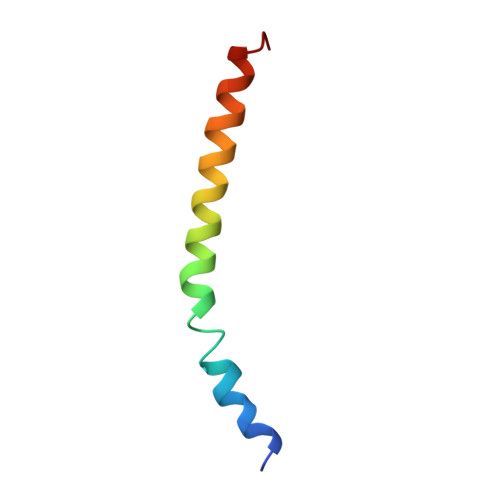
Type IV pili (T4P) are ubiquitous in both bacteria and archaea. They are polymers of the major pilin protein, which has an extended and protruding N-terminal helix, α1, and a globular C-terminal domain. Cryo-EM structures have revealed key differences between the bacterial and archaeal T4P in their C-terminal domain structure and in the packing and continuity of α1. This segment forms a continuous α-helix in archaeal T4P but is partially melted in all published bacterial T4P structures due to a conserved helix breaking proline at position 22. The tad (tight adhesion) T4P are found in both bacteria and archaea and are thought to have been acquired by bacteria through horizontal transfer from archaea. Tad pilins are unique among the T4 pilins, being only 40 to 60 residues in length and entirely lacking a C-terminal domain. They also lack the Pro22 found in all high-resolution bacterial T4P structures. We show using cryo-EM that the bacterial tad pilus from Caulobacter crescentus is composed of continuous helical subunits that, like the archaeal pilins, lack the melted portion seen in other bacterial T4P and share the packing arrangement of the archaeal T4P. We further show that a bacterial T4P, the Vibrio cholerae toxin coregulated pilus, which lacks Pro22 but is not in the tad family, has a continuous N-terminal α-helix, yet its α1 s are arranged similar to those in other bacterial T4P. Our results highlight the role of Pro22 in helix melting and support an evolutionary relationship between tad and archaeal T4P.
- Department of Biochemistry and Molecular Genetics, University of Virginia, Charlottesville, VA 22903.
Organizational Affiliation: