8TW0 | pdb_00008tw0

Crystal Structure of a synthetic ABC heterotrimeric Collagen-like Peptide at 1.53 A


Experimental Data Snapshot

  • Method: X-RAY DIFFRACTION
  • Resolution: 1.53 Å
  • R-Value Free: 
    0.185 (Depositor), 0.187 (DCC) 
  • R-Value Work: 
    0.150 (Depositor), 0.150 (DCC) 
  • R-Value Observed: 
    0.151 (Depositor) 

Starting Model: experimental
View more details

wwPDB Validation 3D Report Full Report

Validation slider image for 8TW0

This is version 2.0 of the entry. See complete history

Literature

Heterotrimeric collagen helix with high specificity of assembly results in a rapid rate of folding.

Cole, C.C.Walker, D.R.Hulgan, S.A.H.Pogostin, B.H.Swain, J.W.R.Miller, M.D.Xu, W.Duella, R.Misiura, M.Wang, X.Kolomeisky, A.B.Philips Jr., G.N.Hartgerink, J.D.

(2024) Nat Chem 16: 1698-1704

  • DOI: https://doi.org/10.1038/s41557-024-01573-2
  • Primary Citation Related Structures: 
    8TW0

  • PubMed Abstract: 

    The most abundant natural collagens form heterotrimeric triple helices. Synthetic mimics of collagen heterotrimers have been found to fold slowly, even compared to the already slow rates of homotrimeric helices. These prolonged folding rates are not understood. Here we compare the stabilities, specificities and folding rates of three heterotrimeric collagen mimics designed through a computationally assisted approach. The crystal structure of one ABC-type heterotrimer verified a well-controlled composition and register and elucidated the geometry of pairwise cation-π and axial and lateral salt bridges in the assembly. This collagen heterotrimer folds much faster (hours versus days) than comparable, well-designed systems. Circular dichroism and NMR data suggest the folding is frustrated by unproductive, competing heterotrimer species and these species must unwind before refolding into the thermodynamically favoured assembly. The heterotrimeric collagen folding rate is inhibited by the introduction of preformed competing triple-helical assemblies, which suggests that slow heterotrimer folding kinetics are dominated by the frustration of the energy landscape caused by competing triple helices.


  • Organizational Affiliation
    • Department of Chemistry, Rice University, Houston, TX, USA.

Macromolecule Content 

  • Total Structure Weight: 9.38 kDa 
  • Atom Count: 852 
  • Modeled Residue Count: 93 
  • Deposited Residue Count: 96 
  • Unique protein chains: 3

Macromolecules

Find similar proteins by:|  3D Structure
Entity ID: 1
MoleculeChains  Sequence LengthOrganismDetailsImage
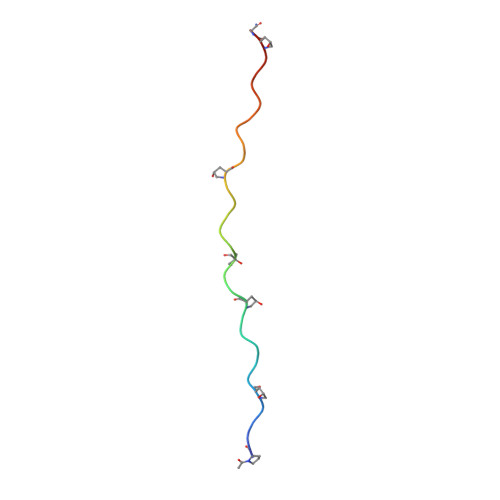
Collagen Mimetic Peptide A32synthetic constructMutation(s): 0 
Find similar proteins by:|  3D Structure
Entity ID: 2
MoleculeChains  Sequence LengthOrganismDetailsImage
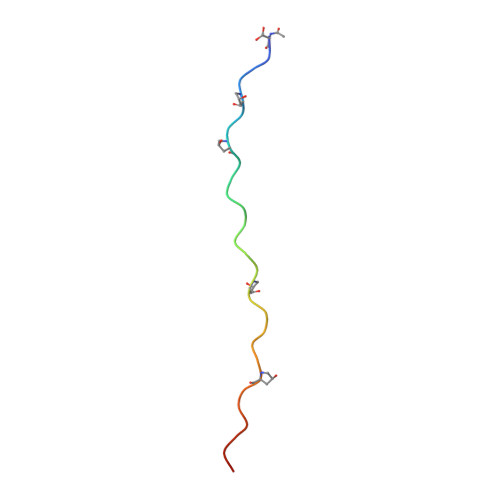
Collagen Mimetic Peptide B32synthetic constructMutation(s): 0 
Find similar proteins by:|  3D Structure
Entity ID: 3
MoleculeChains  Sequence LengthOrganismDetailsImage
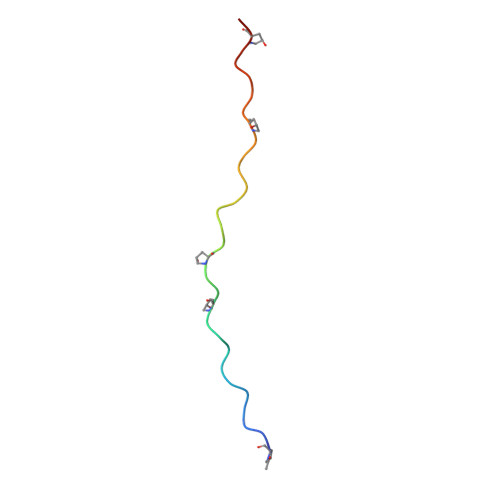
Collagen Mimetic Peptide C32synthetic constructMutation(s): 0 

Experimental Data & Validation

Experimental Data

  • Method: X-RAY DIFFRACTION
  • Resolution: 1.53 Å
  • R-Value Free:  0.185 (Depositor), 0.187 (DCC) 
  • R-Value Work:  0.150 (Depositor), 0.150 (DCC) 
  • R-Value Observed: 0.151 (Depositor) 
Space Group: P 1
Unit Cell:
Length ( Å )Angle ( ˚ )
a = 27.706α = 109.42
b = 27.876β = 111.8
c = 28.396γ = 95.73
Software Package:
Software NamePurpose
PHENIXrefinement
PHASERphasing
Arcimboldophasing
CrysalisProdata scaling
CrysalisProdata reduction

Structure Validation

View Full Validation Report


Entry History 

& Funding Information

Deposition Data


Funding OrganizationLocationGrant Number
National Science Foundation (NSF, United States)United StatesCHE 2203937
National Science Foundation (NSF, United States)United StatesGRFP DGE 1842494
National Science Foundation (NSF, United States)United StatesSTC-1231306
Robert A. Welch FoundationUnited StatesC-2141
Robert A. Welch FoundationUnited StatesC-2118

Revision History  (Full details and data files)

  • Version 1.0: 2024-05-29
    Type: Initial release
  • Version 1.1: 2024-07-31
    Changes: Database references
  • Version 2.0: 2024-10-16
    Changes: Advisory, Atomic model, Data collection, Database references, Derived calculations, Non-polymer description, Polymer sequence, Source and taxonomy, Structure summary