8TQK | pdb_00008tqk

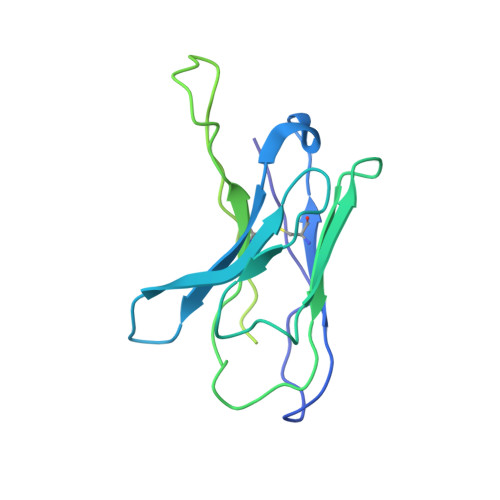
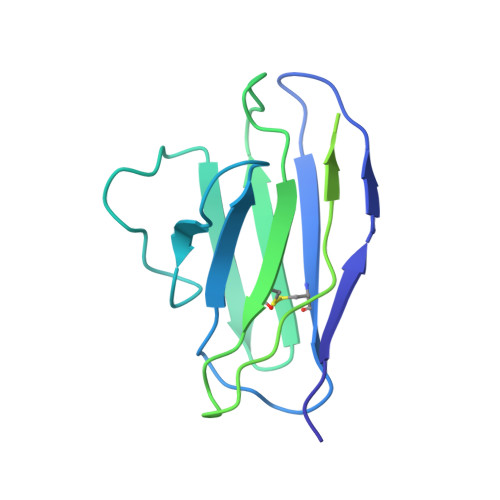
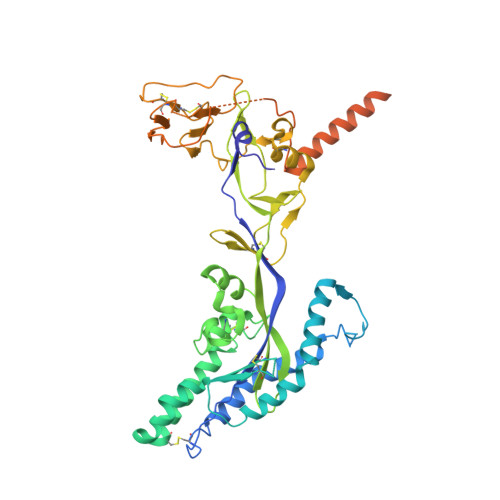
Human parainfluenza virus type 3 prefusion F trimer in complex with rPIV3-18 Fab


Experimental Data Snapshot

  • Method: ELECTRON MICROSCOPY
  • Resolution: 3.20 Å
  • Aggregation State: PARTICLE 
  • Reconstruction Method: SINGLE PARTICLE 

wwPDB Validation 3D Report Full Report

Validation slider image for 8TQK

This is version 1.3 of the entry. See complete history

Literature

Functional and structural basis of human parainfluenza virus type 3 neutralization with human monoclonal antibodies.

Suryadevara, N.Otrelo-Cardoso, A.R.Kose, N.Hu, Y.X.Binshtein, E.Wolters, R.M.Greninger, A.L.Handal, L.S.Carnahan, R.H.Moscona, A.Jardetzky, T.S.Crowe Jr., J.E.

(2024) Nat Microbiol 9: 2128-2143

  • DOI: https://doi.org/10.1038/s41564-024-01722-w
  • Primary Citation Related Structures: 
    8TQI, 8TQK

  • PubMed Abstract: 

    Human parainfluenza virus type 3 (hPIV3) is a respiratory pathogen that can cause severe disease in older people and infants. Currently, vaccines against hPIV3 are in clinical trials but none have been approved yet. The haemagglutinin-neuraminidase (HN) and fusion (F) surface glycoproteins of hPIV3 are major antigenic determinants. Here we describe naturally occurring potently neutralizing human antibodies directed against both surface glycoproteins of hPIV3. We isolated seven neutralizing HN-reactive antibodies and a pre-fusion conformation F-reactive antibody from human memory B cells. One HN-binding monoclonal antibody (mAb), designated PIV3-23, exhibited functional attributes including haemagglutination and neuraminidase inhibition. We also delineated the structural basis of neutralization for two HN and one F mAbs. MAbs that neutralized hPIV3 in vitro protected against infection and disease in vivo in a cotton rat model of hPIV3 infection, suggesting correlates of protection for hPIV3 and the potential clinical utility of these mAbs.


  • Organizational Affiliation
    • Vanderbilt Vaccine Center, Vanderbilt University Medical Center, Nashville, TN, USA.

Macromolecule Content 

  • Total Structure Weight: 314.97 kDa 
  • Atom Count: 14,725 
  • Modeled Residue Count: 1,912 
  • Deposited Residue Count: 2,862 
  • Unique protein chains: 3

Macromolecules

Find similar proteins by:|  3D Structure
Entity ID: 1
MoleculeChains  Sequence LengthOrganismDetailsImage
Heavy chain Fab rPIV3-18A [auth D],
C [auth F],
E [auth H]
224Homo sapiensMutation(s): 0 
UniProt
Find proteins for P0DOX5 (Homo sapiens)
Explore P0DOX5 
Go to UniProtKB:  P0DOX5
Entity Groups
Sequence Clusters30% Identity50% Identity70% Identity90% Identity95% Identity100% Identity
UniProt GroupP0DOX5
Sequence Annotations
Expand
Reference Sequence
Find similar proteins by:|  3D Structure
Entity ID: 2
MoleculeChains  Sequence LengthOrganismDetailsImage
Light chain Fab rPIV3-28B [auth E],
D [auth G],
F [auth L]
214Homo sapiensMutation(s): 0 
Find similar proteins by:|  3D Structure
Entity ID: 3
MoleculeChains  Sequence LengthOrganismDetailsImage
Fusion glycoprotein F0G [auth A],
H [auth B],
I [auth C]
516Human respirovirus 3Mutation(s): 6 
Gene Names: FKMQ_34898gpF
UniProt
Find proteins for A0A059QA82 (Human respirovirus 3)
Explore A0A059QA82 
Go to UniProtKB:  A0A059QA82
Entity Groups
Sequence Clusters30% Identity50% Identity70% Identity90% Identity95% Identity100% Identity
UniProt GroupA0A059QA82
Sequence Annotations
Expand
Reference Sequence

Experimental Data & Validation

Experimental Data

  • Method: ELECTRON MICROSCOPY
  • Resolution: 3.20 Å
  • Aggregation State: PARTICLE 
  • Reconstruction Method: SINGLE PARTICLE 
EM Software:
TaskSoftware PackageVersion
MODEL REFINEMENTPHENIX

Structure Validation

View Full Validation Report


Entry History 

& Funding Information

Deposition Data


Funding OrganizationLocationGrant Number
National Institutes of Health/National Institute Of Allergy and Infectious Diseases (NIH/NIAID)United StatesR01 AI13752

Revision History  (Full details and data files)

  • Version 1.0: 2024-04-24
    Type: Initial release
  • Version 1.1: 2024-10-16
    Changes: Data collection, Structure summary
  • Version 1.2: 2024-11-06
    Changes: Data collection, Database references
  • Version 1.3: 2025-05-14
    Changes: Data collection