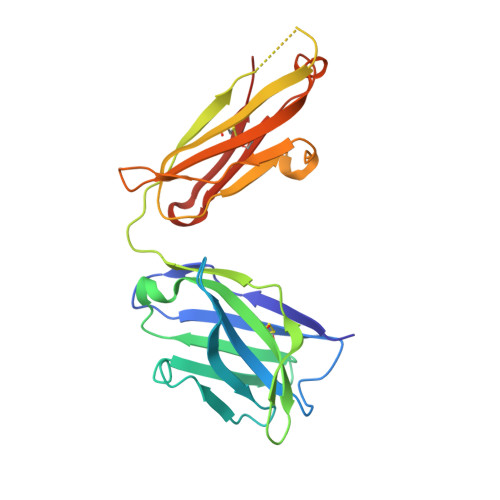
8TFP | pdb_00008tfp

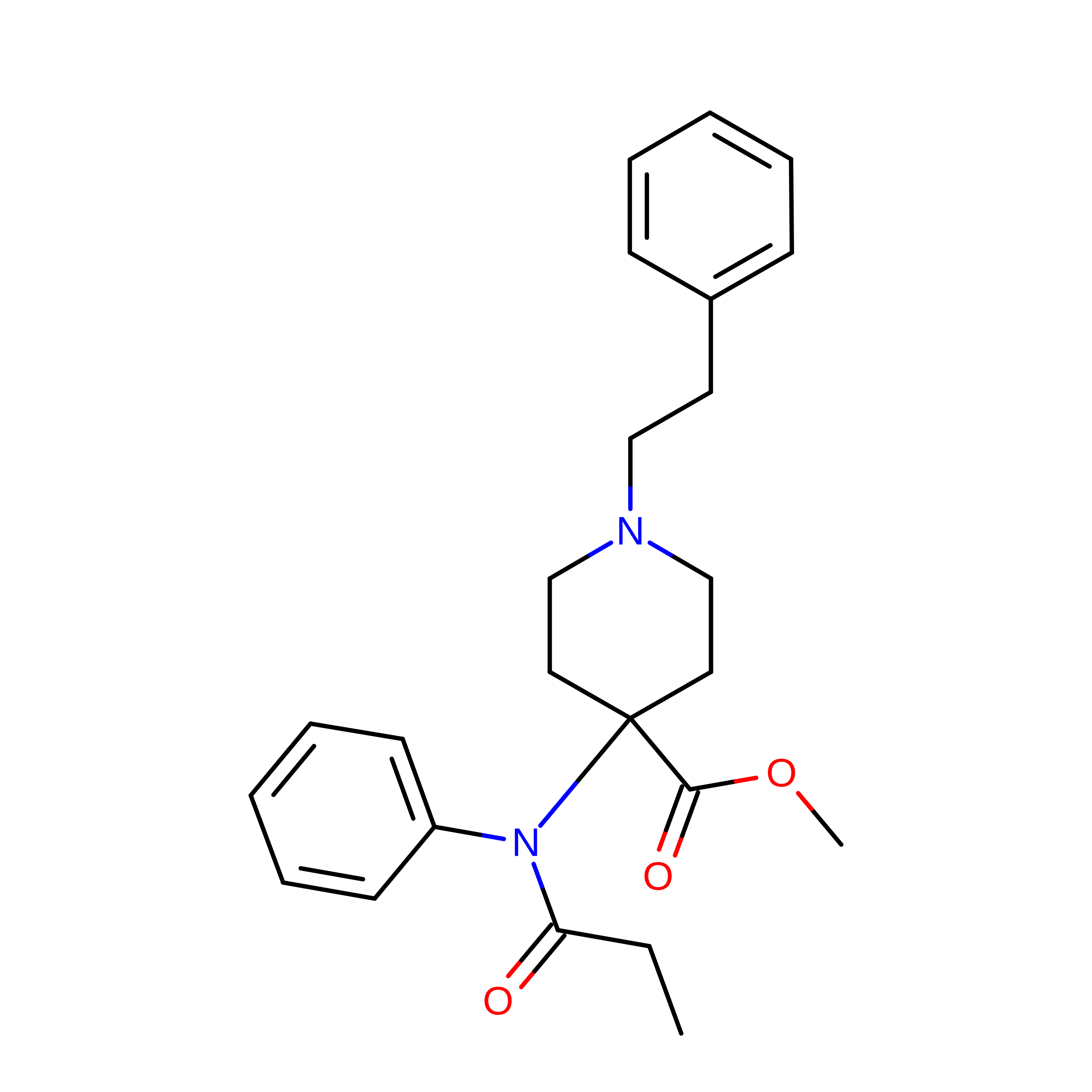
Fab from C10-S66K antibody in complex with carfentanil


Experimental Data Snapshot

  • Method: X-RAY DIFFRACTION
  • Resolution: 1.78 Å
  • R-Value Free: 
    0.207 (Depositor), 0.208 (DCC) 
  • R-Value Work: 
    0.178 (Depositor), 0.180 (DCC) 
  • R-Value Observed: 
    0.179 (Depositor) 

Starting Model: experimental
View more details

wwPDB Validation 3D Report Full Report

Validation slider image for 8TFP

Ligand Structure Quality Assessment 


This is version 1.3 of the entry. See complete history

Literature

An Engineered Human-Antibody Fragment with Fentanyl Pan-Specificity That Reverses Carfentanil-Induced Respiratory Depression.

Eubanks, L.M.Pholcharee, T.Oyen, D.Natori, Y.Zhou, B.Wilson, I.A.Janda, K.D.

(2023) ACS Chem Neurosci 14: 2849-2856

  • DOI: https://doi.org/10.1021/acschemneuro.3c00455
  • Primary Citation Related Structures: 
    8TFP, 8TFQ, 8TFR

  • PubMed Abstract: 

    The opioid overdose crisis primarily driven by potent synthetic opioids resulted in more than 500,000 deaths in the US over the last 20 years. Though naloxone, a short-acting medication, remains the primary treatment option for temporarily reversing opioid overdose effects, alternative countermeasures are needed. Monoclonal antibodies present a versatile therapeutic opportunity that can be tailored to synthetic opioids and help prevent post-treatment renarcotization. The ultrapotent analog carfentanil is especially concerning due to its unique pharmacological properties. With this in mind, we generated a fully human antibody through a drug-specific B cell sorting strategy with a combination of carfentanil and fentanyl probes. The resulting pan-specific antibody was further optimized through scFv phage display, producing C10-S66K. This monoclonal antibody displays high affinity to carfentanil, fentanyl, and other analogs and reversed carfentanil-induced respiratory depression. Additionally, X-ray crystal structures with carfentanil and fentanyl bound provided structural insight into key drug:antibody interactions.

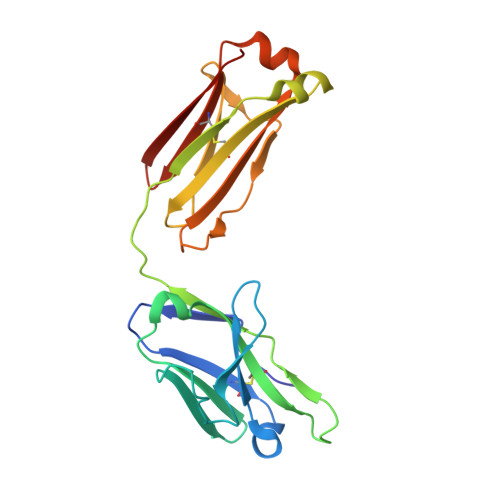
Macromolecule Content 

  • Total Structure Weight: 94.25 kDa 
  • Atom Count: 7,334 
  • Modeled Residue Count: 853 
  • Deposited Residue Count: 874 
  • Unique protein chains: 2

Macromolecules

Find similar proteins by:|  3D Structure
Entity ID: 1
MoleculeChains  Sequence LengthOrganismDetailsImage
Light chain of Fab from C10-S66K antibodyA,
B [auth L]
214Homo sapiensMutation(s): 0 
Find similar proteins by:|  3D Structure
Entity ID: 2
MoleculeChains  Sequence LengthOrganismDetailsImage
Heavy chain of Fab from C10-S66K antibodyC [auth B],
D [auth H]
223Homo sapiensMutation(s): 0 

Experimental Data & Validation

Experimental Data

  • Method: X-RAY DIFFRACTION
  • Resolution: 1.78 Å
  • R-Value Free:  0.207 (Depositor), 0.208 (DCC) 
  • R-Value Work:  0.178 (Depositor), 0.180 (DCC) 
  • R-Value Observed: 0.179 (Depositor) 
Space Group: P 1 21 1
Unit Cell:
Length ( Å )Angle ( ˚ )
a = 71.05α = 90
b = 73.492β = 90.38
c = 95.089γ = 90
Software Package:
Software NamePurpose
PHENIXrefinement
MOSFLMdata reduction
Aimlessdata scaling
PHASERphasing

Structure Validation

View Full Validation Report


Ligand Structure Quality Assessment 


Entry History 

& Funding Information

Deposition Data


Funding OrganizationLocationGrant Number
National Institutes of Health/National Institute on Drug Abuse (NIH/NIDA)United StatesU01DA046232

Revision History  (Full details and data files)

  • Version 1.0: 2023-08-16
    Type: Initial release
  • Version 1.1: 2023-08-23
    Changes: Database references
  • Version 1.2: 2023-09-20
    Changes: Derived calculations, Structure summary
  • Version 1.3: 2024-11-20
    Changes: Structure summary