8TEL | pdb_00008tel

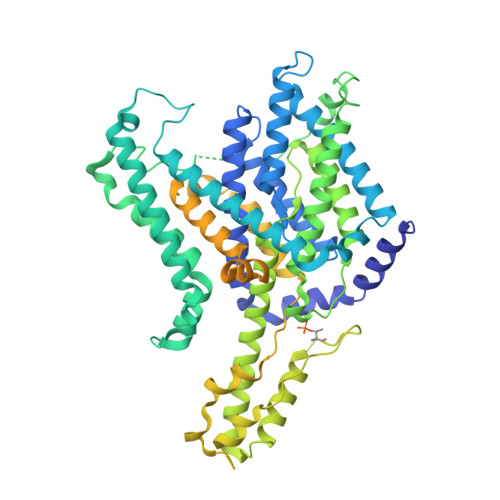
Cryo-EM structure of Arabidopsis thaliana Bor1 mutant (R637E/E641R/R643E) in the occluded conformation in lauryl maltose neopentyl glycol (LMNG)


Experimental Data Snapshot

  • Method: ELECTRON MICROSCOPY
  • Resolution: 2.77 Å
  • Aggregation State: PARTICLE 
  • Reconstruction Method: SINGLE PARTICLE 

wwPDB Validation 3D Report Full Report

Validation slider image for 8TEL

This is version 1.2 of the entry. See complete history

Literature

The Bor1 elevator transport cycle is subject to autoinhibition and activation.

Jiang, Y.Jiang, J.

(2024) Nat Commun 15: 9090-9090

  • DOI: https://doi.org/10.1038/s41467-024-53411-1
  • Primary Citation Related Structures: 
    8TEG, 8TEH, 8TEI, 8TEJ, 8TEL, 8TEM, 8TEN

  • PubMed Abstract: 

    Boron, essential for plant growth, necessitates precise regulation due to its potential toxicity. This regulation is achieved by borate transporters (BORs), which are homologous to the SLC4 family. The Arabidopsis thaliana Bor1 (AtBor1) transporter from clade I undergoes slow regulation through degradation and translational suppression, but its potential for fast regulation via direct activity modulation was unclear. Here, we combine cryo-electron microscopy, mutagenesis, and functional characterization to study AtBor1, revealing high-resolution structures of the dimer in one inactive and three active states. Our findings show that AtBor1 is regulated by two distinct mechanisms: an autoinhibitory domain at the carboxyl terminus obstructs the substrate pathway via conserved salt bridges, and phosphorylation of Thr410 allows interaction with a positively charged pocket at the cytosolic face, essential for borate transport. These results elucidate the molecular basis of AtBor1's activity regulation and highlight its role in fast boron level regulation in plants.


  • Organizational Affiliation
    • Laboratory of Membrane Proteins and Structural Biology, Biochemistry and Biophysics Center, National Heart, Lung, and Blood Institute, National Institutes of Health, Bethesda, MD, USA. yan.jiang@sydney.edu.au.

Macromolecule Content 

  • Total Structure Weight: 160.22 kDa 
  • Atom Count: 7,806 
  • Modeled Residue Count: 988 
  • Deposited Residue Count: 1,428 
  • Unique protein chains: 1

Macromolecules

Find similar proteins by:|  3D Structure
Entity ID: 1
MoleculeChains  Sequence LengthOrganismDetailsImage
Boron transporter 1
A, B
714Arabidopsis thalianaMutation(s): 3 
Gene Names: BOR1At2g47160T3D7.3
Membrane Entity: Yes 
UniProt
Find proteins for Q8VYR7 (Arabidopsis thaliana)
Explore Q8VYR7 
Go to UniProtKB:  Q8VYR7
Entity Groups
Sequence Clusters30% Identity50% Identity70% Identity90% Identity95% Identity100% Identity
UniProt GroupQ8VYR7
Sequence Annotations
Expand
Reference Sequence

Small Molecules

Modified Residues  1 Unique
IDChains TypeFormula2D DiagramParent
TPO
Query on TPO
A, B
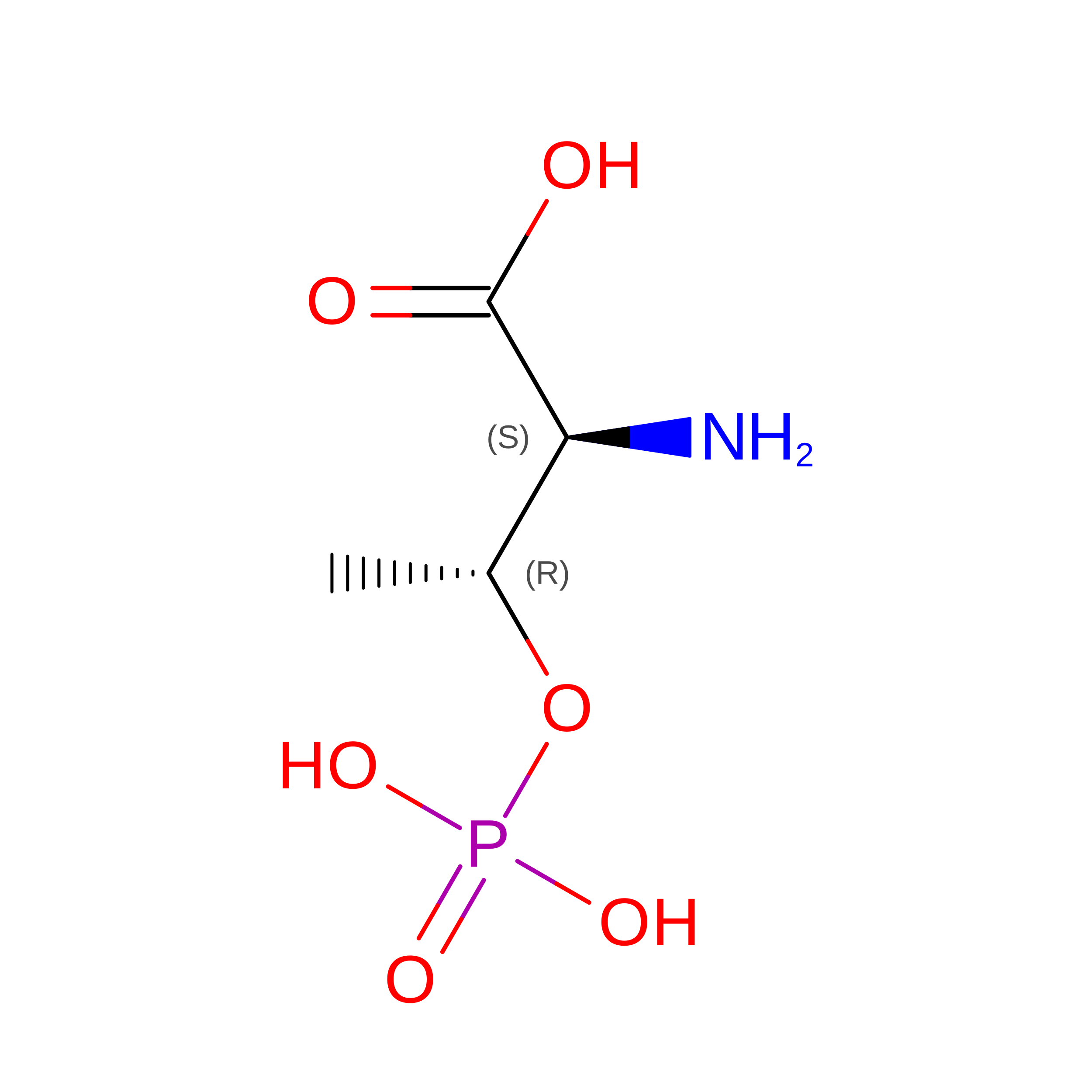
L-PEPTIDE LINKINGC4 H10 N O6 PTHR

Experimental Data & Validation

Experimental Data

  • Method: ELECTRON MICROSCOPY
  • Resolution: 2.77 Å
  • Aggregation State: PARTICLE 
  • Reconstruction Method: SINGLE PARTICLE 
EM Software:
TaskSoftware PackageVersion
MODEL REFINEMENTPHENIX
RECONSTRUCTIONRELION

Structure Validation

View Full Validation Report


Entry History 

& Funding Information

Deposition Data


Funding OrganizationLocationGrant Number
National Institutes of Health/National Heart, Lung, and Blood Institute (NIH/NHLBI)United States--

Revision History  (Full details and data files)

  • Version 1.0: 2024-07-10
    Type: Initial release
  • Version 1.1: 2024-10-23
    Changes: Data collection, Structure summary
  • Version 1.2: 2025-01-22
    Changes: Data collection, Database references