8SXE | pdb_00008sxe

Structure of the C-terminal protease CtpA-LbcA complex of Pseudomonas aeruginosa


Experimental Data Snapshot

  • Method: ELECTRON MICROSCOPY
  • Resolution: 3.55 Å
  • Aggregation State: PARTICLE 
  • Reconstruction Method: SINGLE PARTICLE 

Starting Models: experimental
View more details

wwPDB Validation 3D Report Full Report

Validation slider image for 8SXE

This is version 1.2 of the entry. See complete history

Literature

P. aeruginosa CtpA protease adopts a novel activation mechanism to initiate the proteolytic process.

Hsu, H.C.Wang, M.Kovach, A.Darwin, A.J.Li, H.

(2024) EMBO J 43: 1634-1652

  • DOI: https://doi.org/10.1038/s44318-024-00069-6
  • Primary Citation Related Structures: 
    8SXE, 8SXF, 8SXG, 8SXH

  • PubMed Abstract: 

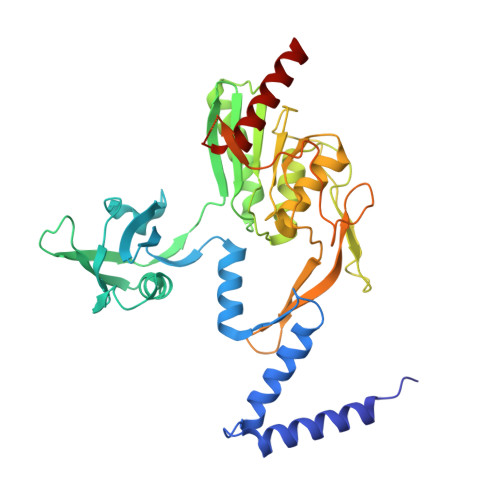
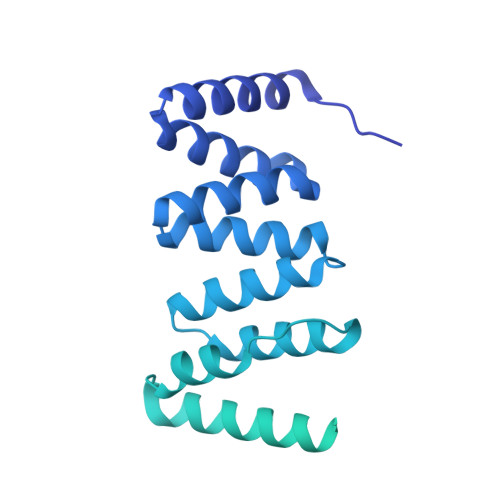
    During bacterial cell growth, hydrolases cleave peptide cross-links between strands of the peptidoglycan sacculus to allow new strand insertion. The Pseudomonas aeruginosa carboxyl-terminal processing protease (CTP) CtpA regulates some of these hydrolases by degrading them. CtpA assembles as an inactive hexamer composed of a trimer-of-dimers, but its lipoprotein binding partner LbcA activates CtpA by an unknown mechanism. Here, we report the cryo-EM structures of the CtpA-LbcA complex. LbcA has an N-terminal adaptor domain that binds to CtpA, and a C-terminal superhelical tetratricopeptide repeat domain. One LbcA molecule attaches to each of the three vertices of a CtpA hexamer. LbcA triggers relocation of the CtpA PDZ domain, remodeling of the substrate binding pocket, and realignment of the catalytic residues. Surprisingly, only one CtpA molecule in a CtpA dimer is activated upon LbcA binding. Also, a long loop from one CtpA dimer inserts into a neighboring dimer to facilitate the proteolytic activity. This work has revealed an activation mechanism for a bacterial CTP that is strikingly different from other CTPs that have been characterized structurally.


  • Organizational Affiliation
    • Department of Structural Biology, Van Andel Institute, Grand Rapids, MI, USA.

Macromolecule Content 

  • Total Structure Weight: 234.04 kDa 
  • Atom Count: 8,285 
  • Modeled Residue Count: 1,101 
  • Deposited Residue Count: 2,164 
  • Unique protein chains: 3

Macromolecules

Find similar proteins by:|  3D Structure
Entity ID: 1
MoleculeChains  Sequence LengthOrganismDetailsImage
Probable carboxyl-terminal protease
A, B, E, F
403Pseudomonas aeruginosaMutation(s): 1 
Gene Names: PA5134
UniProt
Find proteins for Q9HU50 (Pseudomonas aeruginosa (strain ATCC 15692 / DSM 22644 / CIP 104116 / JCM 14847 / LMG 12228 / 1C / PRS 101 / PAO1))
Explore Q9HU50 
Go to UniProtKB:  Q9HU50
Entity Groups
Sequence Clusters30% Identity50% Identity70% Identity90% Identity95% Identity100% Identity
UniProt GroupQ9HU50
Sequence Annotations
Expand
Reference Sequence
Find similar proteins by:|  3D Structure
Entity ID: 2
MoleculeChains  Sequence LengthOrganismDetailsImage
TPR repeat-containing protein PA4667545Pseudomonas aeruginosaMutation(s): 0 
Gene Names: PA4667
UniProt
Find proteins for P42810 (Pseudomonas aeruginosa (strain ATCC 15692 / DSM 22644 / CIP 104116 / JCM 14847 / LMG 12228 / 1C / PRS 101 / PAO1))
Explore P42810 
Go to UniProtKB:  P42810
Entity Groups
Sequence Clusters30% Identity50% Identity70% Identity90% Identity95% Identity100% Identity
UniProt GroupP42810
Sequence Annotations
Expand
Reference Sequence
Find similar proteins by:  Sequence   |   3D Structure  
Entity ID: 3
MoleculeChains  Sequence LengthOrganismDetailsImage
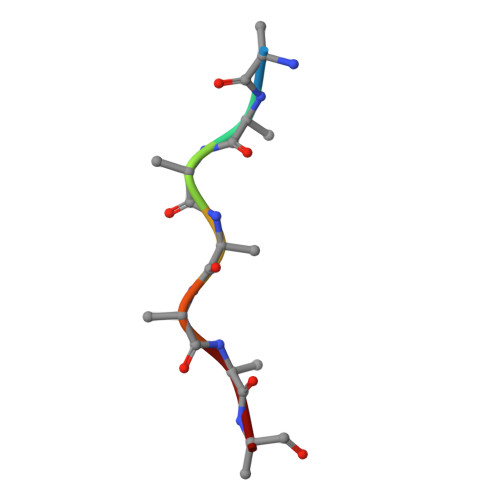
unidentified peptide7Escherichia coli BL21(DE3)Mutation(s): 0 

Experimental Data & Validation

Experimental Data

  • Method: ELECTRON MICROSCOPY
  • Resolution: 3.55 Å
  • Aggregation State: PARTICLE 
  • Reconstruction Method: SINGLE PARTICLE 
EM Software:
TaskSoftware PackageVersion
RECONSTRUCTIONcryoSPARC2.8
MODEL REFINEMENTPHENIX4788

Structure Validation

View Full Validation Report


Entry History 

& Funding Information

Deposition Data


Funding OrganizationLocationGrant Number
National Institutes of Health/National Institute Of Allergy and Infectious Diseases (NIH/NIAID)United StatesAI136901

Revision History  (Full details and data files)

  • Version 1.0: 2024-03-06
    Type: Initial release
  • Version 1.1: 2024-03-27
    Changes: Database references
  • Version 1.2: 2024-04-24
    Changes: Database references