8SQG | pdb_00008sqg

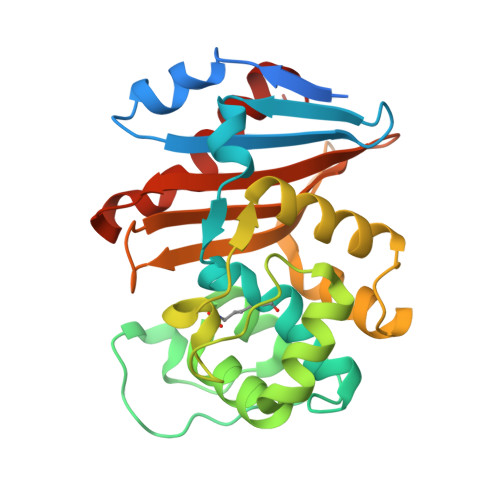
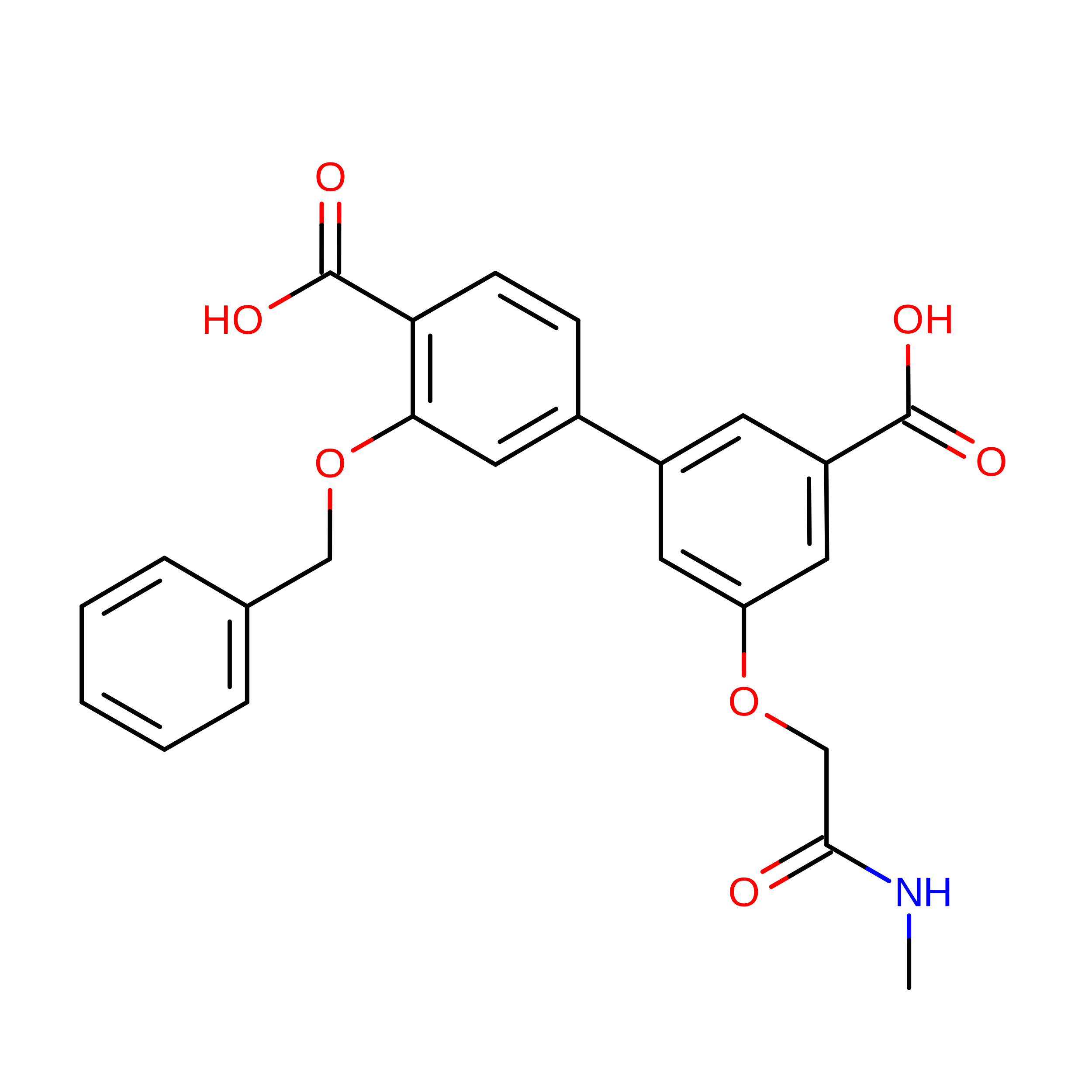
OXA-48 bound to inhibitor CDD-2801


Experimental Data Snapshot

  • Method: X-RAY DIFFRACTION
  • Resolution: 2.03 Å
  • R-Value Free: 
    0.227 (Depositor), 0.228 (DCC) 
  • R-Value Work: 
    0.191 (Depositor), 0.195 (DCC) 
  • R-Value Observed: 
    0.194 (Depositor) 

Starting Model: experimental
View more details

wwPDB Validation 3D Report Full Report

Validation slider image for 8SQG

Ligand Structure Quality Assessment 


This is version 1.1 of the entry. See complete history

Literature

Exploiting the Carboxylate-Binding Pocket of beta-Lactamase Enzymes Using a Focused DNA-Encoded Chemical Library.

Park, S.Fan, J.Chamakuri, S.Palaniappan, M.Sharma, K.Qin, X.Wang, J.Tan, Z.Judge, A.Hu, L.Sankaran, B.Li, F.Prasad, B.V.V.Matzuk, M.M.Palzkill, T.

(2024) J Med Chem 67: 620-642

  • DOI: https://doi.org/10.1021/acs.jmedchem.3c01834
  • Primary Citation Related Structures: 
    8SQF, 8SQG

  • PubMed Abstract: 

    β-Lactamase enzymes hydrolyze and thereby provide bacterial resistance to the important β-lactam class of antibiotics. The OXA-48 and NDM-1 β-lactamases cause resistance to the last-resort β-lactams, carbapenems, leading to a serious public health threat. Here, we utilized DNA-encoded chemical library (DECL) technology to discover novel β-lactamase inhibitors. We exploited the β-lactamase enzyme-substrate binding interactions and created a DECL targeting the carboxylate-binding pocket present in all β-lactamases. A library of 10 6 compounds, each containing a carboxylic acid or a tetrazole as an enzyme recognition element, was designed, constructed, and used to identify OXA-48 and NDM-1 inhibitors with micromolar to nanomolar potency. Further optimization led to NDM-1 inhibitors with increased potencies and biological activities. This work demonstrates that the carboxylate-binding pocket-targeting DECL, designed based on substrate binding information, aids in inhibitor identification and led to the discovery of novel non-β-lactam pharmacophores for the development of β-lactamase inhibitors for enzymes of different structural and mechanistic classes.


  • Organizational Affiliation
    • Verna and Marrs McLean Department of Biochemistry and Molecular Pharmacology, Baylor College of Medicine, Houston, Texas 77030, United States.

Macromolecule Content 

  • Total Structure Weight: 61.87 kDa 
  • Atom Count: 4,297 
  • Modeled Residue Count: 483 
  • Deposited Residue Count: 530 
  • Unique protein chains: 1

Macromolecules

Find similar proteins by:|  3D Structure
Entity ID: 1
MoleculeChains  Sequence LengthOrganismDetailsImage
Beta-lactamaseA [auth B],
B [auth A]
265Klebsiella pneumoniaeMutation(s): 0 
Gene Names: bla OXA-48
EC: 3.5.2.6
UniProt
Find proteins for Q6XEC0 (Klebsiella pneumoniae)
Explore Q6XEC0 
Go to UniProtKB:  Q6XEC0
Entity Groups
Sequence Clusters30% Identity50% Identity70% Identity90% Identity95% Identity100% Identity
UniProt GroupQ6XEC0
Sequence Annotations
Expand
Reference Sequence

Experimental Data & Validation

Experimental Data

  • Method: X-RAY DIFFRACTION
  • Resolution: 2.03 Å
  • R-Value Free:  0.227 (Depositor), 0.228 (DCC) 
  • R-Value Work:  0.191 (Depositor), 0.195 (DCC) 
  • R-Value Observed: 0.194 (Depositor) 
Space Group: P 65 2 2
Unit Cell:
Length ( Å )Angle ( ˚ )
a = 121.929α = 90
b = 121.929β = 90
c = 160.522γ = 120
Software Package:
Software NamePurpose
REFMACrefinement
PHENIXrefinement
MOSFLMdata reduction
SCALAdata scaling
PHASERphasing

Structure Validation

View Full Validation Report


Ligand Structure Quality Assessment 


Entry History 

& Funding Information

Deposition Data


Funding OrganizationLocationGrant Number
National Institutes of Health/National Institute Of Allergy and Infectious Diseases (NIH/NIAID)United States--

Revision History  (Full details and data files)

  • Version 1.0: 2024-01-03
    Type: Initial release
  • Version 1.1: 2024-01-17
    Changes: Database references