8QDF | pdb_00008qdf

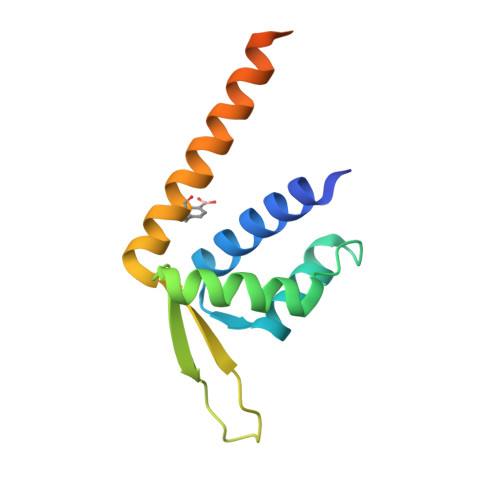
Engineered LmrR with Met-89 replaced by para-boronophenylalanine


Experimental Data Snapshot

  • Method: X-RAY DIFFRACTION
  • Resolution: 2.20 Å
  • R-Value Free: 
    0.277 (Depositor), 0.275 (DCC) 
  • R-Value Work: 
    0.206 (Depositor), 0.206 (DCC) 
  • R-Value Observed: 
    0.210 (Depositor) 

Starting Model: experimental
View more details

wwPDB Validation 3D Report Full Report

Validation slider image for 8QDF

This is version 1.3 of the entry. See complete history

Literature

Boron catalysis in a designer enzyme.

Longwitz, L.Leveson-Gower, R.B.Rozeboom, H.J.Thunnissen, A.W.H.Roelfes, G.

(2024) Nature 629: 824-829

  • DOI: https://doi.org/10.1038/s41586-024-07391-3
  • Primary Citation Related Structures: 
    8QDF, 8QDH

  • PubMed Abstract: 

    Enzymes play an increasingly important role in improving the benignity and efficiency of chemical production, yet the diversity of their applications lags heavily behind chemical catalysts as a result of the relatively narrow range of reaction mechanisms of enzymes. The creation of enzymes containing non-biological functionalities facilitates reaction mechanisms outside nature's canon and paves the way towards fully programmable biocatalysis 1-3 . Here we present a completely genetically encoded boronic-acid-containing designer enzyme with organocatalytic reactivity not achievable with natural or engineered biocatalysts 4,5 . This boron enzyme catalyses the kinetic resolution of hydroxyketones by oxime formation, in which crucial interactions with the protein scaffold assist in the catalysis. A directed evolution campaign led to a variant with natural-enzyme-like enantioselectivities for several different substrates. The unique activation mode of the boron enzyme was confirmed using X-ray crystallography, high-resolution mass spectrometry (HRMS) and 11 B NMR spectroscopy. Our study demonstrates that genetic-code expansion can be used to create evolvable enantioselective enzymes that rely on xenobiotic catalytic moieties such as boronic acids and access reaction mechanisms not reachable through catalytic promiscuity of natural or engineered enzymes.


  • Organizational Affiliation
    • Stratingh Institute for Chemistry, University of Groningen, Groningen, The Netherlands.

Macromolecule Content 

  • Total Structure Weight: 59.3 kDa 
  • Atom Count: 3,596 
  • Modeled Residue Count: 423 
  • Deposited Residue Count: 504 
  • Unique protein chains: 1

Macromolecules

Find similar proteins by:|  3D Structure
Entity ID: 1
MoleculeChains  Sequence LengthOrganismDetailsImage
Transcriptional regulator, PadR-like family
A, B, C, D
126Lactococcus cremoris subsp. cremoris MG1363Mutation(s): 1 
Gene Names: llmg_0323
UniProt
Find proteins for A2RI36 (Lactococcus lactis subsp. cremoris (strain MG1363))
Explore A2RI36 
Go to UniProtKB:  A2RI36
Entity Groups
Sequence Clusters30% Identity50% Identity70% Identity90% Identity95% Identity100% Identity
UniProt GroupA2RI36
Sequence Annotations
Expand
Reference Sequence

Small Molecules

Modified Residues  1 Unique
IDChains TypeFormula2D DiagramParent
7N8
Query on 7N8
A, B, C, D
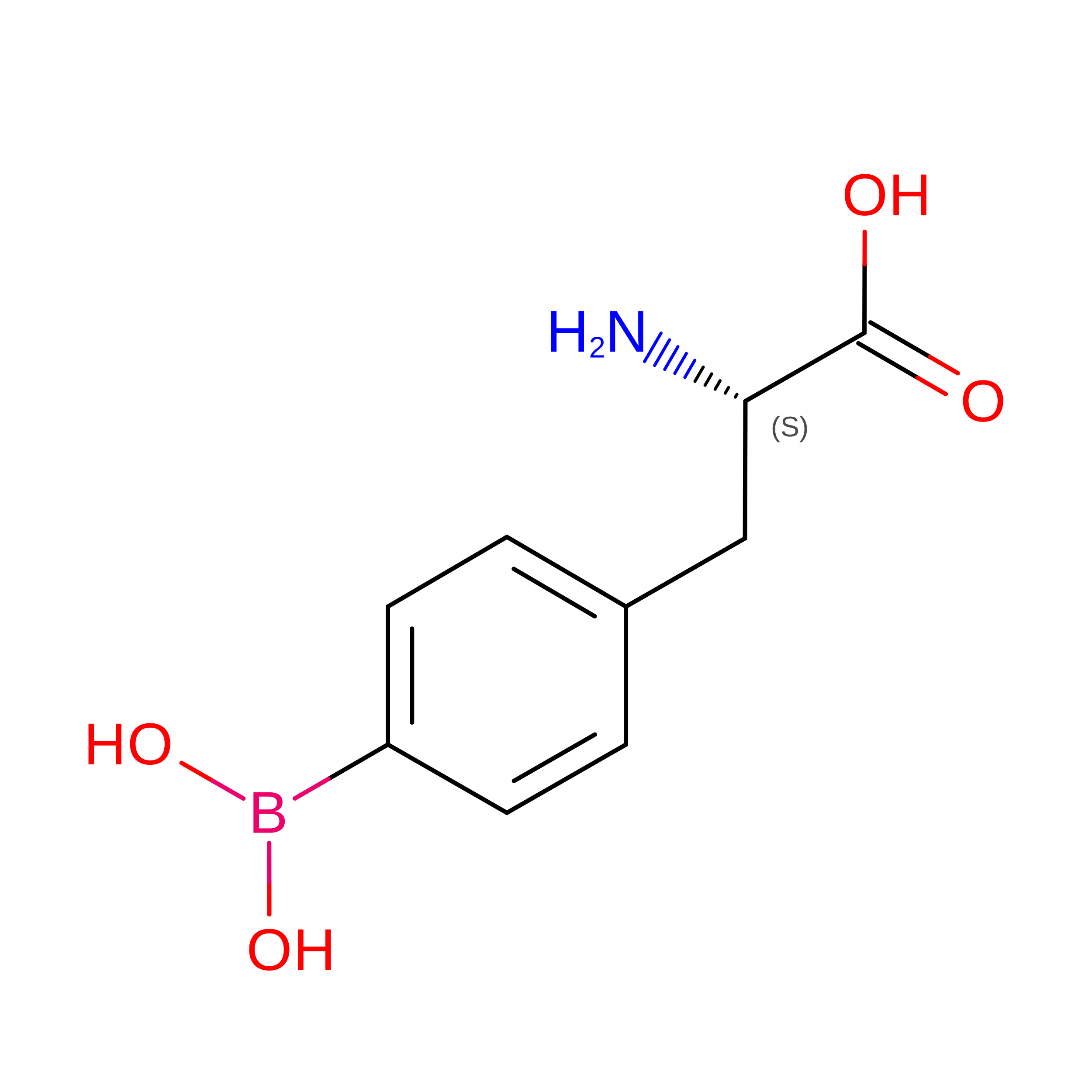
L-PEPTIDE LINKINGC9 H12 B N O4PHE

Experimental Data & Validation

Experimental Data

  • Method: X-RAY DIFFRACTION
  • Resolution: 2.20 Å
  • R-Value Free:  0.277 (Depositor), 0.275 (DCC) 
  • R-Value Work:  0.206 (Depositor), 0.206 (DCC) 
  • R-Value Observed: 0.210 (Depositor) 
Space Group: P 1 21 1
Unit Cell:
Length ( Å )Angle ( ˚ )
a = 60.674α = 90
b = 53.89β = 95.45
c = 69.034γ = 90
Software Package:
Software NamePurpose
PHENIXrefinement
xia2data reduction
Aimlessdata scaling
PHASERphasing

Structure Validation

View Full Validation Report


Entry History 

& Funding Information

Deposition Data


Funding OrganizationLocationGrant Number
European Research Council (ERC)European Union885396

Revision History  (Full details and data files)

  • Version 1.0: 2024-05-01
    Type: Initial release
  • Version 1.1: 2024-05-22
    Changes: Database references
  • Version 1.2: 2024-06-05
    Changes: Database references
  • Version 1.3: 2024-11-13
    Changes: Structure summary