8QA7 | pdb_00008qa7

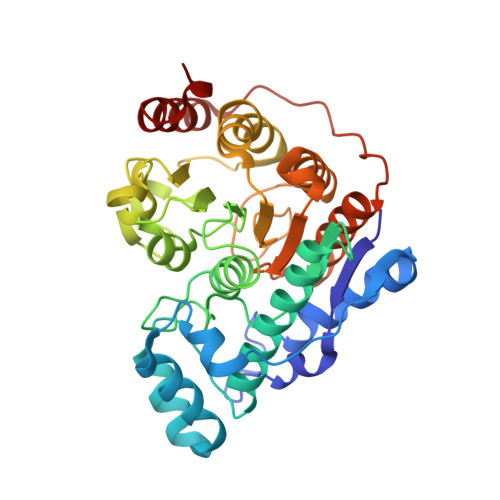
Crystal structure of HDAC6 catalytic domain 2 from zebrafish in complex with buffer component.


Experimental Data Snapshot

  • Method: X-RAY DIFFRACTION
  • Resolution: 1.47 Å
  • R-Value Free: 
    0.240 (Depositor), 0.250 (DCC) 
  • R-Value Work: 
    0.217 (Depositor) 
  • R-Value Observed: 
    0.218 (Depositor) 

Starting Model: experimental
View more details

wwPDB Validation 3D Report Full Report

Validation slider image for 8QA7

This is version 1.1 of the entry. See complete history

Literature

Selective and Bioavailable HDAC6 2-(Difluoromethyl)-1,3,4-oxadiazole Substrate Inhibitors and Modeling of Their Bioactivation Mechanism.

Ripa, L.Sandmark, J.Hughes, G.Shamovsky, I.Gunnarsson, A.Johansson, J.Llinas, A.Collins, M.Jung, B.Noven, A.Pemberton, N.Mogemark, M.Xiong, Y.Li, Q.Tangefjord, S.Ek, M.Astrand, A.

(2023) J Med Chem 66: 14188-14207

  • DOI: https://doi.org/10.1021/acs.jmedchem.3c01269
  • Primary Citation Related Structures: 
    8CJ7, 8QA7

  • PubMed Abstract: 

    Histone deacetylase 6 (HDAC6) is a unique member of the HDAC family mainly targeting cytosolic nonhistone substrates, such as α-tubulin, cortactin, and heat shock protein 90 to regulate cell proliferation, metastasis, invasion, and mitosis in tumors. We describe the identification and characterization of a series of 2-(difluoromethyl)-1,3,4-oxadiazoles (DFMOs) as selective nonhydroxamic acid HDAC6 inhibitors. By comparing structure-activity relationships and performing quantum mechanical calculations of the HDAC6 catalytic mechanism, we show that potent oxadiazoles are electrophilic substrates of HDAC6 and propose a mechanism for the bioactivation. We also observe that the inherent electrophilicity of the oxadiazoles makes them prone to degradation in water solution and the generation of potentially toxic products cannot be ruled out, limiting the developability for chronic diseases. However, the oxadiazoles demonstrate high oral bioavailability and low in vivo clearance and are excellent tools for studying the role of HDAC6 in vitro and in vivo in rats and mice.


  • Organizational Affiliation
    • Respiratory & Immunology (R&I), Research and Early Development, BioPharmaceuticals R&D, AstraZeneca, Pepparedsleden 1, 43183 Mölndal, Sweden.

Macromolecule Content 

  • Total Structure Weight: 80.36 kDa 
  • Atom Count: 5,880 
  • Modeled Residue Count: 715 
  • Deposited Residue Count: 716 
  • Unique protein chains: 1

Macromolecules

Find similar proteins by:|  3D Structure
Entity ID: 1
MoleculeChains  Sequence LengthOrganismDetailsImage
Histone deacetylase 6
A, B
358Danio rerioMutation(s): 0 
Gene Names: hdac6
UniProt
Find proteins for F8W4B7 (Danio rerio)
Explore F8W4B7 
Go to UniProtKB:  F8W4B7
Entity Groups
Sequence Clusters30% Identity50% Identity70% Identity90% Identity95% Identity100% Identity
UniProt GroupF8W4B7
Sequence Annotations
Expand
Reference Sequence

Small Molecules

Ligands 3 Unique
IDChains Name / Formula / InChI Key2D Diagram3D Interactions
EPE

Query on EPE


Download:Ideal Coordinates CCD File
F [auth A],
J [auth B]
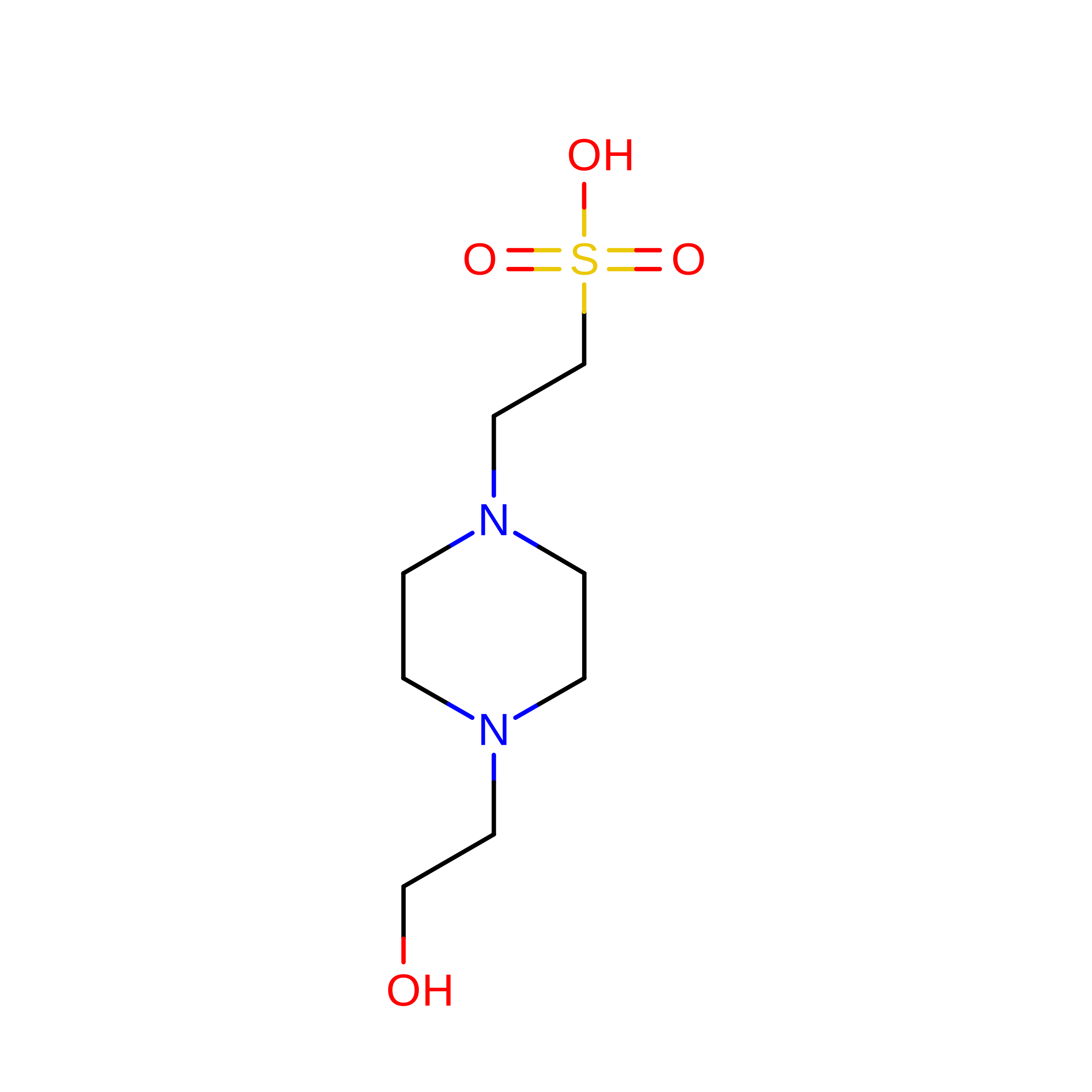
4-(2-HYDROXYETHYL)-1-PIPERAZINE ETHANESULFONIC ACID
C8 H18 N2 O4 S
JKMHFZQWWAIEOD-UHFFFAOYSA-N
ZN

Query on ZN


Download:Ideal Coordinates CCD File
E [auth A],
I [auth B]
ZINC ION
Zn
PTFCDOFLOPIGGS-UHFFFAOYSA-N
K

Query on K


Download:Ideal Coordinates CCD File
C [auth A],
D [auth A],
G [auth B],
H [auth B]
POTASSIUM ION
K
NPYPAHLBTDXSSS-UHFFFAOYSA-N

Experimental Data & Validation

Experimental Data

  • Method: X-RAY DIFFRACTION
  • Resolution: 1.47 Å
  • R-Value Free:  0.240 (Depositor), 0.250 (DCC) 
  • R-Value Work:  0.217 (Depositor) 
  • R-Value Observed: 0.218 (Depositor) 
Space Group: P 21 21 21
Unit Cell:
Length ( Å )Angle ( ˚ )
a = 75.39α = 90
b = 92.373β = 90
c = 96.19γ = 90
Software Package:
Software NamePurpose
REFMACrefinement
autoPROCdata reduction
Aimlessdata scaling
PHASERphasing

Structure Validation

View Full Validation Report


Entry History 

& Funding Information

Deposition Data


Funding OrganizationLocationGrant Number
Not funded--

Revision History  (Full details and data files)

  • Version 1.0: 2024-09-11
    Type: Initial release
  • Version 1.1: 2025-03-26
    Changes: Database references, Structure summary