8Q52 | pdb_00008q52

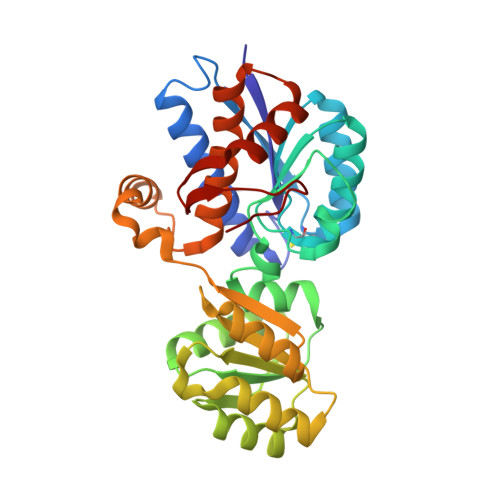
A PBP-like protein built from fragments of different folds


Experimental Data Snapshot

  • Method: X-RAY DIFFRACTION
  • Resolution: 2.15 Å
  • R-Value Free: 
    0.253 (Depositor), 0.251 (DCC) 
  • R-Value Work: 
    0.200 (Depositor), 0.201 (DCC) 
  • R-Value Observed: 
    0.203 (Depositor) 

Starting Model: experimental
View more details

wwPDB Validation 3D Report Full Report

Validation slider image for 8Q52

This is version 1.2 of the entry. See complete history

Literature

Molecular handcraft of a well-folded protein chimera.

Toledo-Patino, S.Goetz, S.K.Shanmugaratnam, S.Hocker, B.Farias-Rico, J.A.

(2024) FEBS Lett 598: 1375-1386

  • DOI: https://doi.org/10.1002/1873-3468.14856
  • Primary Citation Related Structures: 
    8Q52

  • PubMed Abstract: 

    Modular assembly is a compelling pathway to create new proteins, a concept supported by protein engineering and millennia of evolution. Natural evolution provided a repository of building blocks, known as domains, which trace back to even shorter segments that underwent numerous 'copy-paste' processes culminating in the scaffolds we see today. Utilizing the subdomain-database Fuzzle, we constructed a fold-chimera by integrating a flavodoxin-like fragment into a periplasmic binding protein. This chimera is well-folded and a crystal structure reveals stable interfaces between the fragments. These findings demonstrate the adaptability of α/β-proteins and offer a stepping stone for optimization. By emphasizing the practicality of fragment databases, our work pioneers new pathways in protein engineering. Ultimately, the results substantiate the conjecture that periplasmic binding proteins originated from a flavodoxin-like ancestor.


  • Organizational Affiliation
    • Max Planck Institute for Developmental Biology, Tübingen, Germany.

Macromolecule Content 

  • Total Structure Weight: 34.84 kDa 
  • Atom Count: 2,599 
  • Modeled Residue Count: 320 
  • Deposited Residue Count: 321 
  • Unique protein chains: 1

Macromolecules

Find similar proteins by:|  3D Structure
Entity ID: 1
MoleculeChains  Sequence LengthOrganismDetailsImage
Leucine-specific-binding protein,Chemotaxis protein CheY321Escherichia coli K-12Thermotoga maritima MSB8Mutation(s): 0 
Gene Names: livKb3458JW3423cheYTM_0700
UniProt
Find proteins for P04816 (Escherichia coli (strain K12))
Explore P04816 
Go to UniProtKB:  P04816
Find proteins for Q56312 (Thermotoga maritima (strain ATCC 43589 / DSM 3109 / JCM 10099 / NBRC 100826 / MSB8))
Explore Q56312 
Go to UniProtKB:  Q56312
Entity Groups
Sequence Clusters30% Identity50% Identity70% Identity90% Identity95% Identity100% Identity
UniProt GroupsQ56312P04816
Sequence Annotations
Expand
Reference Sequence

Experimental Data & Validation

Experimental Data

  • Method: X-RAY DIFFRACTION
  • Resolution: 2.15 Å
  • R-Value Free:  0.253 (Depositor), 0.251 (DCC) 
  • R-Value Work:  0.200 (Depositor), 0.201 (DCC) 
  • R-Value Observed: 0.203 (Depositor) 
Space Group: P 41 21 2
Unit Cell:
Length ( Å )Angle ( ˚ )
a = 129.56α = 90
b = 129.56β = 90
c = 43.64γ = 90
Software Package:
Software NamePurpose
PHASERphasing
PHENIXrefinement
XDSdata reduction
XDSdata scaling
Cootmodel building

Structure Validation

View Full Validation Report


Entry History 

& Funding Information

Deposition Data


Funding OrganizationLocationGrant Number
German Research Foundation (DFG)GermanyHO 4022/1-2
European Research Council (ERC)European Union647548 'Protein Lego'
Volkswagen FoundationGermany94747
Programa de Apoyo a Proyectos de Investigacion e Innovacion Tecnologica (PAPIIT)MexicoIA204622
Consejo Nacional de Ciencia y Tecnologia (CONACYT)Mexico319320

Revision History  (Full details and data files)

  • Version 1.0: 2024-04-10
    Type: Initial release
  • Version 1.1: 2024-06-19
    Changes: Database references
  • Version 1.2: 2024-11-20
    Changes: Structure summary