8PM4 | pdb_00008pm4

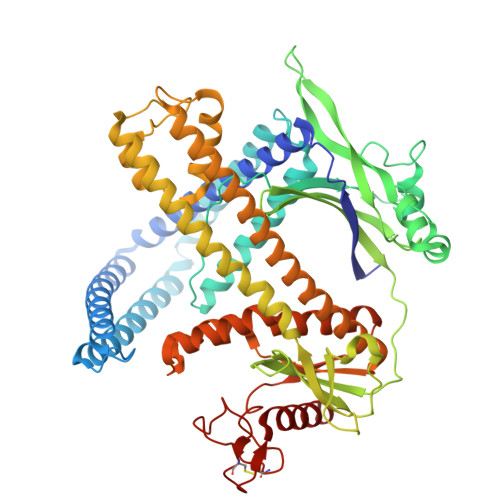
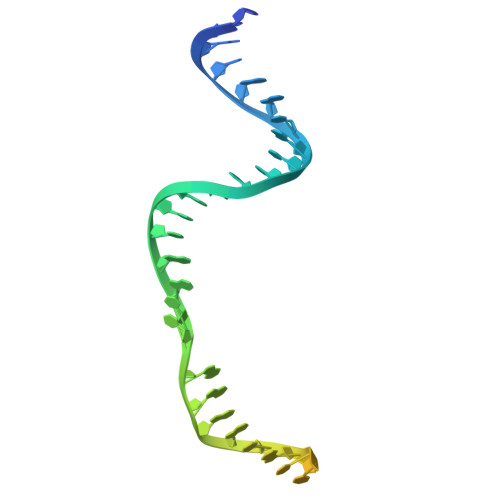
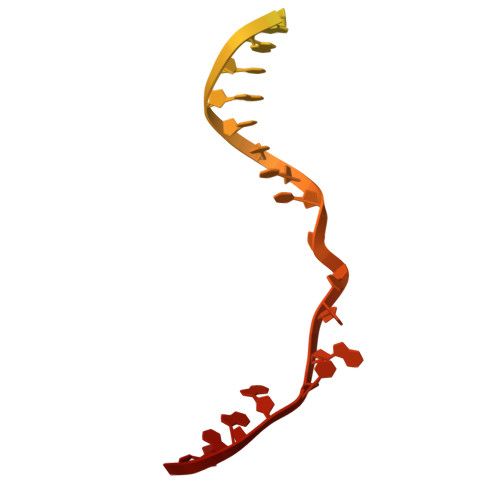
Cryo-EM structure of the Cas12m-crRNA-target DNA complex


Experimental Data Snapshot

  • Method: ELECTRON MICROSCOPY
  • Resolution: 2.93 Å
  • Aggregation State: PARTICLE 
  • Reconstruction Method: SINGLE PARTICLE 

Starting Model: in silico
View more details

wwPDB Validation 3D Report Full Report

Validation slider image for 8PM4

This is version 1.3 of the entry. See complete history

Literature

Innate programmable DNA binding by CRISPR-Cas12m effectors enable efficient base editing.

Bigelyte, G.Duchovska, B.Zedaveinyte, R.Sasnauskas, G.Sinkunas, T.Dalgediene, I.Tamulaitiene, G.Silanskas, A.Kazlauskas, D.Valancauskas, L.Madariaga-Marcos, J.Seidel, R.Siksnys, V.Karvelis, T.

(2024) Nucleic Acids Res 52: 3234-3248

  • DOI: https://doi.org/10.1093/nar/gkae016
  • Primary Citation Related Structures: 
    8PM4

  • PubMed Abstract: 

    Cas9 and Cas12 nucleases of class 2 CRISPR-Cas systems provide immunity in prokaryotes through RNA-guided cleavage of foreign DNA. Here we characterize a set of compact CRISPR-Cas12m (subtype V-M) effector proteins and show that they provide protection against bacteriophages and plasmids through the targeted DNA binding rather than DNA cleavage. Biochemical assays suggest that Cas12m effectors can act as roadblocks inhibiting DNA transcription and/or replication, thereby triggering interference against invaders. Cryo-EM structure of Gordonia otitidis (Go) Cas12m ternary complex provided here reveals the structural mechanism of DNA binding ensuring interference. Harnessing GoCas12m innate ability to bind DNA target we fused it with adenine deaminase TadA-8e and showed an efficient A-to-G editing in Escherichia coli and human cells. Overall, this study expands our understanding of the functionally diverse Cas12 protein family, revealing DNA-binding dependent interference mechanism of Cas12m effectors that could be harnessed for engineering of compact base-editing tools.


  • Organizational Affiliation
    • Institute of Biotechnology, Life Sciences Center, Vilnius University, Vilnius LT-10257, Lithuania.

Macromolecule Content 

  • Total Structure Weight: 114.08 kDa 
  • Atom Count: 6,624 
  • Modeled Residue Count: 700 
  • Deposited Residue Count: 760 
  • Unique protein chains: 1
  • Unique nucleic acid chains: 3

Macromolecules


Find similar proteins by:|  3D Structure
Entity ID: 1
MoleculeChains  Sequence LengthOrganismDetailsImage
Transposase614Gordonia otitidis NBRC 100426Mutation(s): 0 
Gene Names: GOOTI_202_00040
UniProt
Find proteins for H5TRP0 (Gordonia otitidis (strain DSM 44809 / CCUG 52243 / JCM 12355 / NBRC 100426 / IFM 10032))
Explore H5TRP0 
Go to UniProtKB:  H5TRP0
Entity Groups
Sequence Clusters30% Identity50% Identity70% Identity90% Identity95% Identity100% Identity
UniProt GroupH5TRP0
Sequence Annotations
Expand
Reference Sequence
Find similar nucleic acids by:  (by identity cutoff) 
Entity ID: 2
MoleculeChains LengthOrganismImage
crRNA, chain B58Gordonia otitidis NBRC 100426
Sequence Annotations
Expand
Reference Sequence
Find similar nucleic acids by:  (by identity cutoff) 
Entity ID: 3
MoleculeChains LengthOrganismImage
DNA oligoduplex, target strand, chain C44synthetic construct
Sequence Annotations
Expand
Reference Sequence
Find similar nucleic acids by:  (by identity cutoff) 
Entity ID: 4
MoleculeChains LengthOrganismImage
DNA oligoduplex, non-target strand, chain D44synthetic construct
Sequence Annotations
Expand
Reference Sequence

Experimental Data & Validation

Experimental Data

  • Method: ELECTRON MICROSCOPY
  • Resolution: 2.93 Å
  • Aggregation State: PARTICLE 
  • Reconstruction Method: SINGLE PARTICLE 
EM Software:
TaskSoftware PackageVersion
RECONSTRUCTIONcryoSPARC4.2.1
MODEL REFINEMENTPHENIX1.21rc1_4903

Structure Validation

View Full Validation Report


Entry History 

& Funding Information

Deposition Data


Funding OrganizationLocationGrant Number
Research Council of LithuaniaLithuaniaS-MIP-21-8

Revision History  (Full details and data files)

  • Version 1.0: 2024-02-07
    Type: Initial release
  • Version 1.1: 2024-02-14
    Changes: Structure summary
  • Version 1.2: 2024-04-24
    Changes: Database references
  • Version 1.3: 2024-11-13
    Changes: Data collection, Structure summary