8JG2 | pdb_00008jg2

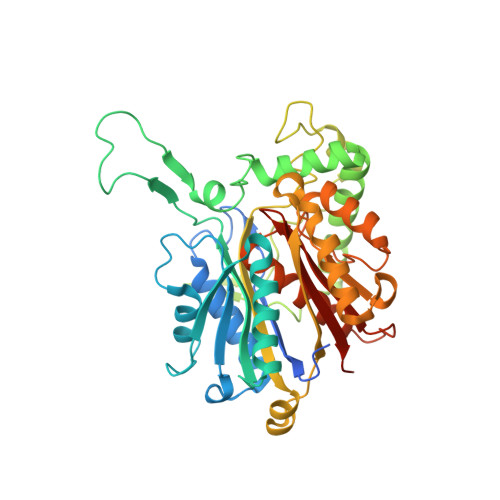
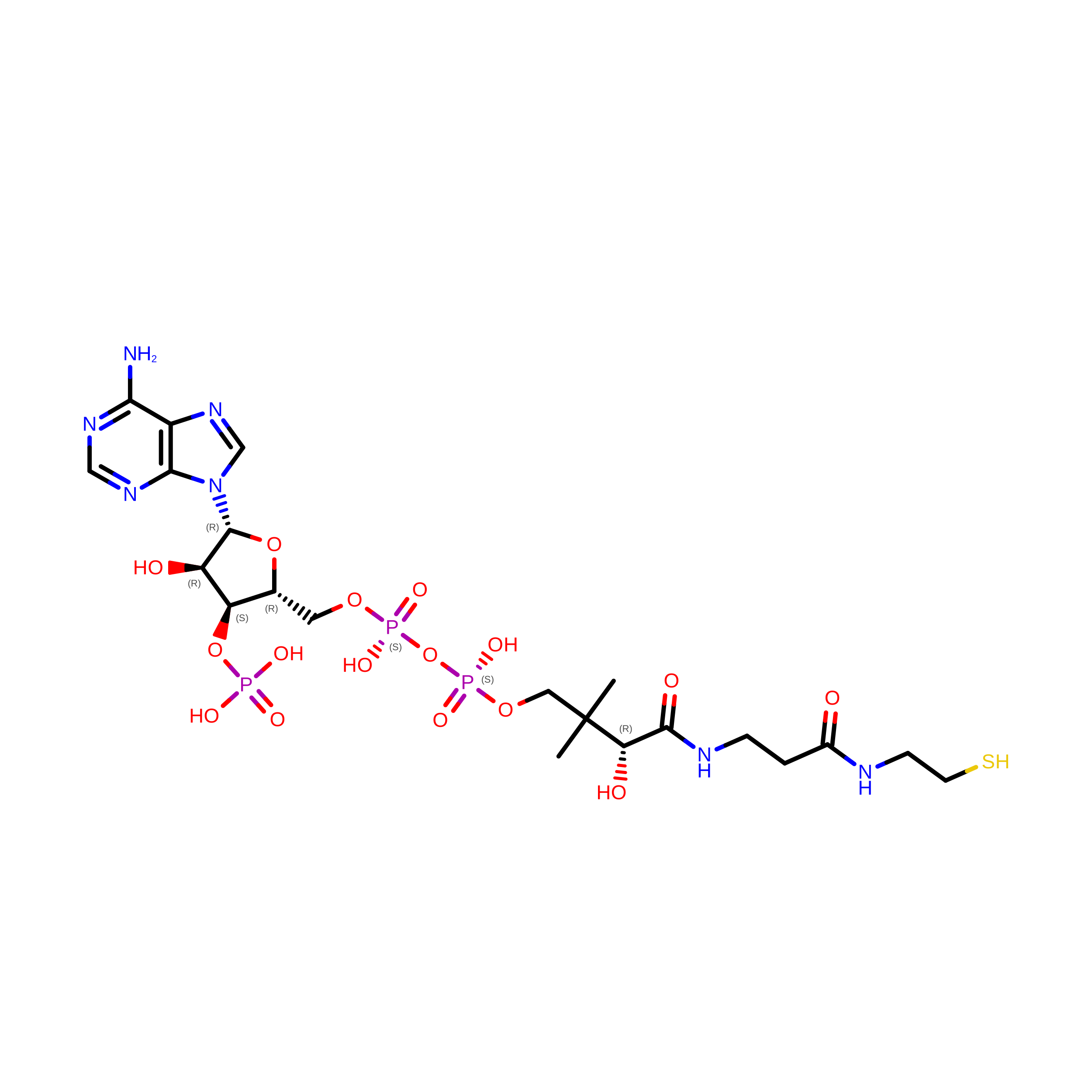
Crystal structure of a biosynthetic thiolase from Megasphaera hexanoica soaked with hexanoyl-CoA


Experimental Data Snapshot

  • Method: X-RAY DIFFRACTION
  • Resolution: 1.64 Å
  • R-Value Free: 
    0.236 (Depositor), 0.244 (DCC) 
  • R-Value Work: 
    0.198 (Depositor), 0.207 (DCC) 
  • R-Value Observed: 
    0.200 (Depositor) 

Starting Model: experimental
View more details

wwPDB Validation 3D Report Full Report

Validation slider image for 8JG2

Ligand Structure Quality Assessment 


This is version 1.1 of the entry. See complete history

Literature

Molecular Chain Elongation Mechanism for n-Caproate Biosynthesis by Megasphaera Hexanoica.

Jeon, B.S.Kim, E.J.Seo, H.Kim, H.Shin, S.Schlaiss, C.Angenent, L.T.Kim, K.J.Sang, B.I.

(2025) Adv Sci (Weinh) : e06069-e06069

  • DOI: https://doi.org/10.1002/advs.202506069
  • Primary Citation Related Structures: 
    8JG2, 8JG3

  • PubMed Abstract: 

    The microbial production of medium-chain carboxylates has attracted considerable interest owing to their potential applications in biofuels and specialty chemicals; however, the underlying biosynthetic mechanisms remain incompletely understood. The present study evaluates the medium-chain carboxylate-producing microbe Megaspahera hexanoica using genomic analysis, transcriptome analysis, and metabolic engineering. Additionally, the n-caproate synthesis pathway of M. hexanoica is characterized with fructose as an electron donor, and the substrate specificity of the respective proteins is evaluated by constructing an n-caproate biosynthetic pathway in Escherichia coli. Among all r-BOX or RBO genes, thl_1583, which encodes β-ketothiolase (MhTHL), is identified as the most critical enzyme for the carbon chain elongation mechanism in M. hexanoica. Therefore, MhTHL is compared with other well-studied β-ketothiolases (CkTHL from Clostridium kluyveri, ReBktB from Ralstonia eutropha (Cupriavidus necator), EcAtoB from E. coli, and CaTHL from C. acetobutylicum). MhTHL is found to exhibit the highest n-caproate production, as evidenced by the protein crystal structure of MhTHL. Structural comparisons with other thiolases show that MhTHL has a larger substrate-binding pocket than ReBktB. Thiolase mutants generated by site-directed mutagenesis reveal that two residues (Leu87 and Val351) are essential for determining the size of the substrate-binding pocket.


  • Organizational Affiliation
    • Korea Institute of Ceramic Engineering and Technology, Osong, 28160, Republic of Korea.

Macromolecule Content 

  • Total Structure Weight: 93.84 kDa 
  • Atom Count: 6,536 
  • Modeled Residue Count: 786 
  • Deposited Residue Count: 868 
  • Unique protein chains: 1

Macromolecules

Find similar proteins by:|  3D Structure
Entity ID: 1
MoleculeChains  Sequence LengthOrganismDetailsImage
Acetyl-CoA C-acetyltransferase
A, B
434Megasphaera hexanoicaMutation(s): 1 
Gene Names: HF872_02440
EC: 2.3.1.9
UniProt
Find proteins for A0A848BQU5 (Megasphaera hexanoica)
Explore A0A848BQU5 
Go to UniProtKB:  A0A848BQU5
Entity Groups
Sequence Clusters30% Identity50% Identity70% Identity90% Identity95% Identity100% Identity
UniProt GroupA0A848BQU5
Sequence Annotations
Expand
Reference Sequence

Experimental Data & Validation

Experimental Data

  • Method: X-RAY DIFFRACTION
  • Resolution: 1.64 Å
  • R-Value Free:  0.236 (Depositor), 0.244 (DCC) 
  • R-Value Work:  0.198 (Depositor), 0.207 (DCC) 
  • R-Value Observed: 0.200 (Depositor) 
Space Group: P 2 21 21
Unit Cell:
Length ( Å )Angle ( ˚ )
a = 51.505α = 90
b = 111.443β = 90
c = 140.996γ = 90
Software Package:
Software NamePurpose
REFMACrefinement
Aimlessdata scaling
XDSdata reduction
MOLREPphasing

Structure Validation

View Full Validation Report


Ligand Structure Quality Assessment 


Entry History 

& Funding Information

Deposition Data


Funding OrganizationLocationGrant Number
National Research Foundation (NRF, Korea)Korea, Republic Of--

Revision History  (Full details and data files)

  • Version 1.0: 2024-05-08
    Type: Initial release
  • Version 1.1: 2025-11-19
    Changes: Database references, Structure summary