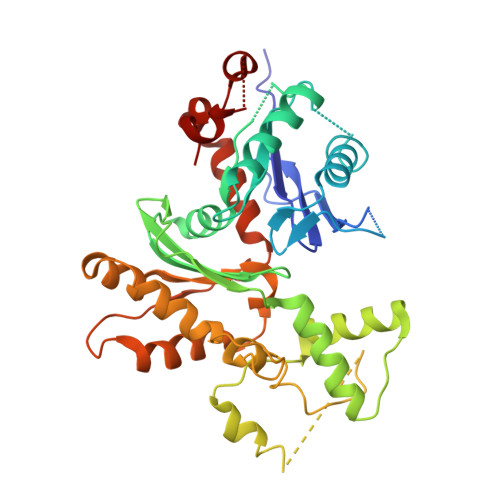
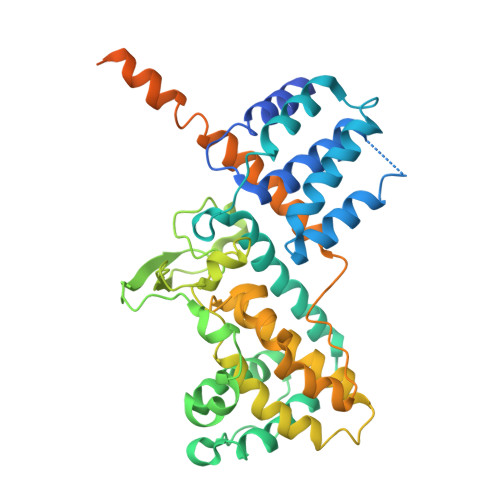
8J9B | pdb_00008j9b

LnaB-actin binary complex


Experimental Data Snapshot

  • Method: X-RAY DIFFRACTION
  • Resolution: 3.42 Å
  • R-Value Free: 
    0.298 (Depositor), 0.292 (DCC) 
  • R-Value Work: 
    0.287 (Depositor), 0.290 (DCC) 

Starting Model: in silico
View more details

wwPDB Validation 3D Report Full Report

Validation slider image for 8J9B

This is version 1.1 of the entry. See complete history

Literature

Legionella maintains host cell ubiquitin homeostasis by effectors with unique catalytic mechanisms.

Fu, J.Li, S.Guan, H.Li, C.Zhao, Y.B.Chen, T.T.Xian, W.Zhang, Z.Liu, Y.Guan, Q.Wang, J.Lu, Q.Kang, L.Zheng, S.R.Li, J.Cao, S.Das, C.Liu, X.Song, L.Ouyang, S.Luo, Z.Q.

(2024) Nat Commun 15: 5953-5953

  • DOI: https://doi.org/10.1038/s41467-024-50311-2
  • Primary Citation Related Structures: 
    8IPJ, 8IPW, 8J9B

  • PubMed Abstract: 

    The intracellular bacterial pathogen Legionella pneumophila modulates host cell functions by secreting multiple effectors with diverse biochemical activities. In particular, effectors of the SidE family interfere with host protein ubiquitination in a process that involves production of phosphoribosyl ubiquitin (PR-Ub). Here, we show that effector LnaB converts PR-Ub into ADP-ribosylated ubiquitin, which is further processed to ADP-ribose and functional ubiquitin by the (ADP-ribosyl)hydrolase MavL, thus maintaining ubiquitin homeostasis in infected cells. Upon being activated by actin, LnaB also undergoes self-AMPylation on tyrosine residues. The activity of LnaB requires a motif consisting of Ser, His and Glu (SHxxxE) present in a large family of toxins from diverse bacterial pathogens. Thus, our study sheds light on the mechanisms by which a pathogen maintains ubiquitin homeostasis and identifies a family of enzymes capable of protein AMPylation.


  • Organizational Affiliation
    • Department of Respiratory Medicine, Center for Infectious Diseases and Pathogen Biology, Key Laboratory of Organ Regeneration and Transplantation of the Ministry of Education, State Key Laboratory for Diagnosis and Treatment of Severe Zoonotic Infectious Diseases, The First Hospital of Jilin University, Changchun, China.

Macromolecule Content 

  • Total Structure Weight: 455.52 kDa 
  • Atom Count: 26,804 
  • Modeled Residue Count: 3,374 
  • Deposited Residue Count: 4,014 
  • Unique protein chains: 2

Macromolecules

Find similar proteins by:|  3D Structure
Entity ID: 1
MoleculeChains  Sequence LengthOrganismDetailsImage
Actin gamma 1
A, B, C, D, E
A, B, C, D, E, F
375Oryctolagus cuniculusMutation(s): 0 
UniProt
Find proteins for A0A8C6VAB1 (Naja naja)
Explore A0A8C6VAB1 
Go to UniProtKB:  A0A8C6VAB1
Entity Groups
Sequence Clusters30% Identity50% Identity70% Identity90% Identity95% Identity100% Identity
UniProt GroupA0A8C6VAB1
Sequence Annotations
Expand
Reference Sequence
Find similar proteins by:|  3D Structure
Entity ID: 2
MoleculeChains  Sequence LengthOrganismDetailsImage
Type IV secretion protein DotG [auth H],
H [auth I],
I [auth J],
J [auth K]
441Legionella pneumophilaMutation(s): 0 
Gene Names: C3927_12730

Experimental Data & Validation

Experimental Data

  • Method: X-RAY DIFFRACTION
  • Resolution: 3.42 Å
  • R-Value Free:  0.298 (Depositor), 0.292 (DCC) 
  • R-Value Work:  0.287 (Depositor), 0.290 (DCC) 
Space Group: P 31
Unit Cell:
Length ( Å )Angle ( ˚ )
a = 110.577α = 90
b = 110.577β = 90
c = 407.927γ = 120
Software Package:
Software NamePurpose
PHENIXrefinement
XDSdata reduction
Aimlessdata scaling
PHASERphasing

Structure Validation

View Full Validation Report


Entry History 

& Funding Information

Deposition Data


Funding OrganizationLocationGrant Number
National Natural Science Foundation of China (NSFC)China--

Revision History  (Full details and data files)

  • Version 1.0: 2024-05-08
    Type: Initial release
  • Version 1.1: 2025-04-09
    Changes: Database references, Structure summary