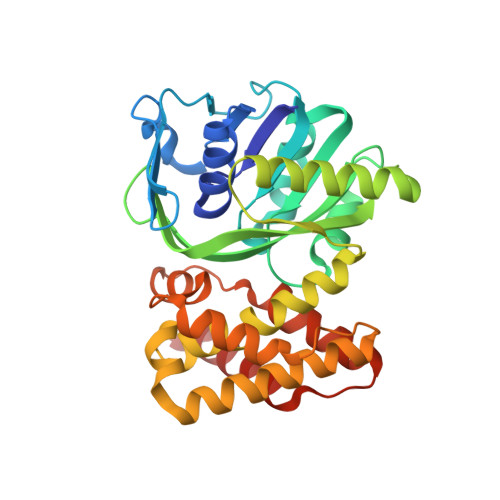
8IWG | pdb_00008iwg

Pseudomoans Aerugiona Wildtype Ketopantoate Reductase native structure


Experimental Data Snapshot

  • Method: X-RAY DIFFRACTION
  • Resolution: 2.15 Å
  • R-Value Free: 
    0.228 (Depositor), 0.229 (DCC) 
  • R-Value Work: 
    0.195 (Depositor), 0.195 (DCC) 
  • R-Value Observed: 
    0.197 (Depositor) 

Starting Model: experimental
View more details

wwPDB Validation 3D Report Full Report

Validation slider image for 8IWG

This is version 1.2 of the entry. See complete history

Literature

Implication of Molecular Constraints Facilitating the Functional Evolution of Pseudomonas aeruginosa KPR2 into a Versatile alpha-Keto-Acid Reductase.

Basu Choudhury, G.Datta, S.

(2024) Biochemistry 63: 1808-1823

  • DOI: https://doi.org/10.1021/acs.biochem.4c00087
  • Primary Citation Related Structures: 
    8IWG, 8IWQ, 8IX9, 8IXH, 8IXM

  • PubMed Abstract: 

    Theoretical concepts linking the structure, function, and evolution of a protein, while often intuitive, necessitate validation through investigations in real-world systems. Our study empirically explores the evolutionary implications of multiple gene copies in an organism by shedding light on the structure-function modulations observed in Pseudomonas aeruginosa 's second copy of ketopantoate reductase (PaKPR2). We demonstrated with two apo structures that the typical active site cleft of the protein transforms into a two-sided pocket where a molecular gate made up of two residues controls the substrate entry site, resulting in its inactivity toward the natural substrate ketopantoate. Strikingly, this structural modification made the protein active against several important α-keto-acid substrates with varied efficiency. Structural constraints at the binding site for this altered functional trait were analyzed with two binary complexes that show the conserved residue microenvironment faces restricted movements due to domain closure. Finally, its mechanistic highlights gathered from a ternary complex structure help in delineating the molecular perspectives behind its kinetic cooperativity toward these broad range of substrates. Detailed structural characteristics of the protein presented here also identified four key amino acid residues responsible for its versatile α-keto-acid reductase activity, which can be further modified to improve its functional properties through protein engineering.


  • Organizational Affiliation
    • CSIR-Indian Institute of Chemical Biology, Raja S C Mullick Road, Jadavpur, Kolkata 700032, India.

Macromolecule Content 

  • Total Structure Weight: 68.5 kDa 
  • Atom Count: 5,098 
  • Modeled Residue Count: 621 
  • Deposited Residue Count: 630 
  • Unique protein chains: 1

Macromolecules

Find similar proteins by:|  3D Structure
Entity ID: 1
MoleculeChains  Sequence LengthOrganismDetailsImage
2-dehydropantoate 2-reductase
A, B
315Pseudomonas aeruginosaMutation(s): 0 
Gene Names: K3T18_18035
EC: 1.1.1.169
UniProt
Find proteins for Q9I2Y5 (Pseudomonas aeruginosa (strain ATCC 15692 / DSM 22644 / CIP 104116 / JCM 14847 / LMG 12228 / 1C / PRS 101 / PAO1))
Explore Q9I2Y5 
Go to UniProtKB:  Q9I2Y5
Entity Groups
Sequence Clusters30% Identity50% Identity70% Identity90% Identity95% Identity100% Identity
UniProt GroupQ9I2Y5
Sequence Annotations
Expand
Reference Sequence

Small Molecules

Ligands 1 Unique
IDChains Name / Formula / InChI Key2D Diagram3D Interactions
GOL

Query on GOL


Download:Ideal Coordinates CCD File
C [auth B]GLYCEROL
C3 H8 O3
PEDCQBHIVMGVHV-UHFFFAOYSA-N

Experimental Data & Validation

Experimental Data

  • Method: X-RAY DIFFRACTION
  • Resolution: 2.15 Å
  • R-Value Free:  0.228 (Depositor), 0.229 (DCC) 
  • R-Value Work:  0.195 (Depositor), 0.195 (DCC) 
  • R-Value Observed: 0.197 (Depositor) 
Space Group: P 1 21 1
Unit Cell:
Length ( Å )Angle ( ˚ )
a = 67.098α = 90
b = 47.691β = 99.31
c = 96.271γ = 90
Software Package:
Software NamePurpose
PHENIXrefinement
PROTEUM PLUSdata reduction
PROTEUM PLUSdata scaling
PHASERphasing

Structure Validation

View Full Validation Report


Entry History 

& Funding Information

Deposition Data


Funding OrganizationLocationGrant Number
Council of Scientific & Industrial Research (CSIR)India--

Revision History  (Full details and data files)

  • Version 1.0: 2024-04-03
    Type: Initial release
  • Version 1.1: 2024-07-17
    Changes: Database references
  • Version 1.2: 2024-07-31
    Changes: Database references