8IO8 | pdb_00008io8

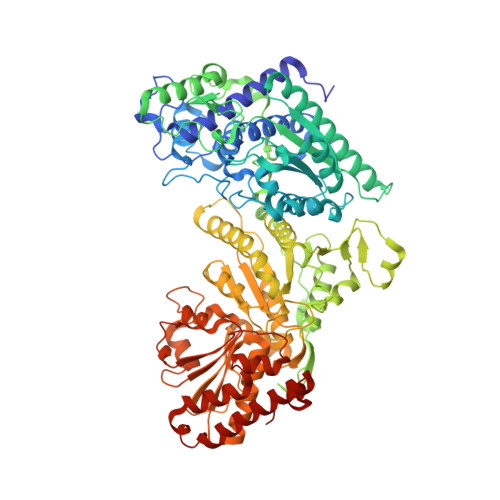
Cryo-EM structure of cyanobacteria phosphoketolase complexed with AMPPNPin dimeric assembly


Experimental Data Snapshot

  • Method: ELECTRON MICROSCOPY
  • Resolution: 2.17 Å
  • Aggregation State: PARTICLE 
  • Reconstruction Method: SINGLE PARTICLE 

Starting Model: in silico
View more details

wwPDB Validation 3D Report Full Report

Validation slider image for 8IO8

This is version 1.3 of the entry. See complete history

Literature

An ATP-sensitive phosphoketolase regulates carbon fixation in cyanobacteria.

Lu, K.J.Chang, C.W.Wang, C.H.Chen, F.Y.Huang, I.Y.Huang, P.H.Yang, C.H.Wu, H.Y.Wu, W.J.Hsu, K.C.Ho, M.C.Tsai, M.D.Liao, J.C.

(2023) Nat Metab 5: 1111-1126

  • DOI: https://doi.org/10.1038/s42255-023-00831-w
  • Primary Citation Related Structures: 
    8IO6, 8IO7, 8IO8, 8IO9, 8IOA, 8IOE

  • PubMed Abstract: 

    Regulation of CO 2 fixation in cyanobacteria is important both for the organism and global carbon balance. Here we show that phosphoketolase in Synechococcus elongatus PCC7942 (SeXPK) possesses a distinct ATP-sensing mechanism, where a drop in ATP level allows SeXPK to divert precursors of the RuBisCO substrate away from the Calvin-Benson-Bassham cycle. Deleting the SeXPK gene increased CO 2 fixation particularly during light-dark transitions. In high-density cultures, the Δxpk strain showed a 60% increase in carbon fixation and unexpectedly resulted in sucrose secretion without any pathway engineering. Using cryo-EM analysis, we discovered that these functions were enabled by a unique allosteric regulatory site involving two subunits jointly binding two ATP, which constantly suppresses the activity of SeXPK until the ATP level drops. This magnesium-independent ATP allosteric site is present in many species across all three domains of life, where it may also play important regulatory functions.


  • Organizational Affiliation
    • Institute of Biological Chemistry, Academia Sinica, Taipei, Taiwan.

Macromolecule Content 

  • Total Structure Weight: 180.18 kDa 
  • Atom Count: 12,596 
  • Modeled Residue Count: 1,576 
  • Deposited Residue Count: 1,592 
  • Unique protein chains: 1

Macromolecules

Find similar proteins by:|  3D Structure
Entity ID: 1
MoleculeChains  Sequence LengthOrganismDetailsImage
Probable phosphoketolase
A, B
796Synechococcus elongatus PCC 7942 = FACHB-805Mutation(s): 0 
Gene Names: Synpcc7942_2080
EC: 4.1.2
UniProt
Find proteins for Q31LF9 (Synechococcus elongatus (strain ATCC 33912 / PCC 7942 / FACHB-805))
Explore Q31LF9 
Go to UniProtKB:  Q31LF9
Entity Groups
Sequence Clusters30% Identity50% Identity70% Identity90% Identity95% Identity100% Identity
UniProt GroupQ31LF9
Sequence Annotations
Expand
Reference Sequence

Small Molecules

Ligands 3 Unique
IDChains Name / Formula / InChI Key2D Diagram3D Interactions
ANP
(Subject of Investigation/LOI)

Query on ANP


Download:Ideal Coordinates CCD File
C [auth A],
F [auth B]
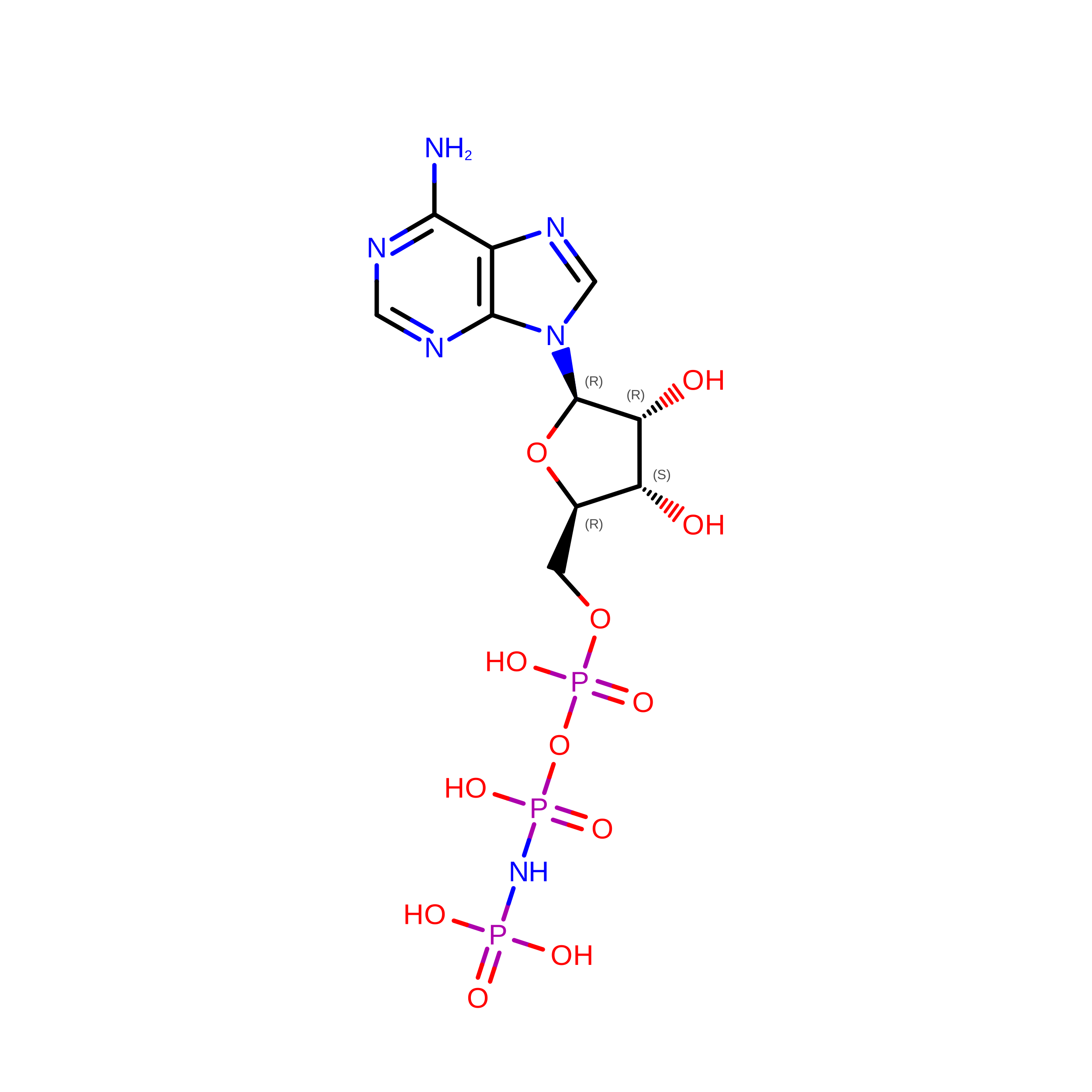
PHOSPHOAMINOPHOSPHONIC ACID-ADENYLATE ESTER
C10 H17 N6 O12 P3
PVKSNHVPLWYQGJ-KQYNXXCUSA-N
TPP
(Subject of Investigation/LOI)

Query on TPP


Download:Ideal Coordinates CCD File
D [auth A],
G [auth B]
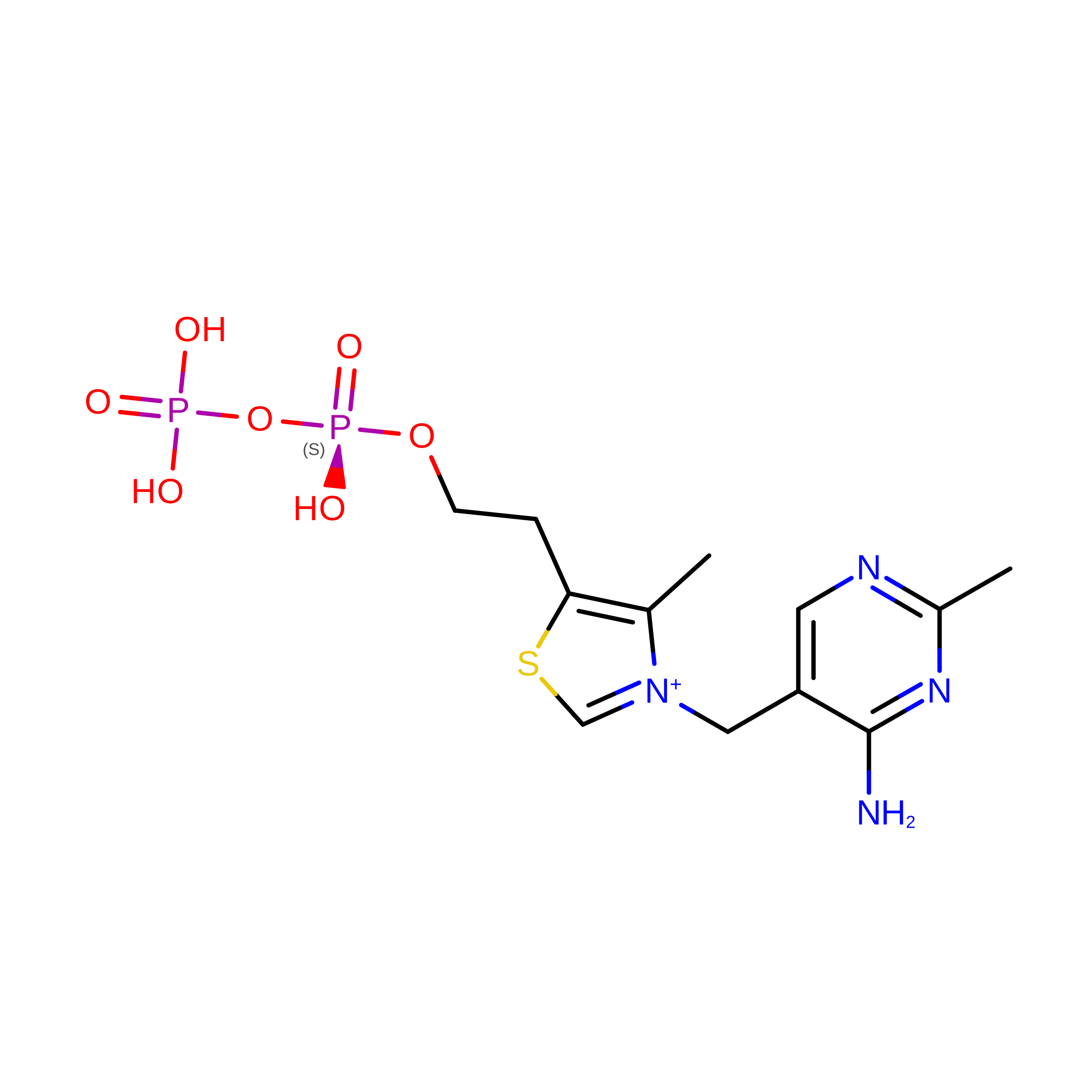
THIAMINE DIPHOSPHATE
C12 H19 N4 O7 P2 S
AYEKOFBPNLCAJY-UHFFFAOYSA-O
MG
(Subject of Investigation/LOI)

Query on MG


Download:Ideal Coordinates CCD File
E [auth A],
H [auth B]
MAGNESIUM ION
Mg
JLVVSXFLKOJNIY-UHFFFAOYSA-N

Experimental Data & Validation

Experimental Data

  • Method: ELECTRON MICROSCOPY
  • Resolution: 2.17 Å
  • Aggregation State: PARTICLE 
  • Reconstruction Method: SINGLE PARTICLE 
EM Software:
TaskSoftware PackageVersion
RECONSTRUCTIONcryoSPARC2.0
MODEL REFINEMENTPHENIX

Structure Validation

View Full Validation Report


Entry History 

& Funding Information

Deposition Data


Funding OrganizationLocationGrant Number
Academia Sinica (Taiwan)TaiwanGrant No. AS-CFII-108-110
Academia Sinica (Taiwan)TaiwanGrant No. AS-KPQ-109-TPP2

Revision History  (Full details and data files)

  • Version 1.0: 2023-06-28
    Type: Initial release
  • Version 1.1: 2023-07-05
    Changes: Database references
  • Version 1.2: 2023-08-02
    Changes: Database references
  • Version 1.3: 2023-11-15
    Changes: Data collection, Source and taxonomy