Find PDB structures and Computed Structure Models (CSM) by combining queries from tools in this suite: Attribute Search, Sequence Similarity, Sequence Motif, 3D Similarity, and 3D Motif with 'AND' logic.
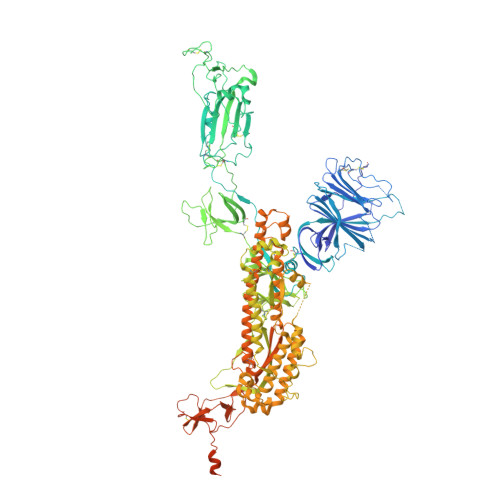
Cryo-electron microscopy (cryo-EM) has been widely used to reveal the structures of proteins at atomic resolution. One key challenge is that almost all proteins are predominantly adsorbed to the air-water interface during standard cryo-EM specimen preparation. The interaction of proteins with air-water interface will significantly impede the success of reconstruction and achievable resolution. Here, we highlight the critical role of impenetrable surfactant monolayers in passivating the air-water interface problems, and develop a robust effective method for high-resolution cryo-EM analysis, by using the superstructure GSAMs which comprises surfactant self-assembled monolayers (SAMs) and graphene membrane. The GSAMs works well in enriching the orientations and improving particle utilization ratio of multiple proteins, facilitating the 3.3-Å resolution reconstruction of a 100-kDa protein complex (ACE2-RBD), which shows strong preferential orientation using traditional specimen preparation protocol. Additionally, we demonstrate that GSAMs enables the successful determinations of small proteins (<100 kDa) at near-atomic resolution. This study expands the understanding of SAMs and provides a key to better control the interaction of protein with air-water interface.
Organizational Affiliation:
Beijing National Laboratory for Molecular Sciences, College of Chemistry and Molecular Engineering, Peking University, Beijing, 100871, China.
Ministry of Education Key Laboratory of Protein Sciences, Beijing Frontier Research Center for Biological Structures, Beijing Advanced Innovation Center for Structural Biology, School of Life Sciences, Tsinghua University, Beijing, 100084, China.
Tsinghua-Peking Joint Center for Life Sciences, Tsinghua University, Beijing, 100084, China.
China Academy of Aerospace Science and Innovation, Beijing, 100088, China.
Faculty of Materials Science and Energy Engineering, Shenzhen University of Advanced Technology, Shenzhen, 518055, China. c.zhao1@siat.ac.cn.
Shenzhen Institute of Advanced Electronic Materials, Shenzhen Institute of Advanced Technology, Chinese Academy of Sciences, Shenzhen, 518103, China. c.zhao1@siat.ac.cn.
Shenzhen Institute of Advanced Technology, Chinese Academy of Sciences, Shenzhen, 518055, China. c.zhao1@siat.ac.cn.
Beijing Graphene Institute (BGI), Beijing, 100095, China.
Shuimu BioSciences Ltd, Beijing, 100089, China.
Academy for Advanced Interdisciplinary Studies, Peking University, Beijing, 100871, China.
Faculty of Materials Science and Energy Engineering, Shenzhen University of Advanced Technology, Shenzhen, 518055, China.
Shenzhen Institute of Advanced Electronic Materials, Shenzhen Institute of Advanced Technology, Chinese Academy of Sciences, Shenzhen, 518103, China.
Shenzhen Institute of Advanced Technology, Chinese Academy of Sciences, Shenzhen, 518055, China.
Ministry of Education Key Laboratory of Protein Sciences, Beijing Frontier Research Center for Biological Structures, Beijing Advanced Innovation Center for Structural Biology, School of Life Sciences, Tsinghua University, Beijing, 100084, China. nanliuem@tsinghua.edu.cn.
School of Biological Sciences, The University of Hong Kong, Hong Kong, 999077, China. nanliuem@tsinghua.edu.cn.
Ministry of Education Key Laboratory of Protein Sciences, Beijing Frontier Research Center for Biological Structures, Beijing Advanced Innovation Center for Structural Biology, School of Life Sciences, Tsinghua University, Beijing, 100084, China. hongweiwang@tsinghua.edu.cn.
Tsinghua-Peking Joint Center for Life Sciences, Tsinghua University, Beijing, 100084, China. hongweiwang@tsinghua.edu.cn.
Beijing National Laboratory for Molecular Sciences, College of Chemistry and Molecular Engineering, Peking University, Beijing, 100871, China. hlpeng@pku.edu.cn.
Beijing Graphene Institute (BGI), Beijing, 100095, China. hlpeng@pku.edu.cn.
Academy for Advanced Interdisciplinary Studies, Peking University, Beijing, 100871, China. hlpeng@pku.edu.cn.

 Download Mendeley