8HRB | pdb_00008hrb

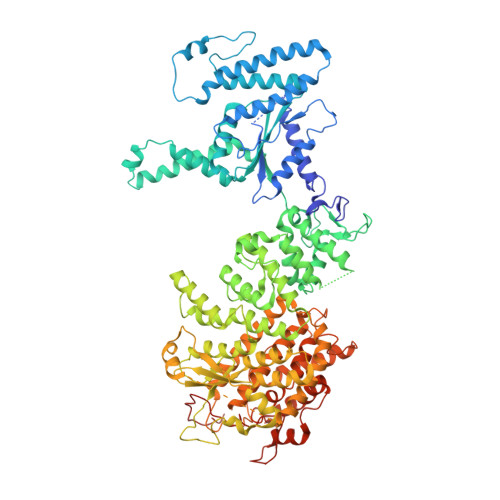
Structure of tetradecameric RdrA ring in RNA-loading state

  • Classification: IMMUNE SYSTEM
  • Organism(s): Escherichia coli
  • Expression System: Escherichia coli
  • Mutation(s): No 

  • Deposited: 2022-12-15 Released: 2023-02-01 
  • Deposition Author(s): Gao, Y.
  • Funding Organization(s): National Natural Science Foundation of China (NSFC)

Experimental Data Snapshot

  • Method: ELECTRON MICROSCOPY
  • Resolution: 3.78 Å
  • Aggregation State: PARTICLE 
  • Reconstruction Method: SINGLE PARTICLE 

wwPDB Validation 3D Report Full Report

Validation slider image for 8HRB

This is version 1.1 of the entry. See complete history

Literature

Molecular basis of RADAR anti-phage supramolecular assemblies.

Gao, Y.Luo, X.Li, P.Li, Z.Ye, F.Liu, S.Gao, P.

(2023) Cell 186: 999-1012.e20

  • DOI: https://doi.org/10.1016/j.cell.2023.01.026
  • Primary Citation Related Structures: 
    8HR7, 8HR8, 8HR9, 8HRA, 8HRB, 8HRC

  • PubMed Abstract: 

    Adenosine-to-inosine RNA editing has been proposed to be involved in a bacterial anti-phage defense system called RADAR. RADAR contains an adenosine triphosphatase (RdrA) and an adenosine deaminase (RdrB). Here, we report cryo-EM structures of RdrA, RdrB, and currently identified RdrA-RdrB complexes in the presence or absence of RNA and ATP. RdrB assembles into a dodecameric cage with catalytic pockets facing outward, while RdrA adopts both autoinhibited tetradecameric and activation-competent heptameric rings. Structural and functional data suggest a model in which RNA is loaded through the bottom section of the RdrA ring and translocated along its inner channel, a process likely coupled with ATP-binding status. Intriguingly, up to twelve RdrA rings can dock one RdrB cage with precise alignments between deaminase catalytic pockets and RNA-translocation channels, indicative of enzymatic coupling of RNA translocation and deamination. Our data uncover an interesting mechanism of enzymatic coupling and anti-phage defense through supramolecular assemblies.


  • Organizational Affiliation
    • CAS Key Laboratory of Infection and Immunity, National Laboratory of Biomacromolecules, CAS Center for Excellence in Biomacromolecules, Institute of Biophysics, Chinese Academy of Sciences, Beijing 100101, China.

Macromolecule Content 

  • Total Structure Weight: 1,542.16 kDa 
  • Atom Count: 96,352 
  • Modeled Residue Count: 11,880 
  • Deposited Residue Count: 13,378 
  • Unique protein chains: 1
  • Unique nucleic acid chains: 1

Macromolecules


Find similar nucleic acids by:  Sequence
Entity ID: 2
MoleculeChains LengthOrganismImage
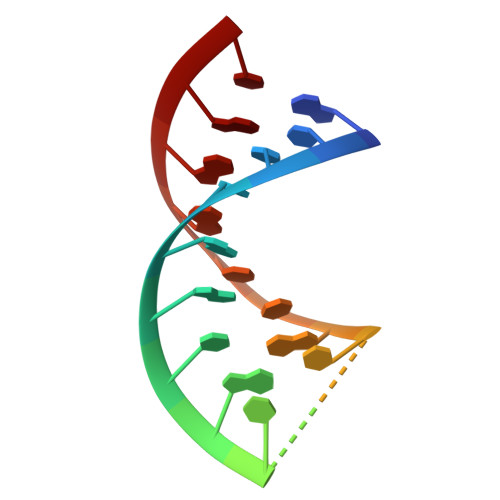
RNA (5'-R(*GP*UP*CP*CP*AP*GP*CP*GP*UP*CP*AP*UP*CP*GP*CP*UP*GP*GP*AP*C)-3')20Escherichia coli
Sequence Annotations
Expand
Reference Sequence

Small Molecules

Experimental Data & Validation

Experimental Data

  • Method: ELECTRON MICROSCOPY
  • Resolution: 3.78 Å
  • Aggregation State: PARTICLE 
  • Reconstruction Method: SINGLE PARTICLE 

Structure Validation

View Full Validation Report


Entry History 

& Funding Information

Deposition Data

  • Released Date: 2023-02-01 
  • Deposition Author(s): Gao, Y.

Funding OrganizationLocationGrant Number
National Natural Science Foundation of China (NSFC)China32100984

Revision History  (Full details and data files)

  • Version 1.0: 2023-02-01
    Type: Initial release
  • Version 1.1: 2023-08-16
    Changes: Data collection, Database references