8HM0 | pdb_00008hm0

F8-A22-E4 complex of MPXV in trimeric form


Experimental Data Snapshot

  • Method: ELECTRON MICROSCOPY
  • Resolution: 3.10 Å
  • Aggregation State: PARTICLE 
  • Reconstruction Method: SINGLE PARTICLE 

wwPDB Validation 3D Report Full Report

Validation slider image for 8HM0

This is version 1.1 of the entry. See complete history

Literature

Structural basis for the assembly of the DNA polymerase holoenzyme from a monkeypox virus variant.

Li, Y.Shen, Y.Hu, Z.Yan, R.

(2023) Sci Adv 9: eadg2331-eadg2331

  • DOI: https://doi.org/10.1126/sciadv.adg2331
  • Primary Citation Related Structures: 
    8HLZ, 8HM0

  • PubMed Abstract: 

    The ongoing global pandemic caused by a variant of the monkeypox (or mpox) virus (MPXV) has prompted widespread concern. The MPXV DNA polymerase holoenzyme, consisting of F8, A22, and E4, is vital for replicating the viral genome and represents a crucial target for the development of antiviral drugs. However, the assembly and working mechanism for the DNA polymerase holoenzyme of MPXV remains elusive. Here, we present the cryo-electron microscopy (cryo-EM) structure of the DNA polymerase holoenzyme at an overall resolution of 3.5 Å. Unexpectedly, the holoenzyme is assembled as a dimer of heterotrimers, of which the extra interface between the thumb domain of F8 and A22 shows a clash between A22 and substrate DNA, suggesting an autoinhibition state. Addition of exogenous double-stranded DNA shifts the hexamer into trimer exposing DNA binding sites, potentially representing a more active state. Our findings provide crucial steps toward developing targeted antiviral therapies for MPXV and related viruses.


  • Organizational Affiliation
    • Center for Infectious Disease Research, Westlake Laboratory of Life Sciences and Biomedicine, Key Laboratory of Structural Biology of Zhejiang Province, School of Life Sciences, Westlake University, Hangzhou, Zhejiang Province 310024, China.

Macromolecule Content 

  • Total Structure Weight: 191.46 kDa 
  • Atom Count: 11,331 
  • Modeled Residue Count: 1,474 
  • Deposited Residue Count: 1,650 
  • Unique protein chains: 3

Macromolecules

Find similar proteins by:|  3D Structure
Entity ID: 1
MoleculeChains  Sequence LengthOrganismDetailsImage
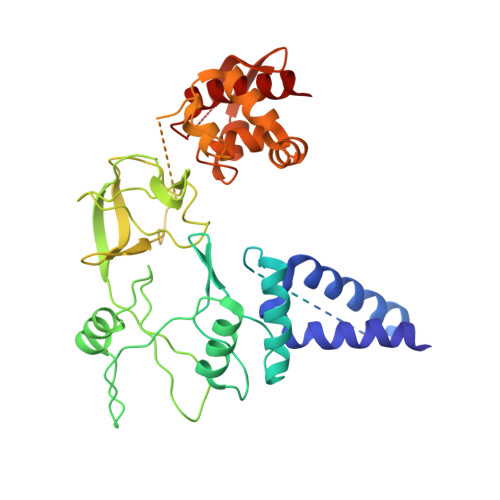
DNA polymerase processivity factor component A20A [auth C]426Monkeypox virusMutation(s): 0 
Gene Names: 
UniProt
Find proteins for A0A7H0DNC0 (Monkeypox virus)
Explore A0A7H0DNC0 
Go to UniProtKB:  A0A7H0DNC0
Entity Groups
Sequence Clusters30% Identity50% Identity70% Identity90% Identity95% Identity100% Identity
UniProt GroupA0A7H0DNC0
Sequence Annotations
Expand
Reference Sequence
Find similar proteins by:|  3D Structure
Entity ID: 2
MoleculeChains  Sequence LengthOrganismDetailsImage
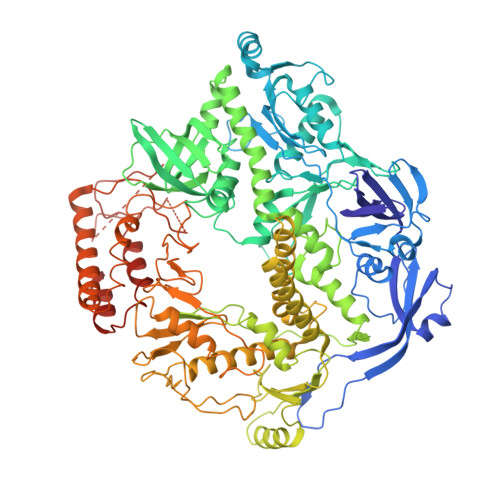
DNA polymeraseB [auth A]1,006Monkeypox virusMutation(s): 0 
Gene Names: 
EC: 2.7.7.7
UniProt
Find proteins for A0A7H0DN44 (Monkeypox virus)
Explore A0A7H0DN44 
Go to UniProtKB:  A0A7H0DN44
Entity Groups
Sequence Clusters30% Identity50% Identity70% Identity90% Identity95% Identity100% Identity
UniProt GroupA0A7H0DN44
Sequence Annotations
Expand
Reference Sequence
Find similar proteins by:|  3D Structure
Entity ID: 3
MoleculeChains  Sequence LengthOrganismDetailsImage
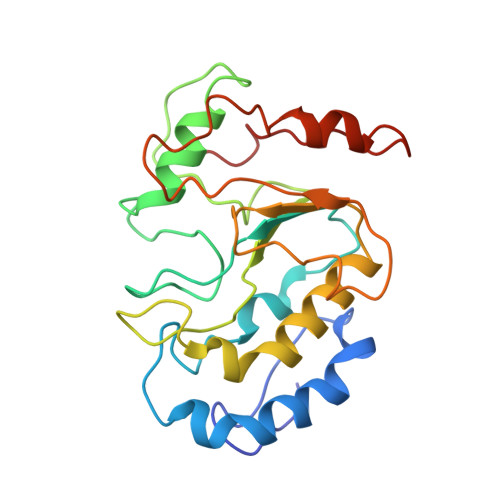
E4RC [auth B]218Monkeypox virusMutation(s): 0 
Gene Names: 
EC: 3.2.2.27
UniProt
Find proteins for M1LL92 (Monkeypox virus)
Explore M1LL92 
Go to UniProtKB:  M1LL92
Entity Groups
Sequence Clusters30% Identity50% Identity70% Identity90% Identity95% Identity100% Identity
UniProt GroupM1LL92
Sequence Annotations
Expand
Reference Sequence

Experimental Data & Validation

Experimental Data

  • Method: ELECTRON MICROSCOPY
  • Resolution: 3.10 Å
  • Aggregation State: PARTICLE 
  • Reconstruction Method: SINGLE PARTICLE 
EM Software:
TaskSoftware PackageVersion
RECONSTRUCTIONRELION3.0.6

Structure Validation

View Full Validation Report


Entry History 

& Funding Information

Deposition Data


Funding OrganizationLocationGrant Number
Ministry of Science and Technology (MoST, China)China2020YFA0509301

Revision History  (Full details and data files)

  • Version 1.0: 2023-05-31
    Type: Initial release
  • Version 1.1: 2023-12-13
    Changes: Data collection, Database references