Download Mendeley
A bivalent form of a RBD-specific synthetic antibody effectively neutralizes SARS-CoV-2 variants.
Kim, D.G., Kim, U., Park, I.H., Ryu, B., Yoo, Y., Cha, J.S., Yoon, G.Y., Kim, S.H., Oh, H., Seo, J.Y., Nam, K.T., Seong, J.K., Shin, J.S., Cho, H.S., Kim, H.S.(2023) Antiviral Res 220: 105738-105738
- PubMed: 37944822 Search on PubMed
- DOI: https://doi.org/10.1016/j.antiviral.2023.105738
- Primary Citation Related Structures:
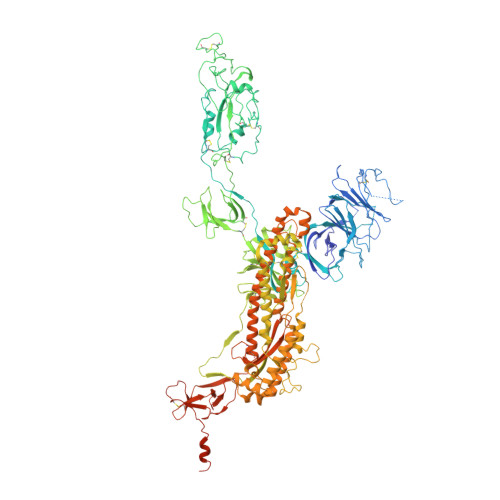
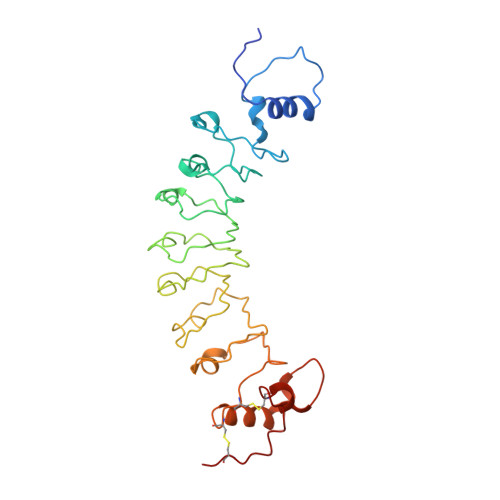
7YCO, 8H6F - PubMed Abstract:
Coronavirus Disease 2019 (COVID-19) pandemic is severely impacting the world, and tremendous efforts have been made to deal with it. Despite many advances in vaccines and therapeutics, severe acute respiratory syndrome coronavirus 2 (SARS-CoV-2) variants remains an intractable challenge. We present a bivalent Receptor Binding Domain (RBD)-specific synthetic antibody, specific for the RBD of wild-type (lineage A), developed from a non-antibody protein scaffold composed of LRR (Leucine-rich repeat) modules through phage display. We further reinforced the unique feature of the synthetic antibody by constructing a tandem dimeric form. The resulting bivalent form showed a broader neutralizing activity against the variants. The in vivo neutralizing efficacy of the bivalent synthetic antibody was confirmed using a human ACE2-expressing mouse model that significantly alleviated viral titer and lung infection. The present approach can be used to develop a synthetic antibody showing a broader neutralizing activity against a multitude of SARS-CoV-2 variants.
- Department of Biological Sciences, Korea Advanced Institute of Science and Technology (KAIST), Daejeon, 34141, South Korea.
Organizational Affiliation: