8H0C | pdb_00008h0c

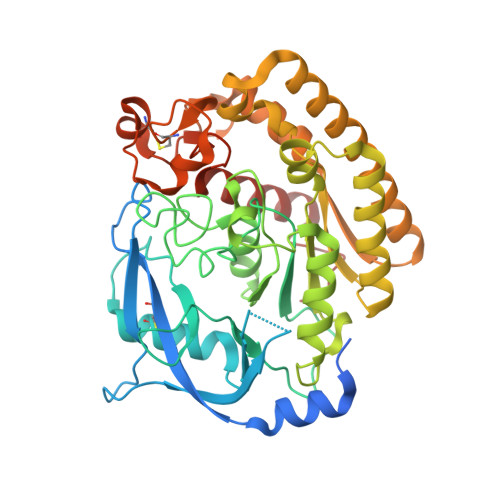
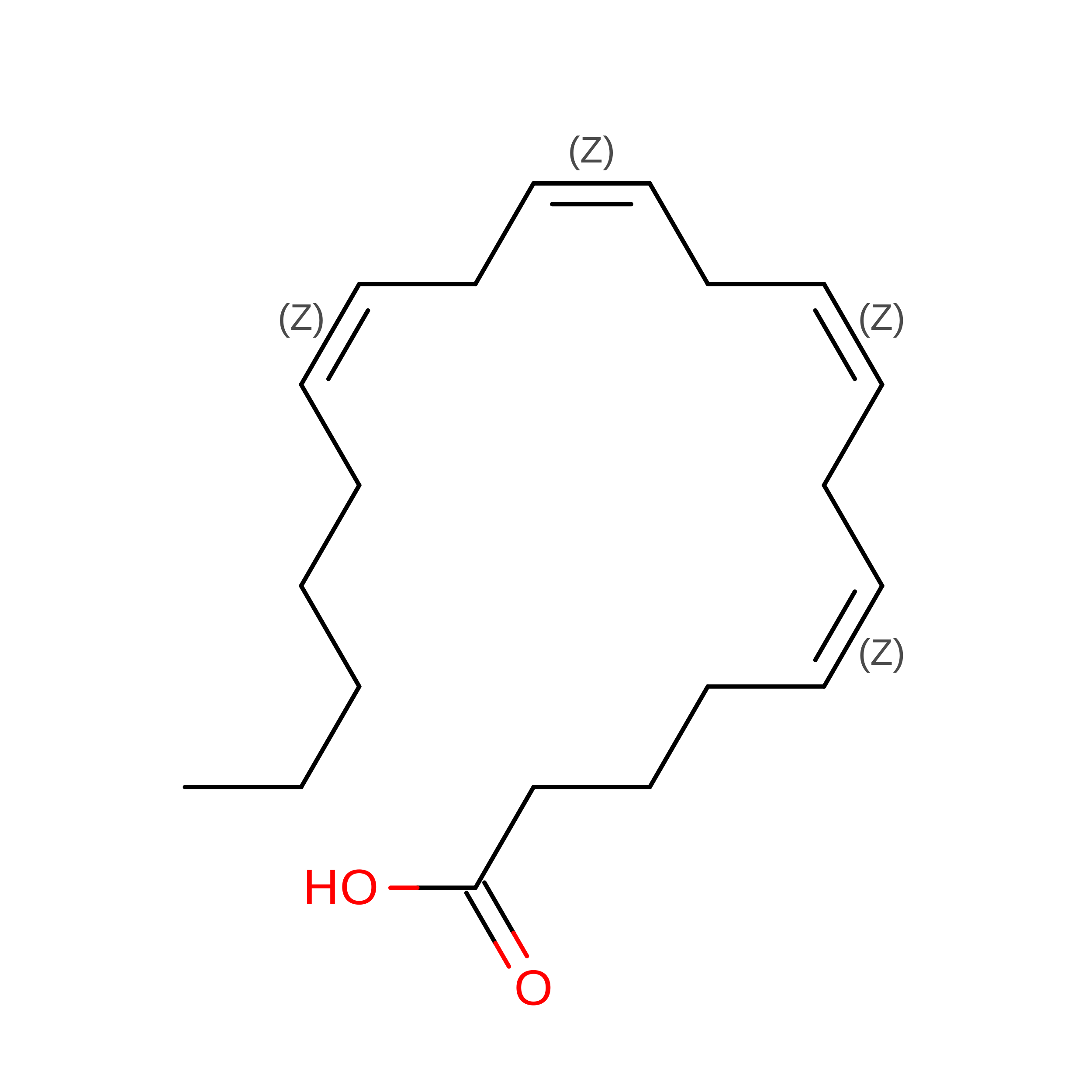
Structure of the thermolabile hemolysin from Vibrio alginolyticus (in complex with arachidonic acid)


Experimental Data Snapshot

  • Method: X-RAY DIFFRACTION
  • Resolution: 1.98 Å
  • R-Value Free: 
    0.227 (Depositor), 0.222 (DCC) 
  • R-Value Work: 
    0.193 (Depositor), 0.192 (DCC) 
  • R-Value Observed: 
    0.194 (Depositor) 

Starting Model: experimental
View more details

wwPDB Validation 3D Report Full Report

Validation slider image for 8H0C

Ligand Structure Quality Assessment 


This is version 1.2 of the entry. See complete history

Literature

Catalytic site flexibility facilitates the substrate and catalytic promiscuity of Vibrio dual lipase/transferase.

Wang, C.Liu, C.Zhu, X.Peng, Q.Ma, Q.

(2023) Nat Commun 14: 4795-4795

  • DOI: https://doi.org/10.1038/s41467-023-40455-y
  • Primary Citation Related Structures: 
    8H09, 8H0A, 8H0B, 8H0C, 8H0D

  • PubMed Abstract: 

    Although enzyme catalysis is typified by high specificity, enzymes can catalyze various substrates (substrate promiscuity) and/or different reaction types (catalytic promiscuity) using a single active site. This interesting phenomenon is widely distributed in enzyme catalysis, with both fundamental and applied importance. To date, the mechanistic understanding of enzyme promiscuity is very limited. Herein, we report the structural mechanism underlying the substrate and catalytic promiscuity of Vibrio dual lipase/transferase (VDLT). Crystal structures of the VDLT from Vibrio alginolyticus (ValDLT) and its fatty acid complexes were solved, revealing prominent structural flexibility. In particular, the "Ser-His-Asp" catalytic triad machinery of ValDLT contains an intrinsically flexible oxyanion hole. Analysis of ligand-bound structures and mutagenesis showed that the flexible oxyanion hole and other binding residues can undergo distinct conformational changes to facilitate substrate and catalytic promiscuity. Our study reveals a previously unknown flexible form of the famous catalytic triad machinery and proposes a "catalytic site tuning" mechanism to expand the mechanistic paradigm of enzyme promiscuity.


  • Organizational Affiliation
    • CAS and Shandong Province Key Laboratory of Experimental Marine Biology, Institute of Oceanology, Chinese Academy of Sciences, Qingdao, China.

Macromolecule Content 

  • Total Structure Weight: 97.51 kDa 
  • Atom Count: 6,592 
  • Modeled Residue Count: 774 
  • Deposited Residue Count: 852 
  • Unique protein chains: 1

Macromolecules

Find similar proteins by:|  3D Structure
Entity ID: 1
MoleculeChains  Sequence LengthOrganismDetailsImage
SGNH/GDSL hydrolase family protein
A, B
426Vibrio alginolyticusMutation(s): 0 
Gene Names: F0254_14065
UniProt
Find proteins for A0A7Y4B3E8 (Vibrio alginolyticus)
Explore A0A7Y4B3E8 
Go to UniProtKB:  A0A7Y4B3E8
Entity Groups
Sequence Clusters30% Identity50% Identity70% Identity90% Identity95% Identity100% Identity
UniProt GroupA0A7Y4B3E8
Sequence Annotations
Expand
Reference Sequence

Experimental Data & Validation

Experimental Data

  • Method: X-RAY DIFFRACTION
  • Resolution: 1.98 Å
  • R-Value Free:  0.227 (Depositor), 0.222 (DCC) 
  • R-Value Work:  0.193 (Depositor), 0.192 (DCC) 
  • R-Value Observed: 0.194 (Depositor) 
Space Group: P 1 21 1
Unit Cell:
Length ( Å )Angle ( ˚ )
a = 66.104α = 90
b = 72.888β = 101.6
c = 83.899γ = 90
Software Package:
Software NamePurpose
BUSTERrefinement
PDB_EXTRACTdata extraction
XDSdata reduction
Aimlessdata scaling
PHASERphasing

Structure Validation

View Full Validation Report


Ligand Structure Quality Assessment 


Entry History 

& Funding Information

Deposition Data


Funding OrganizationLocationGrant Number
National Natural Science Foundation of China (NSFC)China--

Revision History  (Full details and data files)

  • Version 1.0: 2023-08-16
    Type: Initial release
  • Version 1.1: 2024-10-30
    Changes: Structure summary
  • Version 1.2: 2026-03-11
    Changes: Refinement description