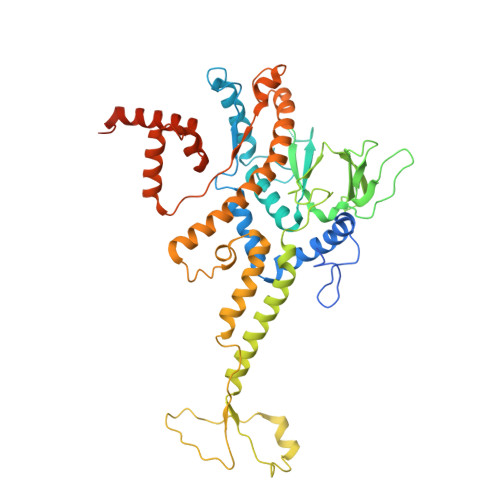
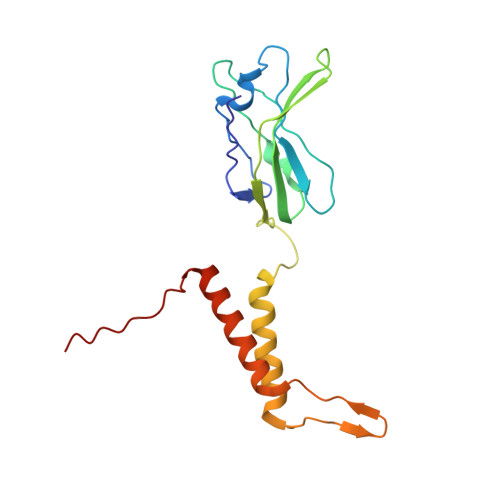
8GTD | pdb_00008gtd

Cryo-EM model of the marine siphophage vB_DshS-R4C portal-adaptor complex


Experimental Data Snapshot

  • Method: ELECTRON MICROSCOPY
  • Resolution: 4.70 Å
  • Aggregation State: PARTICLE 
  • Reconstruction Method: SINGLE PARTICLE 

wwPDB Validation 3D Report Full Report

Validation slider image for 8GTD

This is version 1.1 of the entry. See complete history

Literature

Structure and proposed DNA delivery mechanism of a marine roseophage.

Huang, Y.Sun, H.Wei, S.Cai, L.Liu, L.Jiang, Y.Xin, J.Chen, Z.Que, Y.Kong, Z.Li, T.Yu, H.Zhang, J.Gu, Y.Zheng, Q.Li, S.Zhang, R.Xia, N.

(2023) Nat Commun 14: 3609-3609

  • DOI: https://doi.org/10.1038/s41467-023-39220-y
  • Primary Citation Related Structures: 
    8GTA, 8GTB, 8GTC, 8GTD, 8GTF

  • PubMed Abstract: 

    Tailed bacteriophages (order, Caudovirales) account for the majority of all phages. However, the long flexible tail of siphophages hinders comprehensive investigation of the mechanism of viral gene delivery. Here, we report the atomic capsid and in-situ structures of the tail machine of the marine siphophage, vB_DshS-R4C (R4C), which infects Roseobacter. The R4C virion, comprising 12 distinct structural protein components, has a unique five-fold vertex of the icosahedral capsid that allows genome delivery. The specific position and interaction pattern of the tail tube proteins determine the atypical long rigid tail of R4C, and further provide negative charge distribution within the tail tube. A ratchet mechanism assists in DNA transmission, which is initiated by an absorption device that structurally resembles the phage-like particle, RcGTA. Overall, these results provide in-depth knowledge into the intact structure and underlining DNA delivery mechanism for the ecologically important siphophages.


  • Organizational Affiliation
    • State Key Laboratory of Molecular Vaccinology and Molecular Diagnostics, School of Public Health, School of Life Sciences, Xiamen University, Xiamen, 361102, China.

Macromolecule Content 

  • Total Structure Weight: 955.24 kDa 
  • Atom Count: 29,580 
  • Modeled Residue Count: 7,392 
  • Deposited Residue Count: 8,748 
  • Unique protein chains: 2

Macromolecules

Find similar proteins by:|  3D Structure
Entity ID: 1
MoleculeChains  Sequence LengthOrganismDetailsImage
Portal protein551Dinoroseobacter phage vB_DshS-R4CMutation(s): 0 
UniProt
Find proteins for A0ACD6BAB1 (Dinoroseobacter phage vB_DshS-R4C)
Explore A0ACD6BAB1 
Go to UniProtKB:  A0ACD6BAB1
Entity Groups
Sequence Clusters30% Identity50% Identity70% Identity90% Identity95% Identity100% Identity
UniProt GroupA0ACD6BAB1
Sequence Annotations
Expand
Reference Sequence
Find similar proteins by:|  3D Structure
Entity ID: 2
MoleculeChains  Sequence LengthOrganismDetailsImage
Head-to-tail joining protein178Dinoroseobacter phage vB_DshS-R4CMutation(s): 0 
UniProt
Find proteins for A0ACD6BAB0 (Dinoroseobacter phage vB_DshS-R4C)
Explore A0ACD6BAB0 
Go to UniProtKB:  A0ACD6BAB0
Entity Groups
Sequence Clusters30% Identity50% Identity70% Identity90% Identity95% Identity100% Identity
UniProt GroupA0ACD6BAB0
Sequence Annotations
Expand
Reference Sequence

Experimental Data & Validation

Experimental Data

  • Method: ELECTRON MICROSCOPY
  • Resolution: 4.70 Å
  • Aggregation State: PARTICLE 
  • Reconstruction Method: SINGLE PARTICLE 

Structure Validation

View Full Validation Report


Entry History 

& Funding Information

Deposition Data


Funding OrganizationLocationGrant Number
Not funded--

Revision History  (Full details and data files)

  • Version 1.0: 2023-07-12
    Type: Initial release
  • Version 1.1: 2024-06-19
    Changes: Data collection