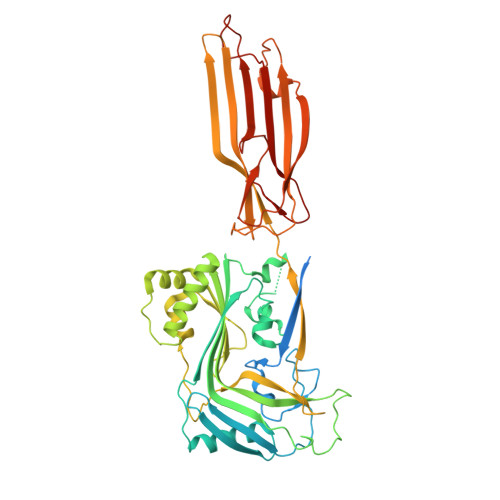
8G33 | pdb_00008g33

Activated form of a CDCL long protein


Experimental Data Snapshot

  • Method: X-RAY DIFFRACTION
  • Resolution: 2.49 Å
  • R-Value Free: 
    0.248 (Depositor), 0.248 (DCC) 
  • R-Value Work: 
    0.207 (Depositor), 0.208 (DCC) 
  • R-Value Observed: 
    0.210 (Depositor) 

Starting Model: experimental
View more details

wwPDB Validation 3D Report Full Report

Validation slider image for 8G33

This is version 1.1 of the entry. See complete history

Literature

Structural basis for the pore-forming activity of a complement-like toxin.

Johnstone, B.A.Christie, M.P.Joseph, R.Morton, C.J.Brown, H.G.Hanssen, E.Sanford, T.C.Abrahamsen, H.L.Tweten, R.K.Parker, M.W.

(2025) Sci Adv 11: eadt2127-eadt2127

  • DOI: https://doi.org/10.1126/sciadv.adt2127
  • Primary Citation Related Structures: 
    8G33, 9CCP, 9CCQ

  • PubMed Abstract: 

    Pore-forming proteins comprise a highly diverse group of proteins exemplified by the membrane attack complex/perforin (MACPF), cholesterol-dependent cytolysin (CDC), and gasdermin superfamilies, which all form gigantic pores (>150 angstroms). A recently found family of pore-forming toxins, called CDC-like proteins (CDCLs), are wide-spread in gut microbes and are a prevalent means of antibacterial antagonism. However, the structural aspects of how CDCLs assemble a pore remain a mystery. Here, we report the crystal structure of a proteolytically activated CDCL and cryo-electron microscopy structures of a prepore-like intermediate and a transmembrane pore providing detailed snapshots across the entire pore-forming pathway. These studies reveal a sophisticated array of regulatory features to ensure productive pore formation, and, thus, CDCLs straddle the MACPF, CDC, and gasdermin lineages of the giant pore superfamilies.


  • Organizational Affiliation
    • Department of Biochemistry and Pharmacology, Bio21 Molecular Science and Biotechnology Institute, University of Melbourne, Parkville, VIC 3010, Australia.

Macromolecule Content 

  • Total Structure Weight: 55.91 kDa 
  • Atom Count: 3,537 
  • Modeled Residue Count: 436 
  • Deposited Residue Count: 497 
  • Unique protein chains: 1

Macromolecules

Find similar proteins by:|  3D Structure
Entity ID: 1
MoleculeChains  Sequence LengthOrganismDetailsImage
Hemolysin497Elizabethkingia anophelis Ag1Mutation(s): 0 
Gene Names: ply_2AYC66_13765BAY09_14710NCTC10586_03727
UniProt
Find proteins for A0A1T3IZT7 (Elizabethkingia anophelis)
Explore A0A1T3IZT7 
Go to UniProtKB:  A0A1T3IZT7
Entity Groups
Sequence Clusters30% Identity50% Identity70% Identity90% Identity95% Identity100% Identity
UniProt GroupA0A1T3IZT7
Sequence Annotations
Expand
Reference Sequence

Experimental Data & Validation

Experimental Data

  • Method: X-RAY DIFFRACTION
  • Resolution: 2.49 Å
  • R-Value Free:  0.248 (Depositor), 0.248 (DCC) 
  • R-Value Work:  0.207 (Depositor), 0.208 (DCC) 
  • R-Value Observed: 0.210 (Depositor) 
Space Group: I 1 2 1
Unit Cell:
Length ( Å )Angle ( ˚ )
a = 61.725α = 90
b = 24.451β = 93.19
c = 300.191γ = 90
Software Package:
Software NamePurpose
XDSdata reduction
Aimlessdata scaling
PHASERphasing
PHENIXrefinement
Cootmodel building

Structure Validation

View Full Validation Report


Entry History 

& Funding Information

Deposition Data


Funding OrganizationLocationGrant Number
Australian Research Council (ARC)AustraliaDP200102871
Australian Research Council (ARC)AustraliaDP160101874

Revision History  (Full details and data files)

  • Version 1.0: 2024-02-07
    Type: Initial release
  • Version 1.1: 2025-04-09
    Changes: Database references, Structure summary