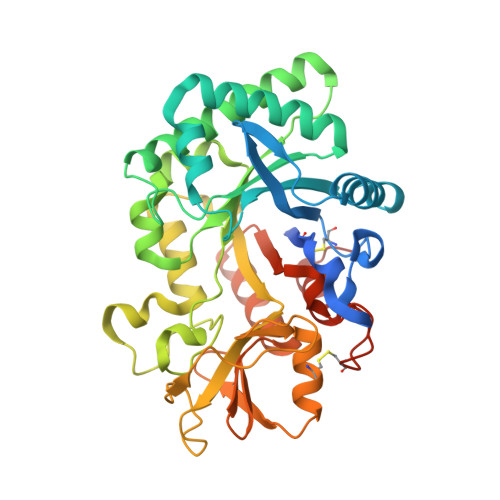
8FRB | pdb_00008frb

Mouse acidic mammalian chitinase, catalytic domain in complex with N,N'-diacetylchitobiose at pH 5.25

  • Classification: HYDROLASE
  • Organism(s): Mus musculus
  • Expression System: Cricetulus griseus
  • Mutation(s): No 

  • Deposited: 2023-01-06 Released: 2023-03-08 
  • Deposition Author(s): Diaz, R.E., Fraser, J.S.
  • Funding Organization(s): Other government, National Institutes of Health/National Institute of General Medical Sciences (NIH/NIGMS)

Experimental Data Snapshot

  • Method: X-RAY DIFFRACTION
  • Resolution: 1.70 Å
  • R-Value Free: 
    0.178 (Depositor), 0.178 (DCC) 
  • R-Value Work: 
    0.142 (Depositor), 0.143 (DCC) 
  • R-Value Observed: 
    0.144 (Depositor) 

Starting Model: experimental
View more details

wwPDB Validation 3D Report Full Report

Validation slider image for 8FRB

This is version 1.4 of the entry. See complete history

Literature

Structural characterization of ligand binding and pH-specific enzymatic activity of mouse Acidic Mammalian Chitinase.

Diaz, R.E.Ecker, A.K.Correy, G.J.Asthana, P.Young, I.D.Faust, B.Thompson, M.C.Seiple, I.B.Van Dyken, S.J.Locksley, R.M.Fraser, J.S.

(2024) bioRxiv 

  • DOI: https://doi.org/10.1101/2023.06.03.542675
  • Primary Citation Related Structures: 
    8FG5, 8FG7, 8FR9, 8FRA, 8FRB, 8FRC, 8FRD, 8FRG, 8GCA

  • PubMed Abstract: 

    Chitin is an abundant biopolymer and pathogen-associated molecular pattern that stimulates a host innate immune response. Mammals express chitin-binding and chitin-degrading proteins to remove chitin from the body. One of these proteins, Acidic Mammalian Chitinase (AMCase), is an enzyme known for its ability to function under acidic conditions in the stomach but is also active in tissues with more neutral pHs, such as the lung. Here, we used a combination of biochemical, structural, and computational modeling approaches to examine how the mouse homolog (mAMCase) can act in both acidic and neutral environments. We measured kinetic properties of mAMCase activity across a broad pH range, quantifying its unusual dual activity optima at pH 2 and 7. We also solved high resolution crystal structures of mAMCase in complex with oligomeric GlcNAcn, the building block of chitin, where we identified extensive conformational ligand heterogeneity. Leveraging these data, we conducted molecular dynamics simulations that suggest how a key catalytic residue could be protonated via distinct mechanisms in each of the two environmental pH ranges. These results integrate structural, biochemical, and computational approaches to deliver a more complete understanding of the catalytic mechanism governing mAMCase activity at different pH. Engineering proteins with tunable pH optima may provide new opportunities to develop improved enzyme variants, including AMCase, for therapeutic purposes in chitin degradation.


  • Organizational Affiliation
    • Department of Bioengineering and Therapeutic Sciences, University of California, San Francisco, San Francisco, CA 94158, USA.

Macromolecule Content 

  • Total Structure Weight: 182.85 kDa 
  • Atom Count: 13,986 
  • Modeled Residue Count: 1,478 
  • Deposited Residue Count: 1,588 
  • Unique protein chains: 1

Macromolecules

Find similar proteins by:|  3D Structure
Entity ID: 1
MoleculeChains  Sequence LengthOrganismDetailsImage
Acidic mammalian chitinase
A, B, C, D
397Mus musculusMutation(s): 0 
Gene Names: ChiaChia1
EC: 3.2.1.14
UniProt
Find proteins for Q91XA9 (Mus musculus)
Explore Q91XA9 
Go to UniProtKB:  Q91XA9
Entity Groups
Sequence Clusters30% Identity50% Identity70% Identity90% Identity95% Identity100% Identity
UniProt GroupQ91XA9
Sequence Annotations
Expand
Reference Sequence

Oligosaccharides

Help  
Entity ID: 2
MoleculeChains Length2D Diagram GlycosylationD Interactions
2-acetamido-2-deoxy-beta-D-glucopyranose-(1-4)-2-acetamido-2-deoxy-beta-D-glucopyranose
E, F, G, H, I
E, F, G, H, I, J, K
2N/AN/A
Glycosylation Resources
GlyTouCan: G42666HT
GlyCosmos: G42666HT
GlyGen: G42666HT
Entity ID: 3
MoleculeChains Length2D Diagram GlycosylationD Interactions
2-acetamido-2-deoxy-beta-D-glucopyranose-(1-4)-2-acetylamino-2-deoxy-alpha-L-idopyranose
L
2N/AN/A
Glycosylation Resources
GlyTouCan: G45933ZU
GlyCosmos: G45933ZU
Entity ID: 4
MoleculeChains Length2D Diagram GlycosylationD Interactions
2-acetamido-2-deoxy-beta-D-glucopyranose-(1-4)-2-acetamido-2-deoxy-alpha-D-glucopyranose
M, N
2N/AN/A
Glycosylation Resources
GlyTouCan: G05026ZL
GlyCosmos: G05026ZL
GlyGen: G05026ZL

Experimental Data & Validation

Experimental Data

  • Method: X-RAY DIFFRACTION
  • Resolution: 1.70 Å
  • R-Value Free:  0.178 (Depositor), 0.178 (DCC) 
  • R-Value Work:  0.142 (Depositor), 0.143 (DCC) 
  • R-Value Observed: 0.144 (Depositor) 
Space Group: P 21 21 21
Unit Cell:
Length ( Å )Angle ( ˚ )
a = 91.926α = 90
b = 106.963β = 90
c = 146.492γ = 90
Software Package:
Software NamePurpose
PHENIXrefinement
xia2data reduction
DIALSdata scaling
PHASERphasing
Cootmodel building

Structure Validation

View Full Validation Report


Entry History 

& Funding Information

Deposition Data


Funding OrganizationLocationGrant Number
Other governmentUnited StatesT29IP0554
National Institutes of Health/National Institute of General Medical Sciences (NIH/NIGMS)United StatesP30GM124169

Revision History  (Full details and data files)

  • Version 1.0: 2023-03-08
    Type: Initial release
  • Version 1.1: 2023-06-14
    Changes: Database references
  • Version 1.2: 2023-07-19
    Changes: Database references
  • Version 1.3: 2024-04-10
    Changes: Data collection, Database references
  • Version 1.4: 2024-11-06
    Changes: Structure summary