8FMU | pdb_00008fmu

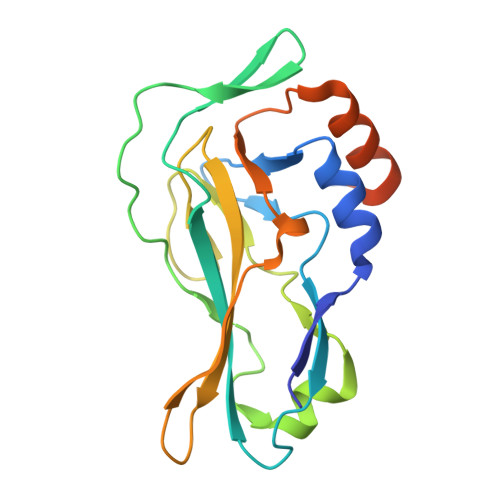
Crystal structure of human Brachyury G177D variant in complex with SJF-4601


Experimental Data Snapshot

  • Method: X-RAY DIFFRACTION
  • Resolution: 2.03 Å
  • R-Value Free: 
    0.266 (Depositor), 0.266 (DCC) 
  • R-Value Work: 
    0.200 (Depositor), 0.199 (DCC) 
  • R-Value Observed: 
    0.203 (Depositor) 

Starting Model: experimental
View more details

wwPDB Validation 3D Report Full Report

Validation slider image for 8FMU

Ligand Structure Quality Assessment 


This is version 1.2 of the entry. See complete history

Literature

Development of a Small Molecule Downmodulator for the Transcription Factor Brachyury.

Chase, D.H.Bebenek, A.M.Nie, P.Jaime-Figueroa, S.Butrin, A.Castro, D.A.Hines, J.Linhares, B.M.Crews, C.M.

(2024) Angew Chem Int Ed Engl 63: e202316496-e202316496

  • DOI: https://doi.org/10.1002/anie.202316496
  • Primary Citation Related Structures: 
    8FMU

  • PubMed Abstract: 

    Brachyury is an oncogenic transcription factor whose overexpression drives chordoma growth. The downmodulation of brachyury in chordoma cells has demonstrated therapeutic potential, however, as a transcription factor it is classically deemed "undruggable". Given that direct pharmacological intervention against brachyury has proven difficult, attempts at intervention have instead targeted upstream kinases. Recently, afatinib, an FDA-approved kinase inhibitor, has been shown to modulate brachyury levels in multiple chordoma cell lines. Herein, we use afatinib as a lead to undertake a structure-based drug design approach, aided by mass-spectrometry and X-ray crystallography, to develop DHC-156, a small molecule that more selectively binds brachyury and downmodulates it as potently as afatinib. We eliminated kinase-inhibition from this novel scaffold while demonstrating that DHC-156 induces the post-translational downmodulation of brachyury that results in an irreversible impairment of chordoma tumor cell growth. In doing so, we demonstrate the feasibility of direct brachyury modulation, which may further be developed into more potent tool compounds and therapies.


  • Organizational Affiliation
    • Department of Chemistry, Yale University, New Haven, CT-06511.

Macromolecule Content 

  • Total Structure Weight: 44.98 kDa 
  • Atom Count: 3,120 
  • Modeled Residue Count: 347 
  • Deposited Residue Count: 384 
  • Unique protein chains: 1

Macromolecules

Find similar proteins by:|  3D Structure
Entity ID: 1
MoleculeChains  Sequence LengthOrganismDetailsImage
T-box transcription factor T
A, B
192Homo sapiensMutation(s): 1 
Gene Names: TBXTT
UniProt & NIH Common Fund Data Resources
Find proteins for O15178 (Homo sapiens)
Explore O15178 
Go to UniProtKB:  O15178
PHAROS:  O15178
GTEx:  ENSG00000164458 
Entity Groups
Sequence Clusters30% Identity50% Identity70% Identity90% Identity95% Identity100% Identity
UniProt GroupO15178
Sequence Annotations
Expand
Reference Sequence

Small Molecules

Ligands 1 Unique
IDChains Name / Formula / InChI Key2D Diagram3D Interactions
Y3T

Query on Y3T


Download:Ideal Coordinates CCD File
C [auth A],
D [auth B]
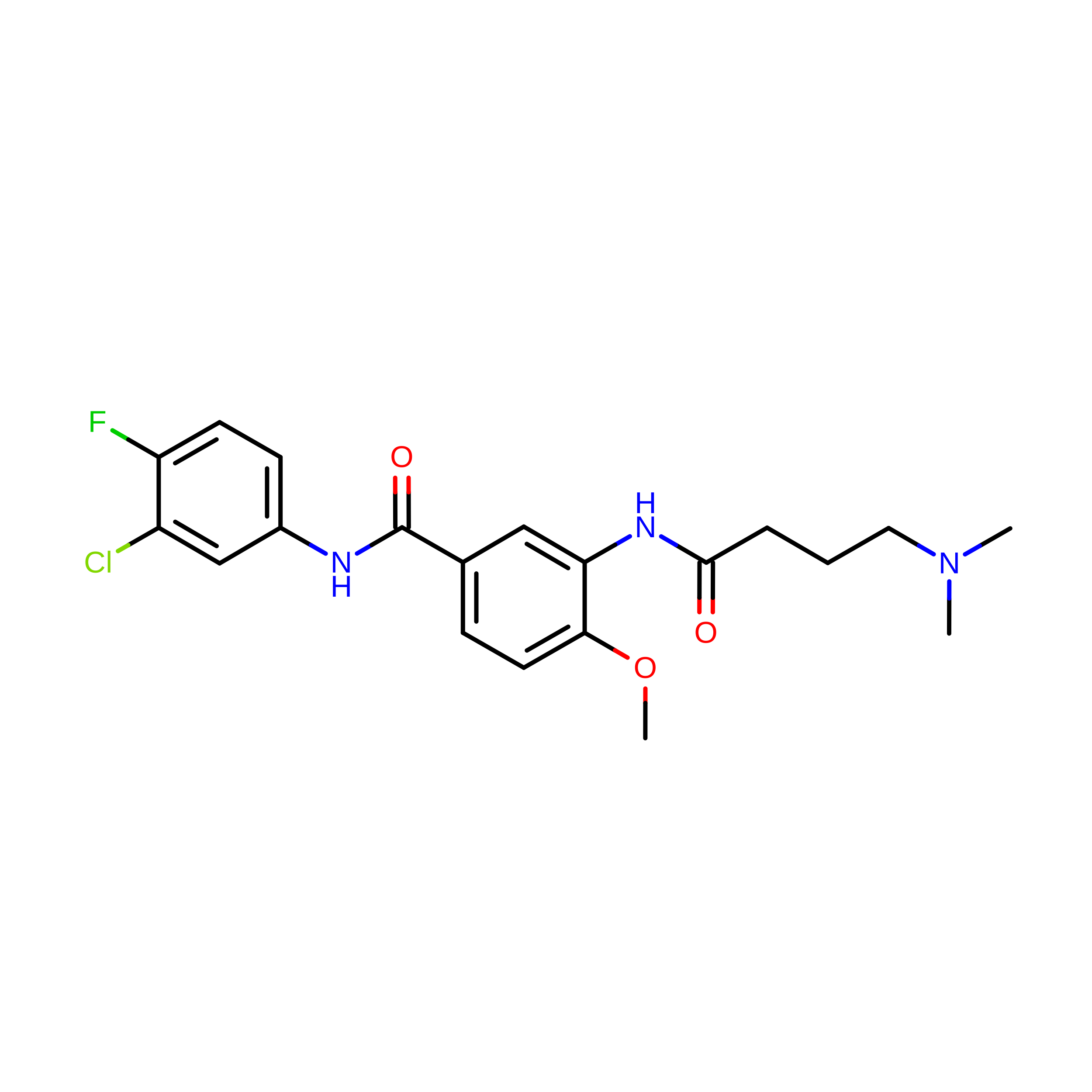
N-(3-chloro-4-fluorophenyl)-3-[4-(dimethylamino)butanamido]-4-methoxybenzamide
C20 H23 Cl F N3 O3
VFCRGORDSAIMRG-UHFFFAOYSA-N

Experimental Data & Validation

Experimental Data

  • Method: X-RAY DIFFRACTION
  • Resolution: 2.03 Å
  • R-Value Free:  0.266 (Depositor), 0.266 (DCC) 
  • R-Value Work:  0.200 (Depositor), 0.199 (DCC) 
  • R-Value Observed: 0.203 (Depositor) 
Space Group: P 21 21 21
Unit Cell:
Length ( Å )Angle ( ˚ )
a = 58.892α = 90
b = 70.294β = 90
c = 81.874γ = 90
Software Package:
Software NamePurpose
PHENIXrefinement
HKL-2000data reduction
HKL-2000data scaling
PHASERphasing

Structure Validation

View Full Validation Report


Ligand Structure Quality Assessment 


Entry History 

& Funding Information

Deposition Data


Funding OrganizationLocationGrant Number
The Mark FoundationUnited States--

Revision History  (Full details and data files)

  • Version 1.0: 2024-02-28
    Type: Initial release
  • Version 1.1: 2024-09-18
    Changes: Database references
  • Version 1.2: 2024-11-06
    Changes: Structure summary