Download Mendeley
Complete integration of carbene-transfer chemistry into biosynthesis.
Huang, J., Quest, A., Cruz-Morales, P., Deng, K., Pereira, J.H., Van Cura, D., Kakumanu, R., Baidoo, E.E.K., Dan, Q., Chen, Y., Petzold, C.J., Northen, T.R., Adams, P.D., Clark, D.S., Balskus, E.P., Hartwig, J.F., Mukhopadhyay, A., Keasling, J.D.(2023) Nature 617: 403-408
- PubMed: 37138074 Search on PubMedSearch on PubMed Central
- DOI: https://doi.org/10.1038/s41586-023-06027-2
- Primary Citation Related Structures:
8FBC - PubMed Abstract:
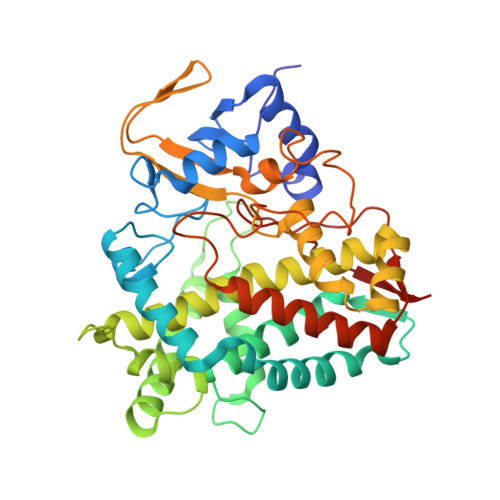
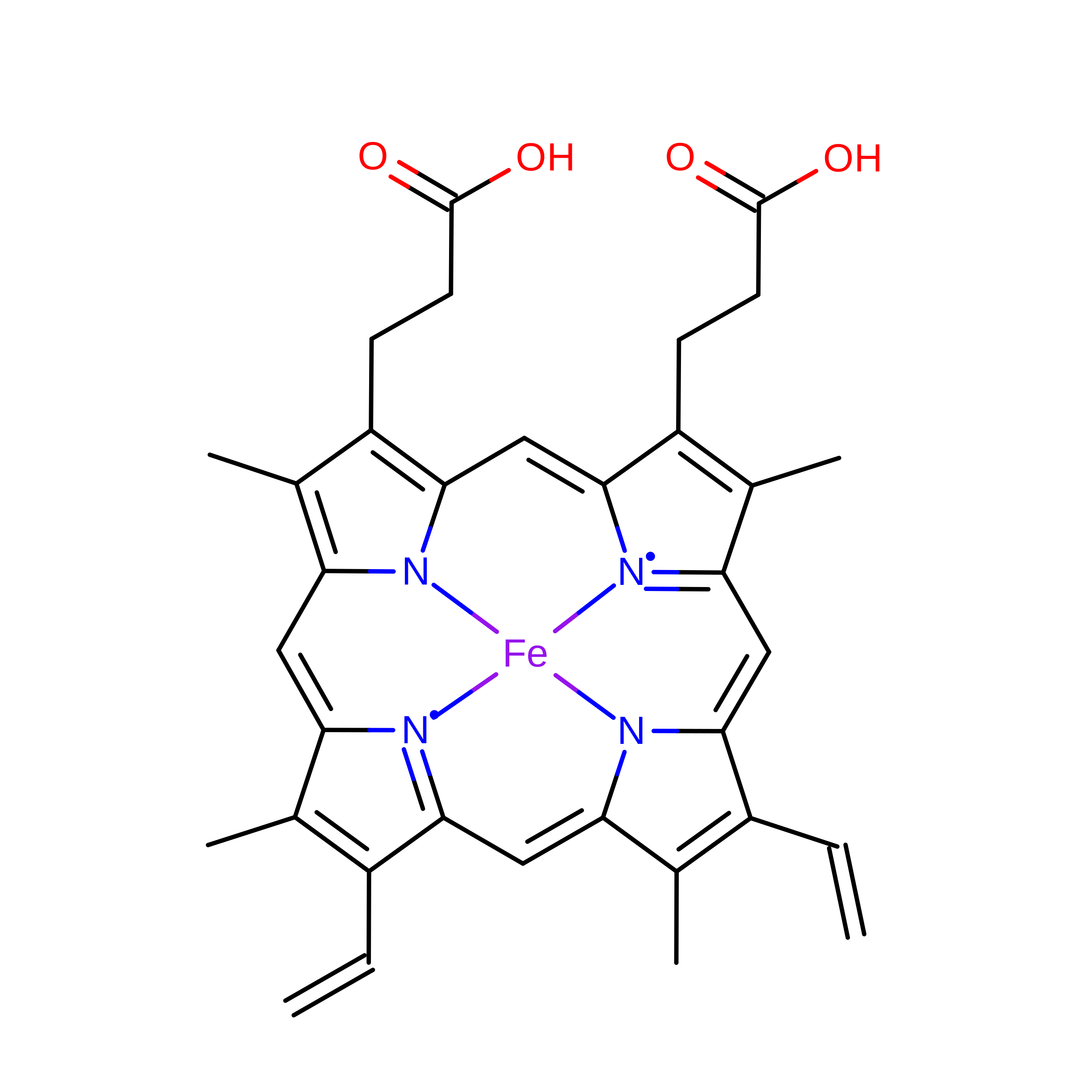
Biosynthesis is an environmentally benign and renewable approach that can be used to produce a broad range of natural and, in some cases, new-to-nature products. However, biology lacks many of the reactions that are available to synthetic chemists, resulting in a narrower scope of accessible products when using biosynthesis rather than synthetic chemistry. A prime example of such chemistry is carbene-transfer reactions 1 . Although it was recently shown that carbene-transfer reactions can be performed in a cell and used for biosynthesis 2,3 , carbene donors and unnatural cofactors needed to be added exogenously and transported into cells to effect the desired reactions, precluding cost-effective scale-up of the biosynthesis process with these reactions. Here we report the access to a diazo ester carbene precursor by cellular metabolism and a microbial platform for introducing unnatural carbene-transfer reactions into biosynthesis. The α-diazoester azaserine was produced by expressing a biosynthetic gene cluster in Streptomyces albus. The intracellularly produced azaserine was used as a carbene donor to cyclopropanate another intracellularly produced molecule-styrene. The reaction was catalysed by engineered P450 mutants containing a native cofactor with excellent diastereoselectivity and a moderate yield. Our study establishes a scalable, microbial platform for conducting intracellular abiological carbene-transfer reactions to functionalize a range of natural and new-to-nature products and expands the scope of organic products that can be produced by cellular metabolism.
- Biological Systems and Engineering Division, Lawrence Berkeley National Laboratory, Berkeley, CA, USA.
Organizational Affiliation: