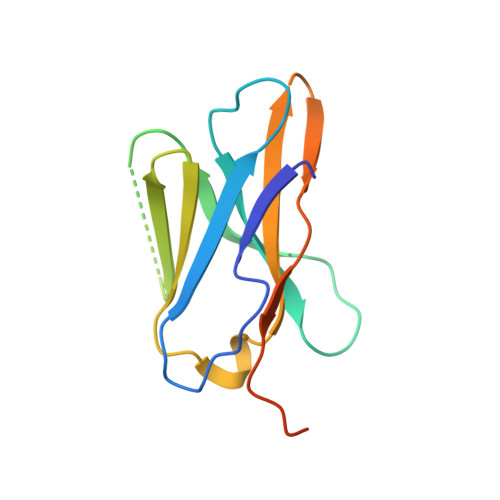
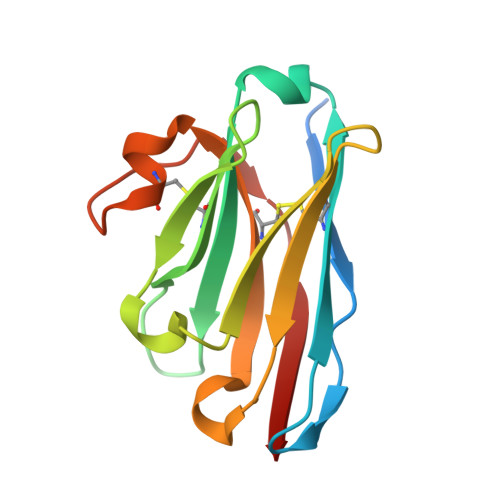
8EW6 | pdb_00008ew6

Anti-human CD8 VHH complex with CD8 alpha


Experimental Data Snapshot

  • Method: X-RAY DIFFRACTION
  • Resolution: 1.90 Å
  • R-Value Free: 
    0.245 (Depositor), 0.254 (DCC) 
  • R-Value Work: 
    0.200 (Depositor) 
  • R-Value Observed: 
    0.202 (Depositor) 

wwPDB Validation 3D Report Full Report

Validation slider image for 8EW6

This is version 1.2 of the entry. See complete history

Literature

Development of an 18 F-labeled anti-human CD8 VHH for same-day immunoPET imaging.

Sriraman, S.K.Davies, C.W.Gill, H.Kiefer, J.R.Yin, J.Ogasawara, A.Urrutia, A.Javinal, V.Lin, Z.Seshasayee, D.Abraham, R.Haas, P.Koth, C.Marik, J.Koerber, J.T.Williams, S.P.

(2023) Eur J Nucl Med Mol Imaging 50: 679-691

  • DOI: https://doi.org/10.1007/s00259-022-05998-0
  • Primary Citation Related Structures: 
    8EW6

  • PubMed Abstract: 

    Cancer immunotherapies (CITs) have revolutionized the treatment of certain cancers, but many patients fail to respond or relapse from current therapies, prompting the need for new CIT agents. CD8 + T cells play a central role in the activity of many CITs, and thus, the rapid imaging of CD8 + cells could provide a critical biomarker for new CIT agents. However, existing 89 Zr-labeled CD8 PET imaging reagents exhibit a long circulatory half-life and high radiation burden that limit potential applications such as same-day and longitudinal imaging. To this end, we discovered and developed a 13-kDa single-domain antibody (VHH5v2) against human CD8 to enable high-quality, same-day imaging with a reduced radiation burden. To enable sensitive and rapid imaging, we employed a site-specific conjugation strategy to introduce an 18 F radiolabel to the VHH. The anti-CD8 VHH, VHH5v2, demonstrated binding to a membrane distal epitope of human CD8 with a binding affinity (K D ) of 500 pM. Subsequent imaging experiments in several xenografts that express varying levels of CD8 demonstrated rapid tumor uptake and fast clearance from the blood. High-quality images were obtained within 1 h post-injection and could quantitatively differentiate the tumor models based on CD8 expression level. Our work reveals the potential of this anti-human CD8 VHH [ 18 F]F-VHH5v2 to enable rapid and specific imaging of CD8 + cells in the clinic.


  • Organizational Affiliation
    • Department of Biomedical Imaging, Genentech, Inc, 1 DNA Way, South San Francisco, Genetech, CA, 94080, USA.

Macromolecule Content 

  • Total Structure Weight: 29.58 kDa 
  • Atom Count: 1,881 
  • Modeled Residue Count: 230 
  • Deposited Residue Count: 266 
  • Unique protein chains: 2

Macromolecules

Find similar proteins by:|  3D Structure
Entity ID: 1
MoleculeChains  Sequence LengthOrganismDetailsImage
T-cell surface glycoprotein CD8 alpha chainA [auth W]129Homo sapiensMutation(s): 0 
Gene Names: CD8AMAL
UniProt & NIH Common Fund Data Resources
Find proteins for P01732 (Homo sapiens)
Explore P01732 
Go to UniProtKB:  P01732
PHAROS:  P01732
GTEx:  ENSG00000153563 
Entity Groups
Sequence Clusters30% Identity50% Identity70% Identity90% Identity95% Identity100% Identity
UniProt GroupP01732
Sequence Annotations
Expand
Reference Sequence
Find similar proteins by:|  3D Structure
Entity ID: 2
MoleculeChains  Sequence LengthOrganismDetailsImage
Anti-CD8 alpha VHHB [auth V]137Lama glamaMutation(s): 0 

Experimental Data & Validation

Experimental Data

  • Method: X-RAY DIFFRACTION
  • Resolution: 1.90 Å
  • R-Value Free:  0.245 (Depositor), 0.254 (DCC) 
  • R-Value Work:  0.200 (Depositor) 
  • R-Value Observed: 0.202 (Depositor) 
Space Group: C 1 2 1
Unit Cell:
Length ( Å )Angle ( ˚ )
a = 57.115α = 90
b = 83.554β = 98.48
c = 51.302γ = 90
Software Package:
Software NamePurpose
HKL-2000data reduction
SCALEPACKdata scaling
PHENIXrefinement
PDB_EXTRACTdata extraction
PHASERphasing

Structure Validation

View Full Validation Report


Entry History 

& Funding Information

Deposition Data


Funding OrganizationLocationGrant Number
Not funded--

Revision History  (Full details and data files)

  • Version 1.0: 2022-11-23
    Type: Initial release
  • Version 1.1: 2023-02-01
    Changes: Database references
  • Version 1.2: 2024-11-13
    Changes: Data collection, Structure summary