8EQU | pdb_00008equ

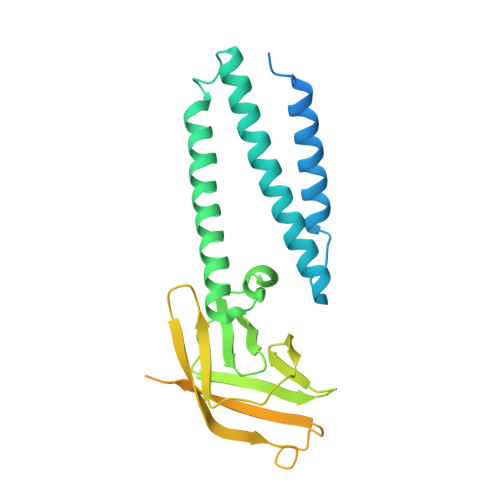
Structure of SARS-CoV-2 Orf3a in late endosome/lysosome-like environment, Saposin A nanodisc


Experimental Data Snapshot

  • Method: ELECTRON MICROSCOPY
  • Resolution: 2.80 Å
  • Aggregation State: PARTICLE 
  • Reconstruction Method: SINGLE PARTICLE 

wwPDB Validation 3D Report Full Report

Validation slider image for 8EQU

This is version 1.0 of the entry. See complete history

Literature

The SARS-CoV-2 accessory protein Orf3a is not an ion channel, but does interact with trafficking proteins.

Miller, A.N.Houlihan, P.R.Matamala, E.Cabezas-Bratesco, D.Lee, G.Y.Cristofori-Armstrong, B.Dilan, T.L.Sanchez-Martinez, S.Matthies, D.Yan, R.Yu, Z.Ren, D.Brauchi, S.E.Clapham, D.E.

(2023) Elife 12

  • DOI: https://doi.org/10.7554/eLife.84477
  • Primary Citation Related Structures: 
    8EQJ, 8EQS, 8EQT, 8EQU

  • PubMed Abstract: 

    The severe acute respiratory syndrome associated coronavirus 2 (SARS-CoV-2) and SARS-CoV-1 accessory protein Orf3a colocalizes with markers of the plasma membrane, endocytic pathway, and Golgi apparatus. Some reports have led to annotation of both Orf3a proteins as viroporins. Here, we show that neither SARS-CoV-2 nor SARS-CoV-1 Orf3a form functional ion conducting pores and that the conductances measured are common contaminants in overexpression and with high levels of protein in reconstitution studies. Cryo-EM structures of both SARS-CoV-2 and SARS-CoV-1 Orf3a display a narrow constriction and the presence of a positively charged aqueous vestibule, which would not favor cation permeation. We observe enrichment of the late endosomal marker Rab7 upon SARS-CoV-2 Orf3a overexpression, and co-immunoprecipitation with VPS39. Interestingly, SARS-CoV-1 Orf3a does not cause the same cellular phenotype as SARS-CoV-2 Orf3a and does not interact with VPS39. To explain this difference, we find that a divergent, unstructured loop of SARS-CoV-2 Orf3a facilitates its binding with VPS39, a HOPS complex tethering protein involved in late endosome and autophagosome fusion with lysosomes. We suggest that the added loop enhances SARS-CoV-2 Orf3a's ability to co-opt host cellular trafficking mechanisms for viral exit or host immune evasion.


  • Organizational Affiliation
    • Janelia Research Campus, Ashburn, United States.

Macromolecule Content 

  • Total Structure Weight: 124.79 kDa 
  • Atom Count: 5,764 
  • Modeled Residue Count: 858 
  • Deposited Residue Count: 1,190 
  • Unique protein chains: 3

Macromolecules

Find similar proteins by:|  3D Structure
Entity ID: 1
MoleculeChains  Sequence LengthOrganismDetailsImage
ORF3a protein
A, B
331Severe acute respiratory syndrome coronavirus 2Mutation(s): 0 
Gene Names: 3a
Membrane Entity: Yes 
UniProt
Find proteins for P0DTC3 (Severe acute respiratory syndrome coronavirus 2)
Explore P0DTC3 
Go to UniProtKB:  P0DTC3
Entity Groups
Sequence Clusters30% Identity50% Identity70% Identity90% Identity95% Identity100% Identity
UniProt GroupP0DTC3
Sequence Annotations
Expand
Reference Sequence
Find similar proteins by:|  3D Structure
Entity ID: 2
MoleculeChains  Sequence LengthOrganismDetailsImage
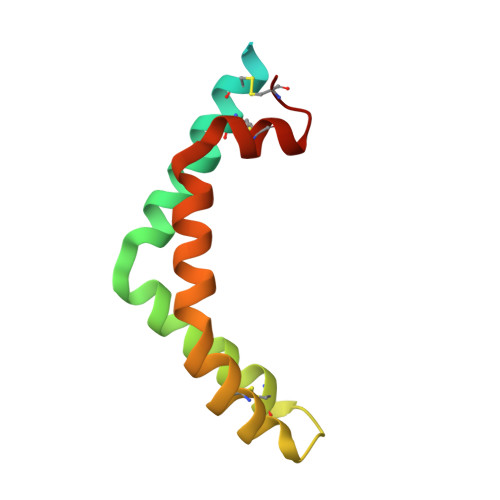
Saposin-A
C, F
106Homo sapiensMutation(s): 0 
Gene Names: PSAPGLBASAP1
Membrane Entity: Yes 
UniProt & NIH Common Fund Data Resources
Find proteins for P07602 (Homo sapiens)
Explore P07602 
Go to UniProtKB:  P07602
PHAROS:  P07602
GTEx:  ENSG00000197746 
Entity Groups
Sequence Clusters30% Identity50% Identity70% Identity90% Identity95% Identity100% Identity
UniProt GroupP07602
Sequence Annotations
Expand
Reference Sequence
Find similar proteins by:|  3D Structure
Entity ID: 3
MoleculeChains  Sequence LengthOrganismDetailsImage
Saposin A, polyalanine model
D, E, G, H
79Homo sapiensMutation(s): 0 

Small Molecules

Experimental Data & Validation

Experimental Data

  • Method: ELECTRON MICROSCOPY
  • Resolution: 2.80 Å
  • Aggregation State: PARTICLE 
  • Reconstruction Method: SINGLE PARTICLE 

Structure Validation

View Full Validation Report


Entry History 

& Funding Information

Deposition Data


Funding OrganizationLocationGrant Number
Howard Hughes Medical Institute (HHMI)United States--

Revision History  (Full details and data files)

  • Version 1.0: 2023-02-08
    Type: Initial release