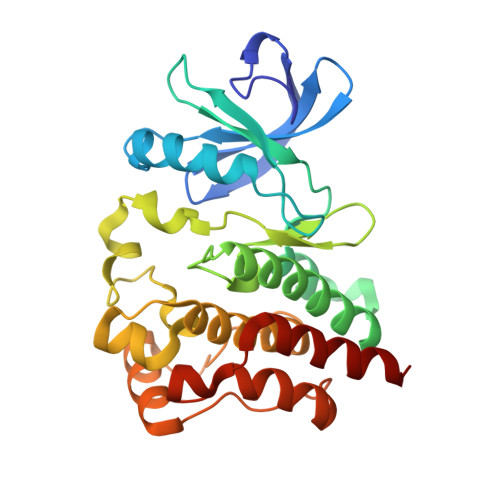
8EJB | pdb_00008ejb

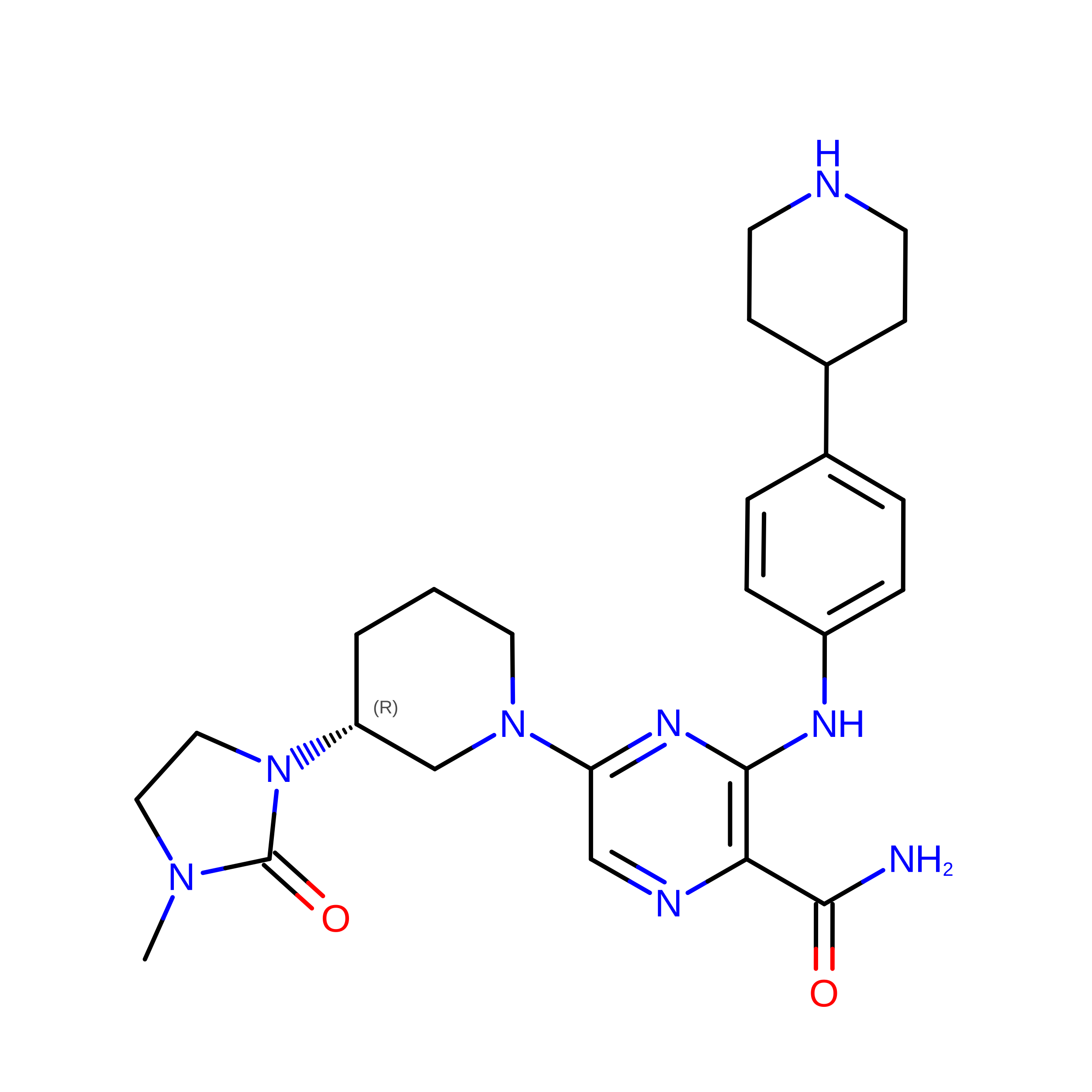
Bruton's tyrosine kinase in complex with 3-{[4-(1-acetylpiperidin-4-yl)phenyl]amino}-5-[(3R)-3-(3-methyl-2-oxoimidazolidin-1-yl)piperidin-1-yl]pyrazine-2-carboxamide


Experimental Data Snapshot

  • Method: X-RAY DIFFRACTION
  • Resolution: 1.58 Å
  • R-Value Free: 
    0.191 (Depositor), 0.193 (DCC) 
  • R-Value Work: 
    0.168 (Depositor), 0.169 (DCC) 
  • R-Value Observed: 
    0.169 (Depositor) 

Starting Model: experimental
View more details

wwPDB Validation 3D Report Full Report

Validation slider image for 8EJB

Ligand Structure Quality Assessment 


This is version 1.2 of the entry. See complete history

Literature

NRX-0492 degrades wild-type and C481 mutant BTK and demonstrates in vivo activity in CLL patient-derived xenografts.

Zhang, D.Harris, H.M.Chen, J.Judy, J.James, G.Kelly, A.McIntosh, J.Tenn-McClellan, A.Ambing, E.Tan, Y.S.Lu, H.Gajewski, S.Clifton, M.C.Yung, S.Robbins, D.W.Pirooznia, M.Skanland, S.S.Gaglione, E.Mhibik, M.Underbayev, C.Ahn, I.E.Sun, C.Herman, S.E.M.Noviski, M.Wiestner, A.

(2023) Blood 141: 1584-1596

  • DOI: https://doi.org/10.1182/blood.2022016934
  • Primary Citation Related Structures: 
    8EJB

  • PubMed Abstract: 

    Bruton tyrosine kinase (BTK) is essential for B-cell receptor (BCR) signaling, a driver of chronic lymphocytic leukemia (CLL). Covalent inhibitors bind C481 in the active site of BTK and have become a preferred CLL therapy. Disease progression on covalent BTK inhibitors is commonly associated with C481 mutations. Here, we investigated a targeted protein degrader, NRX-0492, that links a noncovalent BTK-binding domain to cereblon, an adaptor protein of the E3 ubiquitin ligase complex. NRX-0492 selectively catalyzes ubiquitylation and proteasomal degradation of BTK. In primary CLL cells, NRX-0492 induced rapid and sustained degradation of both wild-type and C481 mutant BTK at half maximal degradation concentration (DC50) of ≤0.2 nM and DC90 of ≤0.5 nM, respectively. Sustained degrader activity was maintained for at least 24 hours after washout and was equally observed in high-risk (deletion 17p) and standard-risk (deletion 13q only) CLL subtypes. In in vitro testing against treatment-naïve CLL samples, NRX-0492 was as effective as ibrutinib at inhibiting BCR-mediated signaling, transcriptional programs, and chemokine secretion. In patient-derived xenografts, orally administered NRX-0492 induced BTK degradation and inhibited activation and proliferation of CLL cells in blood and spleen and remained efficacious against primary C481S mutant CLL cells collected from a patient progressing on ibrutinib. Oral bioavailability, >90% degradation of BTK at subnanomolar concentrations, and sustained pharmacodynamic effects after drug clearance make this class of targeted protein degraders uniquely suitable for clinical translation, in particular as a strategy to overcome BTK inhibitor resistance. Clinical studies testing this approach have been initiated (NCT04830137, NCT05131022).


  • Organizational Affiliation
    • Laboratory of Lymphoid Malignancies, Hematology Branch, National Heart, Lung, and Blood Institute, National Institutes of Health, Bethesda, MD.

Macromolecule Content 

  • Total Structure Weight: 32.26 kDa 
  • Atom Count: 2,571 
  • Modeled Residue Count: 270 
  • Deposited Residue Count: 270 
  • Unique protein chains: 1

Macromolecules

Find similar proteins by:|  3D Structure
Entity ID: 1
MoleculeChains  Sequence LengthOrganismDetailsImage
Tyrosine-protein kinase BTK270Homo sapiensMutation(s): 0 
Gene Names: BTKAGMX1ATKBPK
EC: 2.7.10.2
UniProt & NIH Common Fund Data Resources
Find proteins for Q06187 (Homo sapiens)
Explore Q06187 
Go to UniProtKB:  Q06187
PHAROS:  Q06187
GTEx:  ENSG00000010671 
Entity Groups
Sequence Clusters30% Identity50% Identity70% Identity90% Identity95% Identity100% Identity
UniProt GroupQ06187
Sequence Annotations
Expand
Reference Sequence

Small Molecules

Ligands 4 Unique
IDChains Name / Formula / InChI Key2D Diagram3D Interactions
WKC
(Subject of Investigation/LOI)

Query on WKC


Download:Ideal Coordinates CCD File
B [auth A]5-[(3R)-3-(3-methyl-2-oxoimidazolidin-1-yl)piperidin-1-yl]-3-[4-(piperidin-4-yl)anilino]pyrazine-2-carboxamide
C25 H34 N8 O2
JCGXVYWABUYORV-HXUWFJFHSA-N
PD

Query on PD


Download:Ideal Coordinates CCD File
E [auth A]PALLADIUM ION
Pd
MUJIDPITZJWBSW-UHFFFAOYSA-N
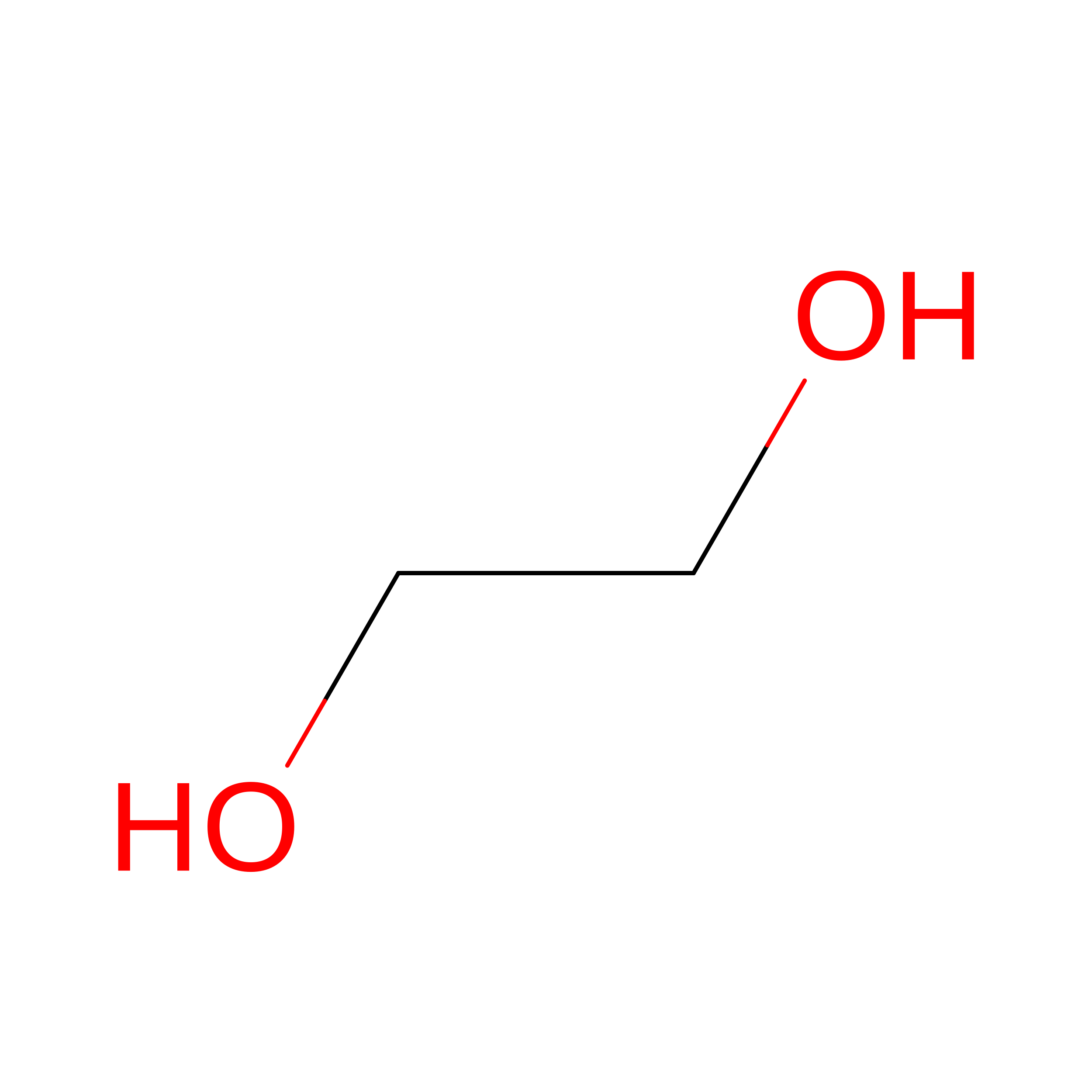
EDO

Query on EDO


Download:Ideal Coordinates CCD File
C [auth A],
D [auth A]
1,2-ETHANEDIOL
C2 H6 O2
LYCAIKOWRPUZTN-UHFFFAOYSA-N
CL

Query on CL


Download:Ideal Coordinates CCD File
F [auth A]CHLORIDE ION
Cl
VEXZGXHMUGYJMC-UHFFFAOYSA-M
Binding Affinity Annotations 
IDSourceBinding Affinity
WKC BindingDB:  8EJB IC50: min: 10, max: 10 (nM) from 2 assay(s)

Experimental Data & Validation

Experimental Data

  • Method: X-RAY DIFFRACTION
  • Resolution: 1.58 Å
  • R-Value Free:  0.191 (Depositor), 0.193 (DCC) 
  • R-Value Work:  0.168 (Depositor), 0.169 (DCC) 
  • R-Value Observed: 0.169 (Depositor) 
Space Group: P 21 21 21
Unit Cell:
Length ( Å )Angle ( ˚ )
a = 38.21α = 90
b = 76.24β = 90
c = 105.87γ = 90
Software Package:
Software NamePurpose
PHENIXrefinement
XDSdata reduction
Aimlessdata scaling
PHASERphasing

Structure Validation

View Full Validation Report


Ligand Structure Quality Assessment 


Entry History 

& Funding Information

Deposition Data


Funding OrganizationLocationGrant Number
Other privateUnited States--

Revision History  (Full details and data files)

  • Version 1.0: 2023-02-15
    Type: Initial release
  • Version 1.1: 2023-04-12
    Changes: Database references
  • Version 1.2: 2024-05-22
    Changes: Data collection