8EI1 | pdb_00008ei1

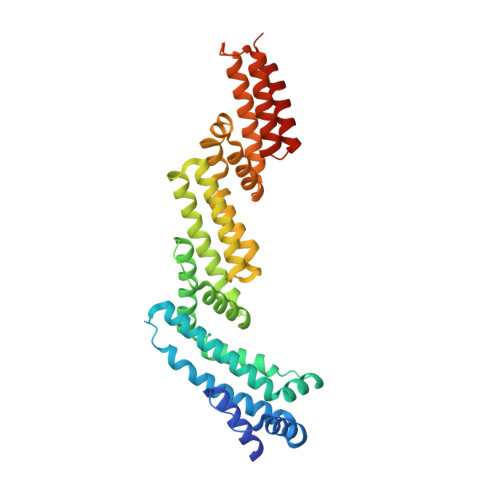
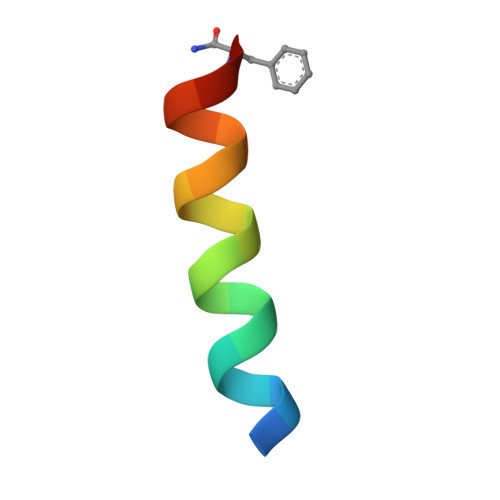
Crystal structure of the N-terminal domain of CUL4B in complex with H316, a Helicon Polypeptide


Experimental Data Snapshot

  • Method: X-RAY DIFFRACTION
  • Resolution: 2.89 Å
  • R-Value Free: 
    0.254 (Depositor), 0.237 (DCC) 
  • R-Value Work: 
    0.212 (Depositor) 
  • R-Value Observed: 
    0.214 (Depositor) 

Starting Model: experimental
View more details

wwPDB Validation 3D Report Full Report

Validation slider image for 8EI1

Ligand Structure Quality Assessment 


This is version 1.3 of the entry. See complete history

Literature

Recognition and reprogramming of E3 ubiquitin ligase surfaces by alpha-helical peptides.

Tokareva, O.S.Li, K.Travaline, T.L.Thomson, T.M.Swiecicki, J.M.Moussa, M.Ramirez, J.D.Litchman, S.Verdine, G.L.McGee, J.H.

(2023) Nat Commun 14: 6992-6992

  • DOI: https://doi.org/10.1038/s41467-023-42395-z
  • Primary Citation Related Structures: 
    8EHZ, 8EI0, 8EI1, 8EI2, 8EI3, 8EI4, 8EI5, 8EI6, 8EI7, 8EI8, 8EI9, 8EIA, 8EIB, 8EIC

  • PubMed Abstract: 

    Molecules that induce novel interactions between proteins hold great promise for the study of biological systems and the development of therapeutics, but their discovery has been limited by the complexities of rationally designing interactions between three components, and because known binders to each protein are typically required to inform initial designs. Here, we report a general and rapid method for discovering α-helically constrained (Helicon) polypeptides that cooperatively induce the interaction between two target proteins without relying on previously known binders or an intrinsic affinity between the proteins. We show that Helicons are capable of binding every major class of E3 ubiquitin ligases, which are of great biological and therapeutic interest but remain largely intractable to targeting by small molecules. We then describe a phage-based screening method for discovering "trimerizer" Helicons, and apply it to reprogram E3s to cooperatively bind an enzyme (PPIA), a transcription factor (TEAD4), and a transcriptional coactivator (β-catenin).


  • Organizational Affiliation
    • FOG Pharmaceuticals Inc., Cambridge, MA, USA.

Macromolecule Content 

  • Total Structure Weight: 176.68 kDa 
  • Atom Count: 11,809 
  • Modeled Residue Count: 1,429 
  • Deposited Residue Count: 1,492 
  • Unique protein chains: 2

Macromolecules

Find similar proteins by:|  3D Structure
Entity ID: 1
MoleculeChains  Sequence LengthOrganismDetailsImage
Cullin-4B
A, B, C, D
354Homo sapiensMutation(s): 0 
Gene Names: CUL4BKIAA0695
UniProt & NIH Common Fund Data Resources
Find proteins for Q13620 (Homo sapiens)
Explore Q13620 
Go to UniProtKB:  Q13620
PHAROS:  Q13620
GTEx:  ENSG00000158290 
Entity Groups
Sequence Clusters30% Identity50% Identity70% Identity90% Identity95% Identity100% Identity
UniProt GroupQ13620
Sequence Annotations
Expand
Reference Sequence
Find similar proteins by:  Sequence   |   3D Structure  
Entity ID: 2
MoleculeChains  Sequence LengthOrganismDetailsImage
H316
E, F, G, H
19synthetic constructMutation(s): 0 

Experimental Data & Validation

Experimental Data

  • Method: X-RAY DIFFRACTION
  • Resolution: 2.89 Å
  • R-Value Free:  0.254 (Depositor), 0.237 (DCC) 
  • R-Value Work:  0.212 (Depositor) 
  • R-Value Observed: 0.214 (Depositor) 
Space Group: P 43 21 2
Unit Cell:
Length ( Å )Angle ( ˚ )
a = 99.65α = 90
b = 99.65β = 90
c = 366.49γ = 90
Software Package:
Software NamePurpose
PHENIXrefinement
PDB_EXTRACTdata extraction
XDSdata reduction
Aimlessdata scaling
PHASERphasing

Structure Validation

View Full Validation Report


Ligand Structure Quality Assessment 


Entry History 

& Funding Information

Deposition Data


Funding OrganizationLocationGrant Number
Other privateUnited States--

Revision History  (Full details and data files)

  • Version 1.0: 2023-10-25
    Type: Initial release
  • Version 1.1: 2023-11-15
    Changes: Database references
  • Version 1.2: 2024-11-13
    Changes: Structure summary
  • Version 1.3: 2026-03-04
    Changes: Refinement description