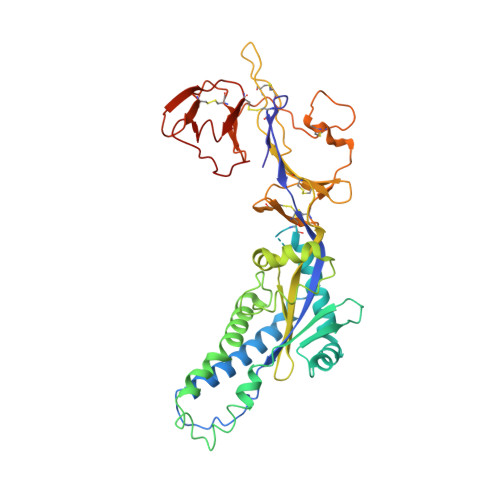
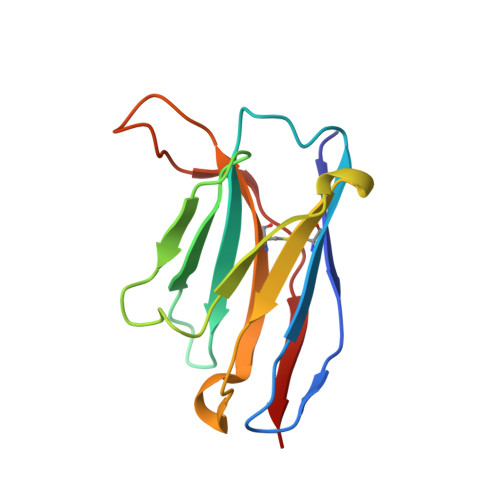
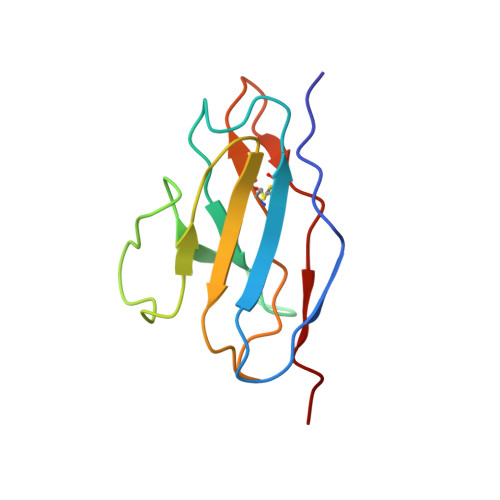
8EAY | pdb_00008eay

HMPV F complex with 4I3 Fab


Experimental Data Snapshot

  • Method: ELECTRON MICROSCOPY
  • Resolution: 3.33 Å
  • Aggregation State: PARTICLE 
  • Reconstruction Method: SINGLE PARTICLE 

Starting Model: experimental
View more details

wwPDB Validation 3D Report Full Report

Validation slider image for 8EAY

This is version 1.2 of the entry. See complete history. 

Literature

Potent cross-neutralization of respiratory syncytial virus and human metapneumovirus through a structurally conserved antibody recognition mode.

Wen, X., Suryadevara, N., Kose, N., Liu, J., Zhan, X., Handal, L.S., Williamson, L.E., Trivette, A., Carnahan, R.H., Jardetzky, T.S., Crowe Jr., J.E.

(2023) Cell Host Microbe 31: 1288-1300.e6

  • DOI: https://doi.org/10.1016/j.chom.2023.07.002
  • Primary Citation Related Structures: 
    8DZW, 8E2U, 8EAY, 8EBP

  • PubMed Abstract: 

    Respiratory syncytial virus (RSV) and human metapneumovirus (hMPV) infections pose a significant health burden. Using pre-fusion conformation fusion (F) proteins, we isolated a panel of anti-F antibodies from a human donor. One antibody (RSV-199) potently cross-neutralized 8 RSV and hMPV strains by recognizing antigenic site III, which is partially conserved in RSV and hMPV F. Next, we determined the cryoelectron microscopy (cryo-EM) structures of RSV-199 bound to RSV F trimers, hMPV F monomers, and an unexpected dimeric form of hMPV F. These structures revealed how RSV-199 engages both RSV and hMPV F proteins through conserved interactions of the antibody heavy-chain variable region and how variability within heavy-chain complementarity-determining region 3 (HCDR3) can be accommodated at the F protein interface in site-III-directed antibodies. Furthermore, RSV-199 offered enhanced protection against RSV A and B strains and hMPV in cotton rats. These findings highlight the mechanisms of broad neutralization and therapeutic potential of RSV-199.


  • Organizational Affiliation: 
    • Department of Structural Biology, Stanford University School of Medical School, Stanford, CA 94305, USA.

Macromolecule Content 

  • Total Structure Weight: 69.86 kDa 
  • Atom Count: 4,761 
  • Modeled Residue Count: 626 
  • Deposited Residue Count: 642 
  • Unique protein chains: 3

Macromolecules

Find similar proteins by:|  3D Structure
Entity ID: 1
MoleculeChains  Sequence LengthOrganismDetailsImage
Fusion glycoprotein F0414Human metapneumovirus AMutation(s): 0 
UniProt
Find proteins for Q8B9P0 (human metapneumovirus)
Explore Q8B9P0 
Go to UniProtKB:  Q8B9P0
Entity Groups
Sequence Clusters30% Identity50% Identity70% Identity90% Identity95% Identity100% Identity
UniProt GroupQ8B9P0
Sequence Annotations
Expand
Reference Sequence
Find similar proteins by:|  3D Structure
Entity ID: 2
MoleculeChains  Sequence LengthOrganismDetailsImage
4I3 heavy chain proteinB [auth H]121Homo sapiensMutation(s): 0 
Entity Groups
Sequence Clusters30% Identity50% Identity70% Identity90% Identity95% Identity100% Identity
Sequence Annotations
Expand
Reference Sequence
Find similar proteins by:|  3D Structure
Entity ID: 3
MoleculeChains  Sequence LengthOrganismDetailsImage
4I3 light chain proteinC [auth L]107Homo sapiensMutation(s): 0 
Entity Groups
Sequence Clusters30% Identity50% Identity70% Identity90% Identity95% Identity100% Identity
Sequence Annotations
Expand
Reference Sequence

Experimental Data & Validation

Experimental Data

  • Method: ELECTRON MICROSCOPY
  • Resolution: 3.33 Å
  • Aggregation State: PARTICLE 
  • Reconstruction Method: SINGLE PARTICLE 
EM Software:
TaskSoftware PackageVersion
RECONSTRUCTIONCoot
MODEL REFINEMENTPHENIX

Structure Validation

View Full Validation Report


Entry History 

& Funding Information

Deposition Data


Funding OrganizationLocationGrant Number
National Institutes of Health/National Institute Of Allergy and Infectious Diseases (NIH/NIAID)United StatesR01AI137523

Revision History  (Full details and data files)

  • Version 1.0: 2023-08-16
    Type: Initial release
  • Version 1.1: 2023-08-23
    Changes: Database references
  • Version 1.2: 2024-11-13
    Changes: Data collection, Refinement description, Structure summary