8E1A | pdb_00008e1a

Structure-based study to overcome cross-reactivity of novel androgen receptor inhibitors


Experimental Data Snapshot

  • Method: X-RAY DIFFRACTION
  • Resolution: 1.20 Å
  • R-Value Free: 
    0.151 (Depositor), 0.167 (DCC) 
  • R-Value Work: 
    0.124 (Depositor) 
  • R-Value Observed: 
    0.126 (Depositor) 

Starting Model: other
View more details

wwPDB Validation 3D Report Full Report

Validation slider image for 8E1A

Ligand Structure Quality Assessment 


This is version 1.4 of the entry. See complete history

Literature

Structure-Based Study to Overcome Cross-Reactivity of Novel Androgen Receptor Inhibitors.

Radaeva, M.Li, H.LeBlanc, E.Dalal, K.Ban, F.Ciesielski, F.Chow, B.Morin, H.Awrey, S.Singh, K.Rennie, P.S.Lallous, N.Cherkasov, A.

(2022) Cells 11

  • DOI: https://doi.org/10.3390/cells11182785
  • Primary Citation Related Structures: 
    8E1A

  • PubMed Abstract: 

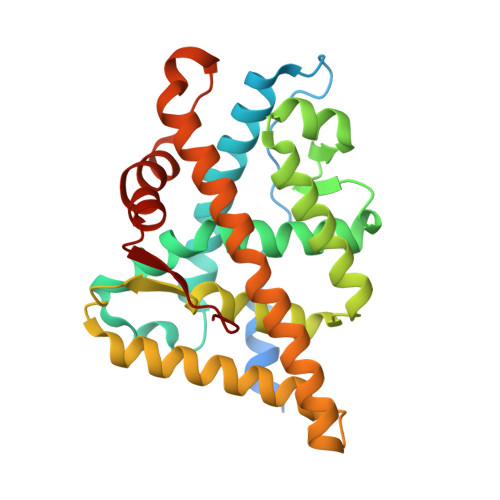
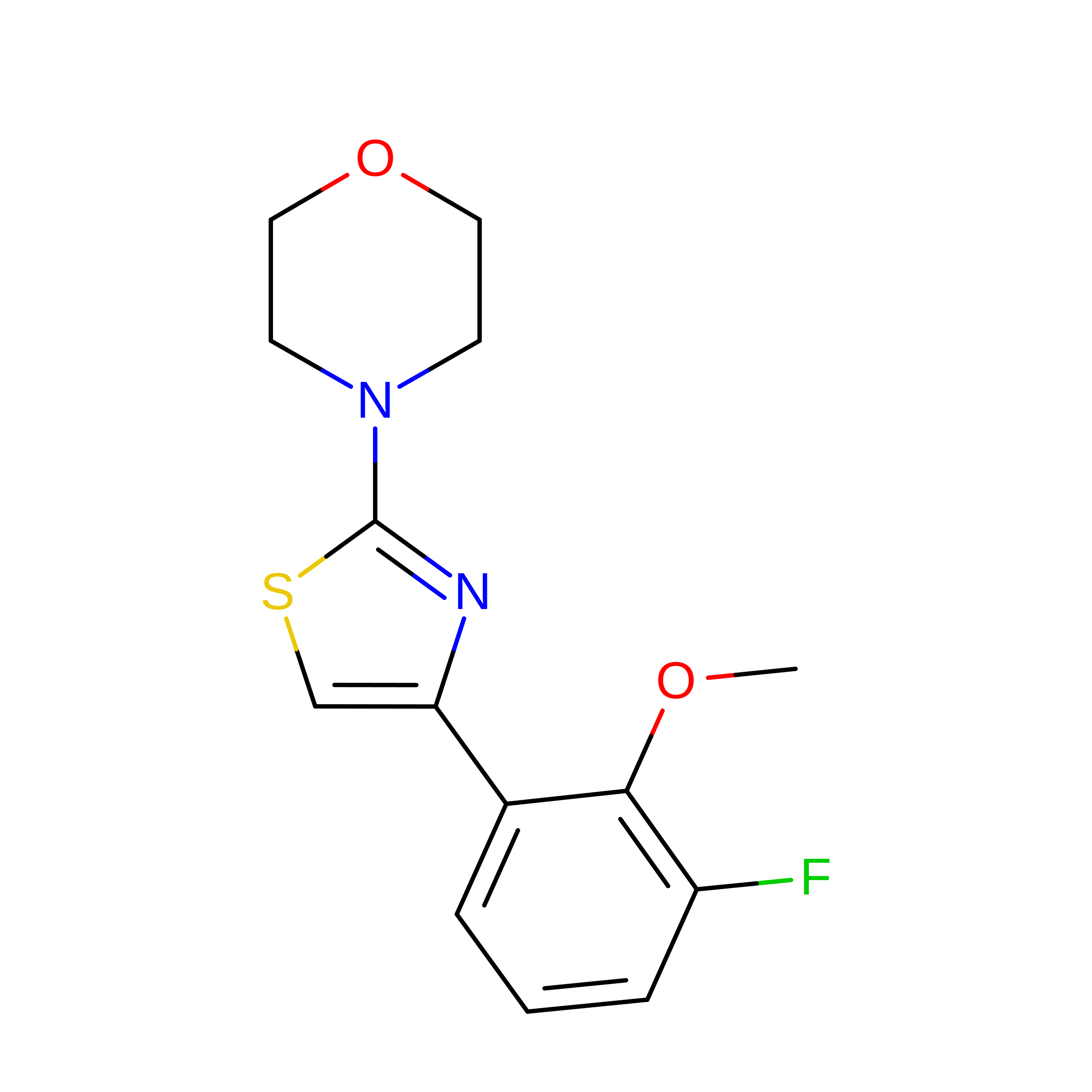
    The mutation-driven transformation of clinical anti-androgen drugs into agonists of the human androgen receptor (AR) represents a major challenge for the treatment of prostate cancer patients. To address this challenge, we have developed a novel class of inhibitors targeting the DNA-binding domain (DBD) of the receptor, which is distanced from the androgen binding site (ABS) targeted by all conventional anti-AR drugs and prone to resistant mutations. While many members of the developed 4-(4-phenylthiazol-2-yl)morpholine series of AR-DBD inhibitors demonstrated the effective suppression of wild-type AR, a few represented by 4-(4-(3-fluoro-2-methoxyphenyl)thiazol-2-yl)morpholine (VPC14368) exhibited a partial agonistic effect toward the mutated T878A form of the receptor, implying their cross-interaction with the AR ABS. To study the molecular basis of the observed cross-reactivity, we co-crystallized the T878A mutated form of the AR ligand binding domain (LBD) with a bound VPC14368 molecule. Computational modelling revealed that helix 12 of AR undergoes a characteristic shift upon VPC14368 binding causing the agonistic behaviour. Based on the obtained structural data we then designed derivatives of VPC14368 to successfully eliminate the cross-reactivity towards the AR ABS, while maintaining significant anti-AR DBD potency.


  • Organizational Affiliation
    • Vancouver Prostate Centre, University of British Columbia, 2660 Oak Street, Vancouver, BC V6H 3Z6, Canada.

Macromolecule Content 

  • Total Structure Weight: 32.68 kDa 
  • Atom Count: 2,445 
  • Modeled Residue Count: 250 
  • Deposited Residue Count: 277 
  • Unique protein chains: 1

Macromolecules

Find similar proteins by:|  3D Structure
Entity ID: 1
MoleculeChains  Sequence LengthOrganismDetailsImage
Androgen receptor277Homo sapiensMutation(s): 0 
Gene Names: ARDHTRNR3C4
UniProt & NIH Common Fund Data Resources
Find proteins for P10275 (Homo sapiens)
Explore P10275 
Go to UniProtKB:  P10275
PHAROS:  P10275
GTEx:  ENSG00000169083 
Entity Groups
Sequence Clusters30% Identity50% Identity70% Identity90% Identity95% Identity100% Identity
UniProt GroupP10275
Sequence Annotations
Expand
Reference Sequence

Experimental Data & Validation

Experimental Data

  • Method: X-RAY DIFFRACTION
  • Resolution: 1.20 Å
  • R-Value Free:  0.151 (Depositor), 0.167 (DCC) 
  • R-Value Work:  0.124 (Depositor) 
  • R-Value Observed: 0.126 (Depositor) 
Space Group: P 21 21 21
Unit Cell:
Length ( Å )Angle ( ˚ )
a = 54.953α = 90
b = 65.762β = 90
c = 69.128γ = 90
Software Package:
Software NamePurpose
REFMACrefinement
XDSdata reduction
XDSdata scaling
PHASERphasing

Structure Validation

View Full Validation Report


Ligand Structure Quality Assessment 


Entry History 

& Funding Information

Deposition Data


Funding OrganizationLocationGrant Number
Other privateCanada272111

Revision History  (Full details and data files)

  • Version 1.0: 2022-09-14
    Type: Initial release
  • Version 1.1: 2022-10-05
    Changes: Database references
  • Version 1.2: 2022-11-16
    Changes: Advisory
  • Version 1.3: 2022-11-30
    Changes: Advisory
  • Version 1.4: 2024-04-03
    Changes: Data collection, Refinement description