8DGC | pdb_00008dgc

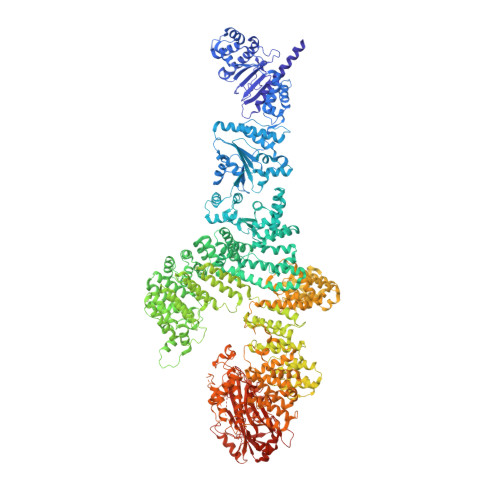
Avs3 bound to phage PhiV-1 terminase


Experimental Data Snapshot

  • Method: ELECTRON MICROSCOPY
  • Resolution: 3.40 Å
  • Aggregation State: PARTICLE 
  • Reconstruction Method: SINGLE PARTICLE 

wwPDB Validation 3D Report Full Report

Validation slider image for 8DGC

This is version 1.3 of the entry. See complete history

Literature

Prokaryotic innate immunity through pattern recognition of conserved viral proteins.

Gao, L.A.Wilkinson, M.E.Strecker, J.Makarova, K.S.Macrae, R.K.Koonin, E.V.Zhang, F.

(2022) Science 377: eabm4096-eabm4096

  • DOI: https://doi.org/10.1126/science.abm4096
  • Primary Citation Related Structures: 
    8DGC, 8DGF

  • PubMed Abstract: 

    Many organisms have evolved specialized immune pattern-recognition receptors, including nucleotide-binding oligomerization domain-like receptors (NLRs) of the STAND superfamily that are ubiquitous in plants, animals, and fungi. Although the roles of NLRs in eukaryotic immunity are well established, it is unknown whether prokaryotes use similar defense mechanisms. Here, we show that antiviral STAND (Avs) homologs in bacteria and archaea detect hallmark viral proteins, triggering Avs tetramerization and the activation of diverse N-terminal effector domains, including DNA endonucleases, to abrogate infection. Cryo-electron microscopy reveals that Avs sensor domains recognize conserved folds, active-site residues, and enzyme ligands, allowing a single Avs receptor to detect a wide variety of viruses. These findings extend the paradigm of pattern recognition of pathogen-specific proteins across all three domains of life.


  • Organizational Affiliation
    • Howard Hughes Medical Institute, Massachusetts Institute of Technology, Cambridge, MA 02139, USA.

Macromolecule Content 

  • Total Structure Weight: 1,216.82 kDa 
  • Atom Count: 81,600 
  • Modeled Residue Count: 10,216 
  • Deposited Residue Count: 10,712 
  • Unique protein chains: 2

Macromolecules

Find similar proteins by:|  3D Structure
Entity ID: 1
MoleculeChains  Sequence LengthOrganismDetailsImage
SeAvs3
A, B, C, D
2,092Salmonella entericaMutation(s): 0 
Find similar proteins by:|  3D Structure
Entity ID: 2
MoleculeChains  Sequence LengthOrganismDetailsImage
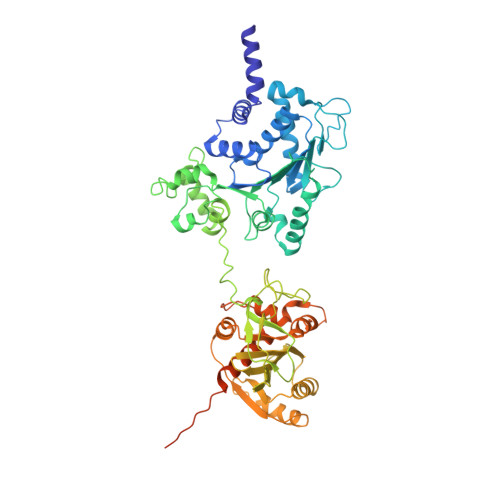
Terminase, large subunit
E, F, G, H
586Escherichia phage PhiV-1Mutation(s): 0 
EC: 3.6.4 (PDB Primary Data), 3.1.21 (PDB Primary Data)
UniProt
Find proteins for A0A7G3WWS0 (Escherichia phage PhiV-1)
Explore A0A7G3WWS0 
Go to UniProtKB:  A0A7G3WWS0
Entity Groups
Sequence Clusters30% Identity50% Identity70% Identity90% Identity95% Identity100% Identity
UniProt GroupA0A7G3WWS0
Sequence Annotations
Expand
Reference Sequence

Small Molecules

Ligands 2 Unique
IDChains Name / Formula / InChI Key2D Diagram3D Interactions
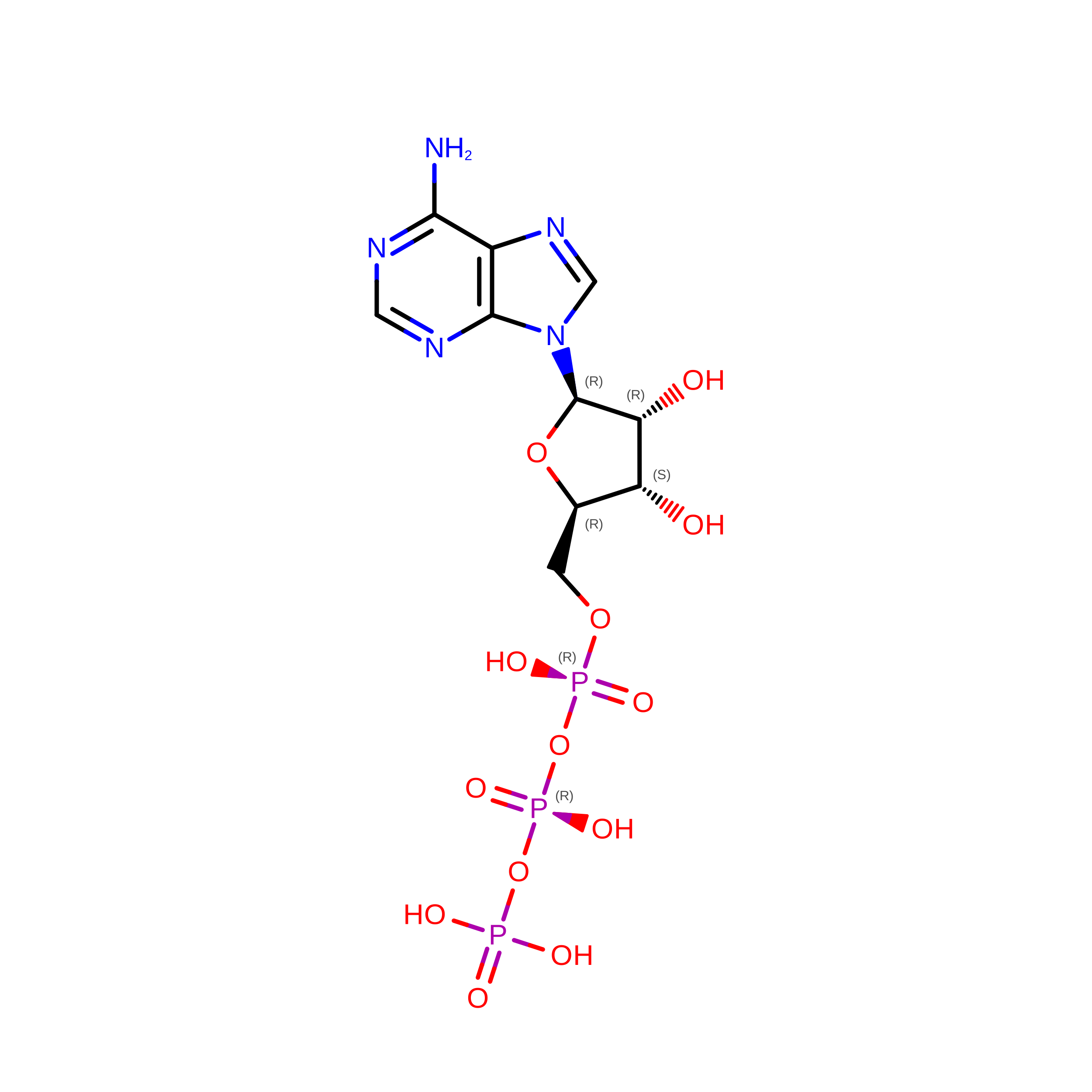
ATP
(Subject of Investigation/LOI)

Query on ATP


Download:Ideal Coordinates CCD File
I [auth A]
K [auth B]
M [auth C]
O [auth D]
Q [auth E]
I [auth A],
K [auth B],
M [auth C],
O [auth D],
Q [auth E],
S [auth F],
U [auth G],
W [auth H]
ADENOSINE-5'-TRIPHOSPHATE
C10 H16 N5 O13 P3
ZKHQWZAMYRWXGA-KQYNXXCUSA-N
MG
(Subject of Investigation/LOI)

Query on MG


Download:Ideal Coordinates CCD File
J [auth A]
L [auth B]
N [auth C]
P [auth D]
R [auth E]
J [auth A],
L [auth B],
N [auth C],
P [auth D],
R [auth E],
T [auth F],
V [auth G],
X [auth H]
MAGNESIUM ION
Mg
JLVVSXFLKOJNIY-UHFFFAOYSA-N

Experimental Data & Validation

Experimental Data

  • Method: ELECTRON MICROSCOPY
  • Resolution: 3.40 Å
  • Aggregation State: PARTICLE 
  • Reconstruction Method: SINGLE PARTICLE 
EM Software:
TaskSoftware PackageVersion
MODEL REFINEMENTPHENIX
RECONSTRUCTIONRELION4.0

Structure Validation

View Full Validation Report


Entry History 

& Funding Information

Deposition Data


Funding OrganizationLocationGrant Number
National Institutes of Health/National Heart, Lung, and Blood Institute (NIH/NHLBI)United States5DP1HL141201-04
National Institutes of Health/National Human Genome Research Institute (NIH/NHGRI)United States2R01HG009761-05
Howard Hughes Medical Institute (HHMI)United States--

Revision History  (Full details and data files)

  • Version 1.0: 2022-08-03
    Type: Initial release
  • Version 1.1: 2022-08-24
    Changes: Database references
  • Version 1.2: 2024-02-14
    Changes: Data collection
  • Version 1.3: 2025-05-14
    Changes: Data collection, Structure summary