8D9O | pdb_00008d9o

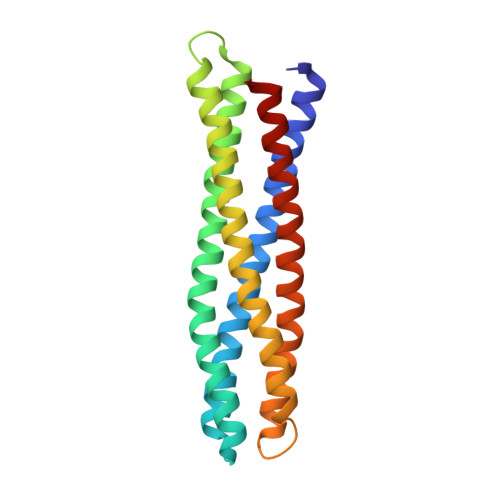
De Novo Photosynthetic Reaction Center Protein in Apo-State


Experimental Data Snapshot

  • Method: X-RAY DIFFRACTION
  • Resolution: 1.78 Å
  • R-Value Free: 
    0.209 (Depositor), 0.208 (DCC) 
  • R-Value Work: 
    0.183 (Depositor), 0.183 (DCC) 
  • R-Value Observed: 
    0.184 (Depositor) 

Starting Model: experimental
View more details

wwPDB Validation 3D Report Full Report

Validation slider image for 8D9O

This is version 1.2 of the entry. See complete history

Literature

Rational design of photosynthetic reaction center protein maquettes.

Ennist, N.M.Stayrook, S.E.Dutton, P.L.Moser, C.C.

(2022) Front Mol Biosci 9: 997295-997295

  • DOI: https://doi.org/10.3389/fmolb.2022.997295
  • Primary Citation Related Structures: 
    8D9O, 8D9P

  • PubMed Abstract: 

    New technologies for efficient solar-to-fuel energy conversion will help facilitate a global shift from dependence on fossil fuels to renewable energy. Nature uses photosynthetic reaction centers to convert photon energy into a cascade of electron-transfer reactions that eventually produce chemical fuel. The design of new reaction centers de novo deepens our understanding of photosynthetic charge separation and may one day allow production of biofuels with higher thermodynamic efficiency than natural photosystems. Recently, we described the multi-step electron-transfer activity of a designed reaction center maquette protein (the RC maquette), which can assemble metal ions, tyrosine, a Zn tetrapyrrole, and heme into an electron-transport chain. Here, we detail our modular strategy for rational protein design and show that the intended RC maquette design agrees with crystal structures in various states of assembly. A flexible, dynamic apo-state collapses by design into a more ordered holo-state upon cofactor binding. Crystal structures illustrate the structural transitions upon binding of different cofactors. Spectroscopic assays demonstrate that the RC maquette binds various electron donors, pigments, and electron acceptors with high affinity. We close with a critique of the present RC maquette design and use electron-tunneling theory to envision a path toward a designed RC with a substantially higher thermodynamic efficiency than natural photosystems.


  • Organizational Affiliation
    • Department of Biochemistry and Biophysics, University of Pennsylvania, Philadelphia, PA, United States.

Macromolecule Content 

  • Total Structure Weight: 23.77 kDa 
  • Atom Count: 1,678 
  • Modeled Residue Count: 194 
  • Deposited Residue Count: 196 
  • Unique protein chains: 1

Macromolecules

Find similar proteins by:|  3D Structure
Entity ID: 1
MoleculeChains  Sequence LengthOrganismDetailsImage
Reaction Center Maquette196synthetic constructMutation(s): 0 

Small Molecules

Ligands 1 Unique
IDChains Name / Formula / InChI Key2D Diagram3D Interactions
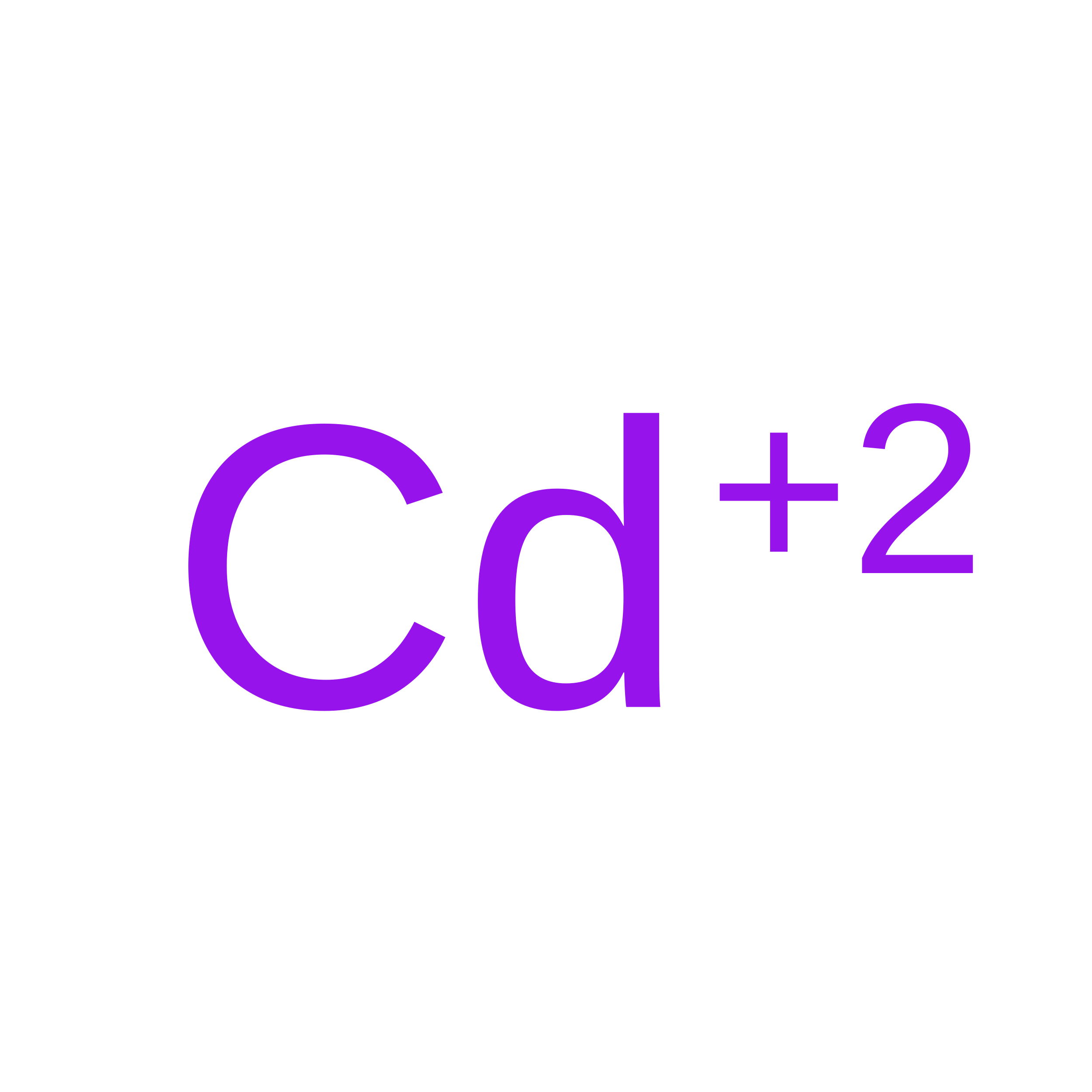
CD
(Subject of Investigation/LOI)

Query on CD


Download:Ideal Coordinates CCD File
B [auth A]
C [auth A]
D [auth A]
E [auth A]
F [auth A]
B [auth A],
C [auth A],
D [auth A],
E [auth A],
F [auth A],
G [auth A],
H [auth A],
I [auth A],
J [auth A],
K [auth A],
L [auth A]
CADMIUM ION
Cd
WLZRMCYVCSSEQC-UHFFFAOYSA-N

Experimental Data & Validation

Experimental Data

  • Method: X-RAY DIFFRACTION
  • Resolution: 1.78 Å
  • R-Value Free:  0.209 (Depositor), 0.208 (DCC) 
  • R-Value Work:  0.183 (Depositor), 0.183 (DCC) 
  • R-Value Observed: 0.184 (Depositor) 
Space Group: C 1 2 1
Unit Cell:
Length ( Å )Angle ( ˚ )
a = 89.692α = 90
b = 23.693β = 99.93
c = 72.756γ = 90
Software Package:
Software NamePurpose
PHENIXrefinement
XDSdata reduction
XSCALEdata scaling
PHASERphasing

Structure Validation

View Full Validation Report


Entry History 

& Funding Information

Deposition Data


Funding OrganizationLocationGrant Number
Department of Energy (DOE, United States)United StatesDESC0001035

Revision History  (Full details and data files)

  • Version 1.0: 2022-09-28
    Type: Initial release
  • Version 1.1: 2022-10-26
    Changes: Database references
  • Version 1.2: 2023-10-18
    Changes: Data collection, Refinement description