8D86 | pdb_00008d86

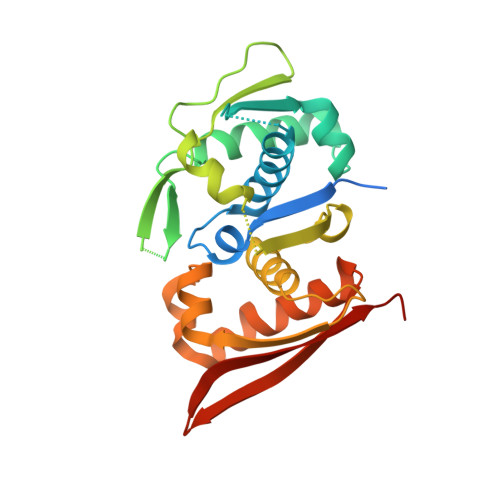
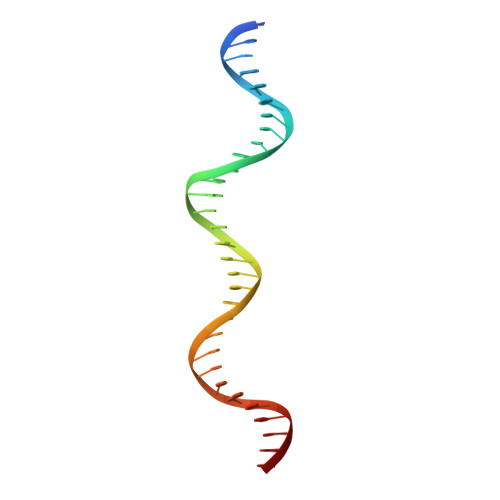
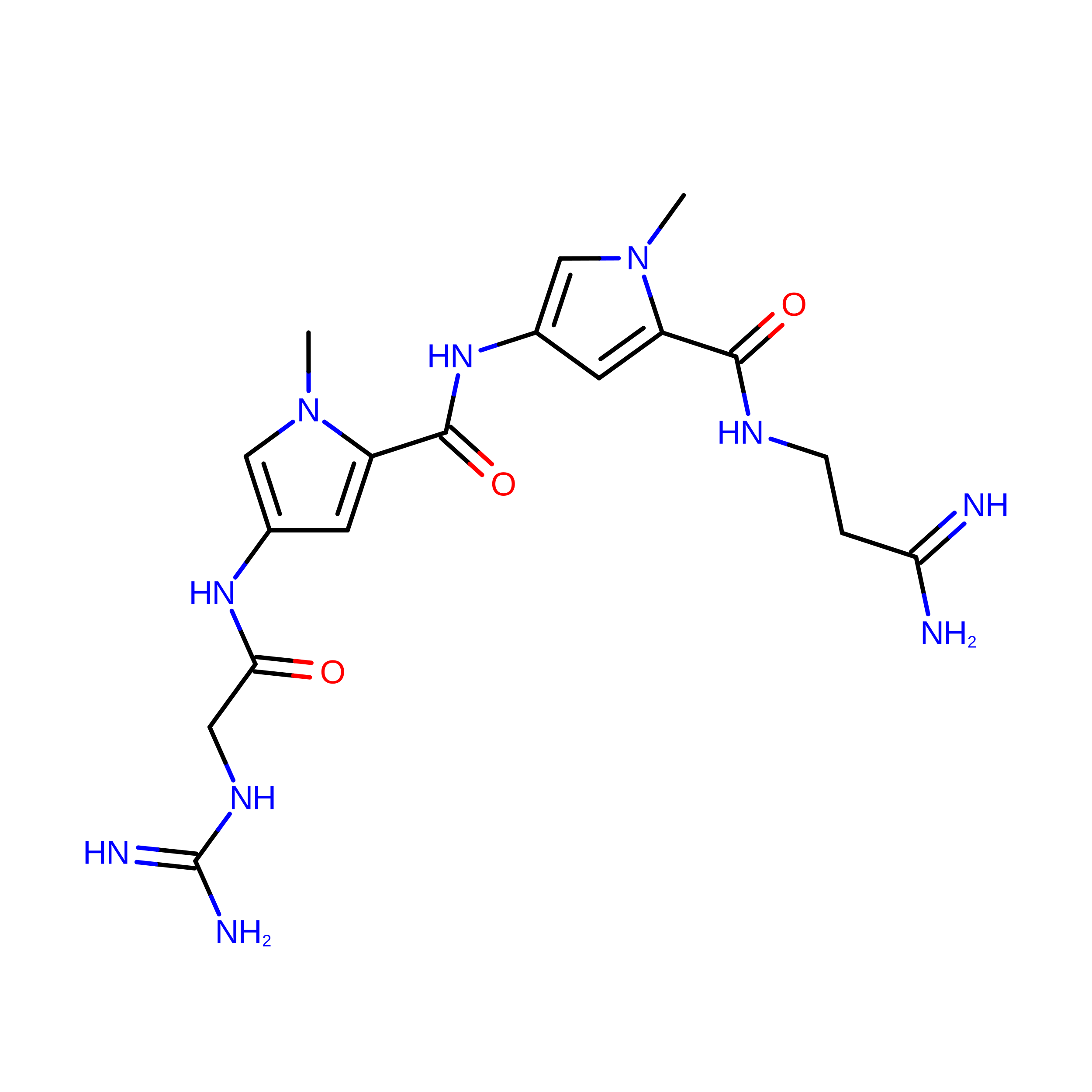
Isoreticular, interpenetrating co-crystal of Replication Initiator Protein REPE54 and symmetrical expanded duplex (31mer) containing the cognate REPE54 sequence and an additional G-C rich sequence co-crystallized with a guest small molecule, netropsin.


Experimental Data Snapshot

  • Method: X-RAY DIFFRACTION
  • Resolution: 3.12 Å
  • R-Value Free: 
    0.234 (Depositor), 0.234 (DCC) 
  • R-Value Work: 
    0.193 (Depositor), 0.195 (DCC) 
  • R-Value Observed: 
    0.197 (Depositor) 

Starting Model: experimental
View more details

wwPDB Validation 3D Report Full Report

Validation slider image for 8D86

Ligand Structure Quality Assessment 


This is version 1.2 of the entry. See complete history

Literature

Modular Protein-DNA Cocrystals as Precise, Programmable Assembly Scaffolds.

Orun, A.R.Shields, E.T.Dmytriw, S.Vajapayajula, A.Slaughter, C.K.Snow, C.D.

(2023) ACS Nano 17: 13110-13120

  • DOI: https://doi.org/10.1021/acsnano.2c07282
  • Primary Citation Related Structures: 
    7SDP, 7SOZ, 7U6K, 7U7O, 7UFX, 7UOG, 7UR0, 7UV6, 7UV7, 7UXY, 8D86

  • PubMed Abstract: 

    High-precision nanomaterials to entrap DNA-binding molecules are sought after for applications such as controlled drug delivery and scaffold-assisted structural biology. Here, we engineered protein-DNA cocrystals to serve as scaffolds for DNA-binding molecules. The designed cocrystals, isoreticular cocrystals, contain DNA-binding protein and cognate DNA blocks where the DNA-DNA junctions stack end-to-end. Furthermore, the crystal symmetry allows topology preserving (isoreticular) expansion of the DNA stack without breaking protein-protein contacts, hence providing larger solvent channels for guest diffusion. Experimentally, the resulting designed isoreticular cocrystal adopted an interpenetrating I 222 lattice, a phenomenon previously observed in metal-organic frameworks (MOFs). The interpenetrating lattice crystallized dependably in the same space group despite myriad modifications at the DNA-DNA junctions. Assembly was modular with respect to the DNA inserted for expansion, providing an interchangeable DNA sequence for guest-specified scaffolding. Also, the DNA-DNA junctions were tunable, accommodating varied sticky base overhang lengths and terminal phosphorylation. As a proof of concept, we used the interpenetrating scaffold crystals to separately entrap three distinct guest molecules during crystallization. Isoreticular cocrystal design offers a route to a programmable scaffold for DNA-binding molecules, and the design principles may be applied to existing cocrystals to develop scaffolding materials.


  • Organizational Affiliation
    • Department of Chemistry, Colorado State University, 1301 Center Ave., Fort Collins, Colorado 80523, United States.

Macromolecule Content 

  • Total Structure Weight: 51 kDa 
  • Atom Count: 3,141 
  • Modeled Residue Count: 278 
  • Deposited Residue Count: 327 
  • Unique protein chains: 1
  • Unique nucleic acid chains: 2

Macromolecules


Find similar proteins by:|  3D Structure
Entity ID: 3
MoleculeChains  Sequence LengthOrganismDetailsImage
Replication initiation protein263Escherichia coli K-12Mutation(s): 1 
Gene Names: repEErepECOK12F045
UniProt
Find proteins for P03856 (Escherichia coli (strain K12))
Explore P03856 
Go to UniProtKB:  P03856
Entity Groups
Sequence Clusters30% Identity50% Identity70% Identity90% Identity95% Identity100% Identity
UniProt GroupP03856
Sequence Annotations
Expand
Reference Sequence
Find similar nucleic acids by:  (by identity cutoff) 
Entity ID: 1
MoleculeChains LengthOrganismImage
DNA (5'-D(A*CP*CP*CP*GP*GP*AP*CP*CP*TP*GP*TP*GP*AP*CP*AP*AP*AP*TP*TP*GP*CP*CP*CP*TP*CP*AP*GP*AP*CP*GP*G)-3')32Escherichia coli
Sequence Annotations
Expand
Reference Sequence
Find similar nucleic acids by:  (by identity cutoff) 
Entity ID: 2
MoleculeChains LengthOrganismImage
DNA (5'-D(A*GP*GP*CP*CP*GP*TP*CP*TP*GP*AP*GP*GP*GP*CP*AP*AP*TP*TP*TP*GP*TP*CP*AP*CP*AP*GP*GP*TP*CP*CP*G)-3')32Escherichia coli
Sequence Annotations
Expand
Reference Sequence

Experimental Data & Validation

Experimental Data

  • Method: X-RAY DIFFRACTION
  • Resolution: 3.12 Å
  • R-Value Free:  0.234 (Depositor), 0.234 (DCC) 
  • R-Value Work:  0.193 (Depositor), 0.195 (DCC) 
  • R-Value Observed: 0.197 (Depositor) 
Space Group: I 2 2 2
Unit Cell:
Length ( Å )Angle ( ˚ )
a = 74.15α = 90
b = 132.731β = 90
c = 134.261γ = 90
Software Package:
Software NamePurpose
PHENIXrefinement
Cootmodel building
XDSdata reduction
XSCALEdata scaling
SCALAdata scaling
PHASERphasing

Structure Validation

View Full Validation Report


Ligand Structure Quality Assessment 


Entry History 

& Funding Information

Deposition Data


Funding OrganizationLocationGrant Number
National Science Foundation (NSF, United States)United States2003748

Revision History  (Full details and data files)

  • Version 1.0: 2023-06-28
    Type: Initial release
  • Version 1.1: 2023-10-25
    Changes: Data collection, Refinement description
  • Version 1.2: 2023-11-01
    Changes: Database references