Download Mendeley
The conserved AAA ATPase PCH-2 distributes its regulation of meiotic prophase events through multiple meiotic HORMADs in C. elegans.
Russo, A.E., Giacopazzi, S., Deshong, A., Menon, M., Ortiz, V., Ego, K.M., Corbett, K.D., Bhalla, N.(2023) PLoS Genet 19: e1010708-e1010708
- PubMed: 37058535 Search on PubMedSearch on PubMed Central
- DOI: https://doi.org/10.1371/journal.pgen.1010708
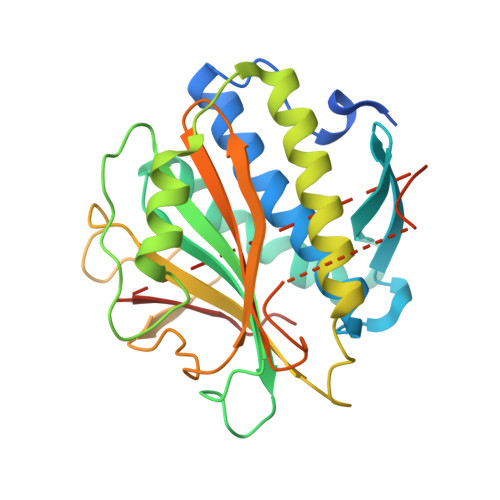
- Primary Citation Related Structures:
8CXK - PubMed Abstract:
During meiotic prophase, the essential events of homolog pairing, synapsis, and recombination are coordinated with meiotic progression to promote fidelity and prevent aneuploidy. The conserved AAA+ ATPase PCH-2 coordinates these events to guarantee crossover assurance and accurate chromosome segregation. How PCH-2 accomplishes this coordination is poorly understood. Here, we provide evidence that PCH-2 decelerates pairing, synapsis and recombination in C. elegans by remodeling meiotic HORMADs. We propose that PCH-2 converts the closed versions of these proteins, which drive these meiotic prophase events, to unbuckled conformations, destabilizing interhomolog interactions and delaying meiotic progression. Further, we find that PCH-2 distributes this regulation among three essential meiotic HORMADs in C. elegans: PCH-2 acts through HTP-3 to regulate pairing and synapsis, HIM-3 to promote crossover assurance, and HTP-1 to control meiotic progression. In addition to identifying a molecular mechanism for how PCH-2 regulates interhomolog interactions, our results provide a possible explanation for the expansion of the meiotic HORMAD family as a conserved evolutionary feature of meiosis. Taken together, our work demonstrates that PCH-2's remodeling of meiotic HORMADs has functional consequences for the rate and fidelity of homolog pairing, synapsis, recombination and meiotic progression, ensuring accurate meiotic chromosome segregation.
- Department of Molecular, Cell and Developmental Biology, University of California, Santa Cruz, California, United States of America.
Organizational Affiliation: