8CMV | pdb_00008cmv

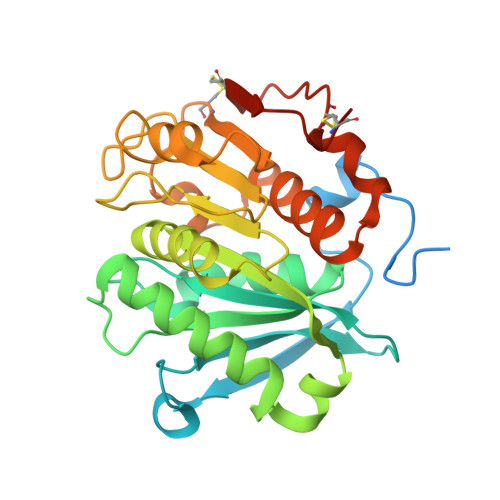
Engineered PETase enzyme from LCC - C09 mutant


Experimental Data Snapshot

  • Method: X-RAY DIFFRACTION
  • Resolution: 1.28 Å
  • R-Value Free: 
    0.187 (Depositor), 0.187 (DCC) 
  • R-Value Work: 
    0.163 (Depositor), 0.164 (DCC) 

Starting Model: experimental
View more details

wwPDB Validation 3D Report Full Report

Validation slider image for 8CMV

Ligand Structure Quality Assessment 


This is version 1.3 of the entry. See complete history

Literature

Development of a highly active engineered PETase enzyme for polyester degradation.

Bhattacharya, S.Castagna, R.Estiri, H.Upmanis, T.Ricci, A.Gautieri, A.Parisini, E.

(2026) FEBS J 293: 443-455

  • DOI: https://doi.org/10.1111/febs.70228
  • Primary Citation Related Structures: 
    8CMV

  • PubMed Abstract: 

    Polyethylene terephthalate (PET) accounts for ≈6% of global plastic production, contributing considerably to the global solid-waste stream and environmental plastic pollution. Since the discovery of PET-depolymerizing enzymes, enzymatic PET recycling has been regarded as a promising method for plastic disposal, particularly in the context of a circular economy strategy. However, because the PET-degrading enzymes developed so far suffer from relatively limited thermostability and low catalytic efficiency, as well as degradation product inhibition, their large-scale industrial applications are still largely hampered. To overcome these limitations, we engineered the current PET-hydrolyzing enzyme gold standard [the ICCG variant of leaf-branch compost cutinase (LCC-ICCG)] using in silico protein design methods to develop a PET-hydrolyzing enzyme that features enhanced thermal stability and PET depolymerization activity. Our mutant, LCC-ICCG-C09, features a 3.5 °C increase in melting temperature relative to the LCC-ICCG enzyme. Under optimal reaction conditions (68 °C), the engineered enzyme hydrolyzes amorphous PET material into terephthalic acid (TPA) with a two-fold higher efficiency compared to LCC-ICCG. Owing to its enhanced properties, LCC-ICCG-C09 may be a promising candidate for future applications in industrial PET recycling processes.


  • Organizational Affiliation
    • Department of Biotechnology, Latvian Institute of Organic Synthesis, Riga, Latvia.

Macromolecule Content 

  • Total Structure Weight: 33.19 kDa 
  • Atom Count: 2,285 
  • Modeled Residue Count: 258 
  • Deposited Residue Count: 301 
  • Unique protein chains: 1

Macromolecules

Find similar proteins by:|  3D Structure
Entity ID: 1
MoleculeChains  Sequence LengthOrganismDetailsImage
Leaf-branch compost cutinase301unidentified prokaryotic organismMutation(s): 1 
EC: 3.1.1.74 (PDB Primary Data), 3.1.1.101 (PDB Primary Data)
UniProt
Find proteins for G9BY57 (Unknown prokaryotic organism)
Explore G9BY57 
Go to UniProtKB:  G9BY57
Entity Groups
Sequence Clusters30% Identity50% Identity70% Identity90% Identity95% Identity100% Identity
UniProt GroupG9BY57
Sequence Annotations
Expand
Reference Sequence

Experimental Data & Validation

Experimental Data

  • Method: X-RAY DIFFRACTION
  • Resolution: 1.28 Å
  • R-Value Free:  0.187 (Depositor), 0.187 (DCC) 
  • R-Value Work:  0.163 (Depositor), 0.164 (DCC) 
Space Group: P 63
Unit Cell:
Length ( Å )Angle ( ˚ )
a = 108.876α = 90
b = 108.876β = 90
c = 35.402γ = 120
Software Package:
Software NamePurpose
REFMACrefinement
XDSdata reduction
Aimlessdata scaling
MLPHAREphasing

Structure Validation

View Full Validation Report


Ligand Structure Quality Assessment 


Entry History 

& Funding Information

Deposition Data


Funding OrganizationLocationGrant Number
Other governmentLatvialzp-2020/2-0013

Revision History  (Full details and data files)

  • Version 1.0: 2024-03-06
    Type: Initial release
  • Version 1.1: 2024-09-25
    Changes: Database references
  • Version 1.2: 2024-11-13
    Changes: Structure summary
  • Version 1.3: 2026-02-18
    Changes: Database references