8CD0 | pdb_00008cd0

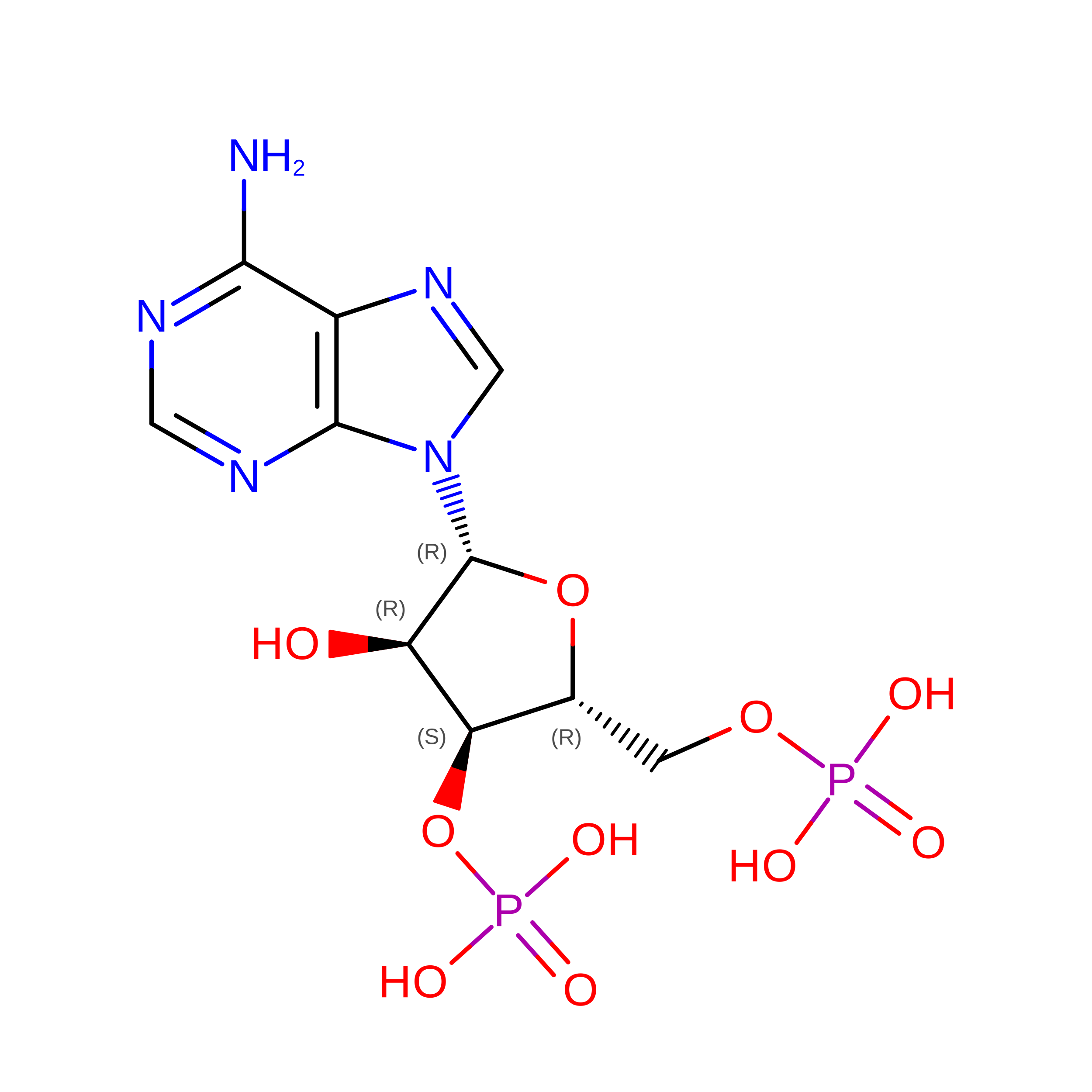
Human heparan sulfate N-deacetylase-N-sulfotransferase 1 in complex with calcium, 3'-phosphoadenosine-5'-phosphosulfate, and nanobody nAb7 (composite map and model)


Experimental Data Snapshot

  • Method: ELECTRON MICROSCOPY
  • Resolution: 2.42 Å
  • Aggregation State: PARTICLE 
  • Reconstruction Method: SINGLE PARTICLE 

wwPDB Validation 3D Report Full Report

Validation slider image for 8CD0

This is version 1.2 of the entry. See complete history

Literature

Structural and mechanistic characterization of bifunctional heparan sulfate N-deacetylase-N-sulfotransferase 1.

Mycroft-West, C.J.Abdelkarim, S.Duyvesteyn, H.M.E.Gandhi, N.S.Skidmore, M.A.Owens, R.J.Wu, L.

(2024) Nat Commun 15: 1326-1326

  • DOI: https://doi.org/10.1038/s41467-024-45419-4
  • Primary Citation Related Structures: 
    8CCY, 8CD0, 8CHS

  • PubMed Abstract: 

    Heparan sulfate (HS) polysaccharides are major constituents of the extracellular matrix, which are involved in myriad structural and signaling processes. Mature HS polysaccharides contain complex, non-templated patterns of sulfation and epimerization, which mediate interactions with diverse protein partners. Complex HS modifications form around initial clusters of glucosamine-N-sulfate (GlcNS) on nascent polysaccharide chains, but the mechanistic basis underpinning incorporation of GlcNS itself into HS remains unclear. Here, we determine cryo-electron microscopy structures of human N-deacetylase-N-sulfotransferase (NDST)1, the bifunctional enzyme primarily responsible for initial GlcNS modification of HS. Our structures reveal the architecture of both NDST1 deacetylase and sulfotransferase catalytic domains, alongside a non-catalytic N-terminal domain. The two catalytic domains of NDST1 adopt a distinct back-to-back topology that limits direct cooperativity. Binding analyses, aided by activity-modulating nanobodies, suggest that anchoring of the substrate at the sulfotransferase domain initiates the NDST1 catalytic cycle, providing a plausible mechanism for cooperativity despite spatial domain separation. Our data shed light on key determinants of NDST1 activity, and describe tools to probe NDST1 function in vitro and in vivo.


  • Organizational Affiliation
    • The Rosalind Franklin Institute, Harwell Science & Innovation Campus, OX11 0QX, Didcot, UK.

Macromolecule Content 

  • Total Structure Weight: 119.12 kDa 
  • Atom Count: 6,860 
  • Modeled Residue Count: 837 
  • Deposited Residue Count: 1,044 
  • Unique protein chains: 2

Macromolecules

Find similar proteins by:|  3D Structure
Entity ID: 1
MoleculeChains  Sequence LengthOrganismDetailsImage
Bifunctional heparan sulfate N-deacetylase/N-sulfotransferase 1882Homo sapiensMutation(s): 0 
Gene Names: NDST1HSSTHSST1
EC: 3.5.1 (PDB Primary Data), 2.8.2.8 (PDB Primary Data)
UniProt & NIH Common Fund Data Resources
Find proteins for P52848 (Homo sapiens)
Explore P52848 
Go to UniProtKB:  P52848
PHAROS:  P52848
GTEx:  ENSG00000070614 
Entity Groups
Sequence Clusters30% Identity50% Identity70% Identity90% Identity95% Identity100% Identity
UniProt GroupP52848
Sequence Annotations
Expand
Reference Sequence
Find similar proteins by:|  3D Structure
Entity ID: 2
MoleculeChains  Sequence LengthOrganismDetailsImage
Nanobody nAb7B [auth C]162Lama glamaMutation(s): 0 

Experimental Data & Validation

Experimental Data

  • Method: ELECTRON MICROSCOPY
  • Resolution: 2.42 Å
  • Aggregation State: PARTICLE 
  • Reconstruction Method: SINGLE PARTICLE 

Structure Validation

View Full Validation Report


Entry History 

& Funding Information

Deposition Data


Funding OrganizationLocationGrant Number
Engineering and Physical Sciences Research CouncilUnited Kingdom--
Wellcome TrustUnited Kingdom060208/Z/00/Z
Wellcome TrustUnited Kingdom093305/Z/10/Z
Wellcome TrustUnited Kingdom203141/Z/16/Z
Wellcome TrustUnited Kingdom218579/Z/19/Z
Biotechnology and Biological Sciences Research Council (BBSRC)United KingdomBB/V018523/1

Revision History  (Full details and data files)

  • Version 1.0: 2024-02-07
    Type: Initial release
  • Version 1.1: 2024-02-28
    Changes: Database references
  • Version 1.2: 2024-10-09
    Changes: Data collection, Structure summary