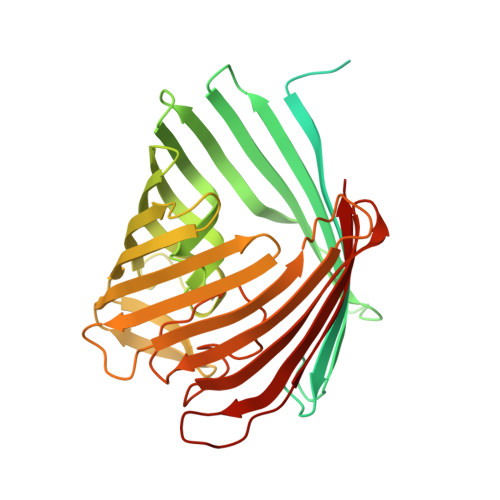
8BYT | pdb_00008byt

Outer membrane attachment porin OmpM1 from Veillonella parvula, C3 symmetry


Experimental Data Snapshot

  • Method: ELECTRON MICROSCOPY
  • Resolution: 2.78 Å
  • Aggregation State: PARTICLE 
  • Reconstruction Method: SINGLE PARTICLE 

wwPDB Validation 3D Report Full Report

Validation slider image for 8BYT

This is version 1.1 of the entry. See complete history

Re-refinement Note

This entry reflects an alternative modeling of the original data in: 8BYM

Literature

Dual function of OmpM as outer membrane tether and nutrient uptake channel in diderm Firmicutes.

Silale, A.Zhu, Y.Witwinowski, J.Smith, R.E.Newman, K.E.Bhamidimarri, S.P.Basle, A.Khalid, S.Beloin, C.Gribaldo, S.van den Berg, B.

(2023) Nat Commun 14: 7152-7152

  • DOI: https://doi.org/10.1038/s41467-023-42601-y
  • Primary Citation Related Structures: 
    8BYM, 8BYS, 8BYT, 8BZ2

  • PubMed Abstract: 

    The outer membrane (OM) in diderm, or Gram-negative, bacteria must be tethered to peptidoglycan for mechanical stability and to maintain cell morphology. Most diderm phyla from the Terrabacteria group have recently been shown to lack well-characterised OM attachment systems, but instead have OmpM, which could represent an ancestral tethering system in bacteria. Here, we have determined the structure of the most abundant OmpM protein from Veillonella parvula (diderm Firmicutes) by single particle cryogenic electron microscopy. We also characterised the channel properties of the transmembrane β-barrel of OmpM and investigated the structure and PG-binding properties of its periplasmic stalk region. Our results show that OM tethering and nutrient acquisition are genetically linked in V. parvula, and probably other diderm Terrabacteria. This dual function of OmpM may have played a role in the loss of the OM in ancestral bacteria and the emergence of monoderm bacterial lineages.


  • Organizational Affiliation
    • Biosciences Institute, Faculty of Medical Sciences, Newcastle University, Framlington Place, NE2 4HH, Newcastle upon Tyne, UK.

Macromolecule Content 

  • Total Structure Weight: 142.67 kDa 
  • Atom Count: 7,077 
  • Modeled Residue Count: 924 
  • Deposited Residue Count: 1,305 
  • Unique protein chains: 1

Macromolecules

Find similar proteins by:|  3D Structure
Entity ID: 1
MoleculeChains  Sequence LengthOrganismDetailsImage
S-layer homology domain-containing protein
A, B, C
435Veillonella parvulaMutation(s): 0 
Gene Names: D3219_09385
Membrane Entity: Yes 
UniProt
Find proteins for A0A100YN03 (Veillonella parvula)
Explore A0A100YN03 
Go to UniProtKB:  A0A100YN03
Entity Groups
Sequence Clusters30% Identity50% Identity70% Identity90% Identity95% Identity100% Identity
UniProt GroupA0A100YN03
Sequence Annotations
Expand
Reference Sequence

Experimental Data & Validation

Experimental Data

  • Method: ELECTRON MICROSCOPY
  • Resolution: 2.78 Å
  • Aggregation State: PARTICLE 
  • Reconstruction Method: SINGLE PARTICLE 
EM Software:
TaskSoftware PackageVersion
RECONSTRUCTIONcryoSPARC3.3.2
MODEL REFINEMENTPHENIX1.20.1-4487

Structure Validation

View Full Validation Report


Entry History 

& Funding Information

Deposition Data


Funding OrganizationLocationGrant Number
Wellcome TrustUnited Kingdom214222/Z/18/Z

Revision History  (Full details and data files)

  • Version 1.0: 2023-11-08
    Type: Initial release
  • Version 1.1: 2023-12-27
    Changes: Database references