8BSB | pdb_00008bsb

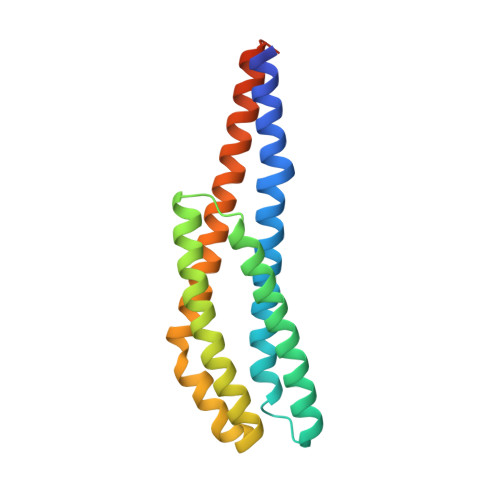
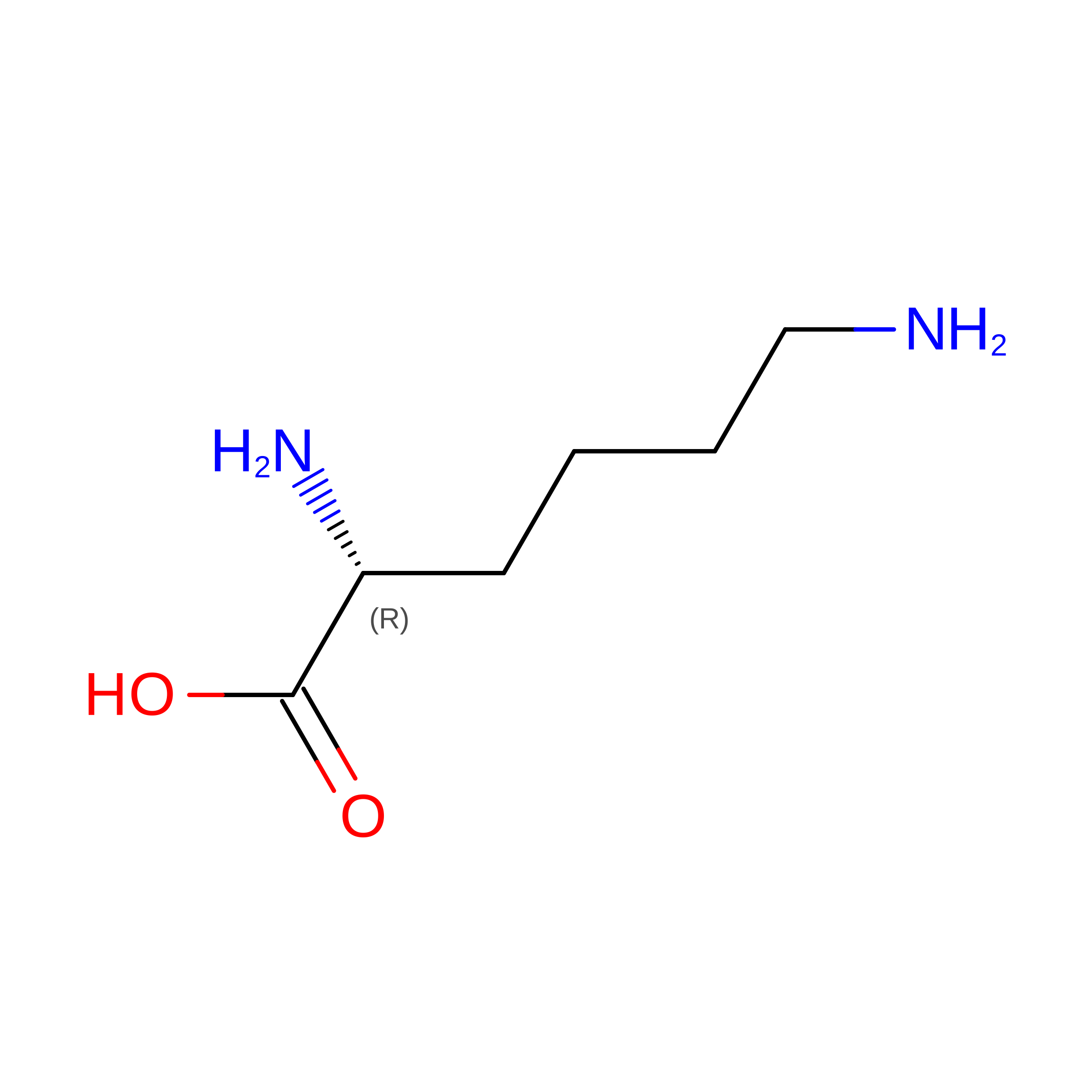
Vc1313-LBD bound to D-lysine


Experimental Data Snapshot

  • Method: X-RAY DIFFRACTION
  • Resolution: 1.90 Å
  • R-Value Free: 
    0.233 (Depositor), 0.236 (DCC) 
  • R-Value Work: 
    0.189 (Depositor), 0.189 (DCC) 
  • R-Value Observed: 
    0.190 (Depositor) 

Starting Model: other
View more details

wwPDB Validation 3D Report Full Report

Validation slider image for 8BSB

Ligand Structure Quality Assessment 


This is version 1.5 of the entry. See complete history

Literature

D-amino acids signal a stress-dependent run-away response in Vibrio cholerae.

Irazoki, O.Ter Beek, J.Alvarez, L.Mateus, A.Colin, R.Typas, A.Savitski, M.M.Sourjik, V.Berntsson, R.P.Cava, F.

(2023) Nat Microbiol 8: 1549-1560

  • DOI: https://doi.org/10.1038/s41564-023-01419-6
  • Primary Citation Related Structures: 
    8BSA, 8BSB

  • PubMed Abstract: 

    To explore favourable niches while avoiding threats, many bacteria use a chemotaxis navigation system. Despite decades of studies on chemotaxis, most signals and sensory proteins are still unknown. Many bacterial species release D-amino acids to the environment; however, their function remains largely unrecognized. Here we reveal that D-arginine and D-lysine are chemotactic repellent signals for the cholera pathogen Vibrio cholerae. These D-amino acids are sensed by a single chemoreceptor MCP DRK co-transcribed with the racemase enzyme that synthesizes them under the control of the stress-response sigma factor RpoS. Structural characterization of this chemoreceptor bound to either D-arginine or D-lysine allowed us to pinpoint the residues defining its specificity. Interestingly, the specificity for these D-amino acids appears to be restricted to those MCP DRK orthologues transcriptionally linked to the racemase. Our results suggest that D-amino acids can shape the biodiversity and structure of complex microbial communities under adverse conditions.


  • Organizational Affiliation
    • The Laboratory for Molecular Infection Medicine Sweden (MIMS), Umeå Center for Microbial Research (UCMR), Science for Life Laboratory (SciLifeLab), Department of Molecular Biology, Umeå University, Umeå, Sweden.

Macromolecule Content 

  • Total Structure Weight: 40.42 kDa 
  • Atom Count: 2,712 
  • Modeled Residue Count: 320 
  • Deposited Residue Count: 354 
  • Unique protein chains: 1

Macromolecules

Find similar proteins by:|  3D Structure
Entity ID: 1
MoleculeChains  Sequence LengthOrganismDetailsImage
Methyl-accepting chemotaxis protein
A, B
177Vibrio cholerae O1 biovar El Tor str. N16961Mutation(s): 0 
Gene Names: FLM12_13895
UniProt
Find proteins for Q9KSE4 (Vibrio cholerae serotype O1 (strain ATCC 39315 / El Tor Inaba N16961))
Explore Q9KSE4 
Go to UniProtKB:  Q9KSE4
Entity Groups
Sequence Clusters30% Identity50% Identity70% Identity90% Identity95% Identity100% Identity
UniProt GroupQ9KSE4
Sequence Annotations
Expand
Reference Sequence

Experimental Data & Validation

Experimental Data

  • Method: X-RAY DIFFRACTION
  • Resolution: 1.90 Å
  • R-Value Free:  0.233 (Depositor), 0.236 (DCC) 
  • R-Value Work:  0.189 (Depositor), 0.189 (DCC) 
  • R-Value Observed: 0.190 (Depositor) 
Space Group: P 1
Unit Cell:
Length ( Å )Angle ( ˚ )
a = 38.337α = 75.32
b = 44.927β = 79.17
c = 56.939γ = 73.69
Software Package:
Software NamePurpose
PHENIXrefinement
REFMACrefinement
PHENIXphasing
Cootmodel building
XDSdata reduction
XDSdata scaling

Structure Validation

View Full Validation Report


Ligand Structure Quality Assessment 


Entry History 

& Funding Information

Deposition Data


Funding OrganizationLocationGrant Number
Swedish Research CouncilSweden2016-03599
Knut and Alice Wallenberg FoundationSweden--

Revision History  (Full details and data files)

  • Version 1.0: 2023-06-07
    Type: Initial release
  • Version 1.1: 2023-06-28
    Changes: Database references
  • Version 1.2: 2023-07-05
    Changes: Database references
  • Version 1.3: 2023-08-09
    Changes: Database references
  • Version 1.4: 2023-11-15
    Changes: Data collection, Source and taxonomy
  • Version 1.5: 2024-05-01
    Changes: Refinement description