8BN8 | pdb_00008bn8

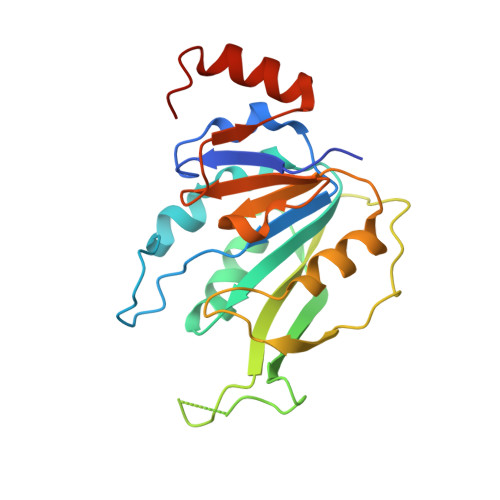
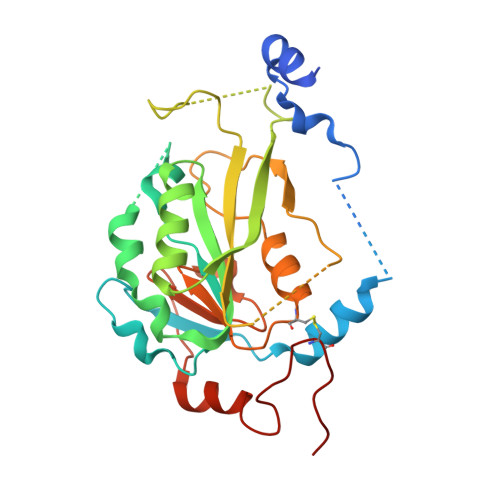
METTL3-METTL14 heterodimer bound to the SAM competitive small molecule inhibitor STM3006


Experimental Data Snapshot

  • Method: X-RAY DIFFRACTION
  • Resolution: 2.21 Å
  • R-Value Free: 
    0.244 (Depositor), 0.245 (DCC) 
  • R-Value Work: 
    0.184 (Depositor), 0.193 (DCC) 

Starting Model: experimental
View more details

wwPDB Validation 3D Report Full Report

Validation slider image for 8BN8

Ligand Structure Quality Assessment 


This is version 1.3 of the entry. See complete history

Literature

Inhibition of METTL3 Results in a Cell-Intrinsic Interferon Response That Enhances Antitumor Immunity.

Guirguis, A.A.Ofir-Rosenfeld, Y.Knezevic, K.Blackaby, W.Hardick, D.Chan, Y.C.Motazedian, A.Gillespie, A.Vassiliadis, D.Lam, E.Y.N.Tran, K.Andrews, B.Harbour, M.E.Vasiliauskaite, L.Saunders, C.J.Tsagkogeorga, G.Azevedo, A.Obacz, J.Pilka, E.S.Carkill, M.MacPherson, L.Wainwright, E.N.Liddicoat, B.Blyth, B.J.Albertella, M.R.Rausch, O.Dawson, M.A.

(2023) Cancer Discov 13: 2228-2247

  • DOI: https://doi.org/10.1158/2159-8290.CD-23-0007
  • Primary Citation Related Structures: 
    8BN8

  • PubMed Abstract: 

    Therapies that enhance antitumor immunity have altered the natural history of many cancers. Consequently, leveraging nonoverlapping mechanisms to increase immunogenicity of cancer cells remains a priority. Using a novel enzymatic inhibitor of the RNA methyl-transferase METTL3, we demonstrate a global decrease in N6-methyladenosine (m6A) results in double-stranded RNA (dsRNA) formation and a profound cell-intrinsic interferon response. Through unbiased CRISPR screens, we establish dsRNA-sensing and interferon signaling are primary mediators that potentiate T-cell killing of cancer cells following METTL3 inhibition. We show in a range of immunocompetent mouse models that although METTL3 inhibition is equally efficacious to anti-PD-1 therapy, the combination has far greater preclinical activity. Using SPLINTR barcoding, we demonstrate that anti-PD-1 therapy and METTL3 inhibition target distinct malignant clones, and the combination of these therapies overcomes clones insensitive to the single agents. These data provide the mole-cular and preclinical rationale for employing METTL3 inhibitors to promote antitumor immunity in the clinic. This work demonstrates that METTL3 inhibition stimulates a cell-intrinsic interferon response through dsRNA formation. This immunomodulatory mechanism is distinct from current immunotherapeutic agents and provides the molecular rationale for combination with anti-PD-1 immune-checkpoint blockade to augment antitumor immunity. This article is featured in Selected Articles from This Issue, p. 2109.


  • Organizational Affiliation
    • Cancer Research Division, Peter MacCallum Cancer Centre, Melbourne, Victoria, Australia.

Macromolecule Content 

  • Total Structure Weight: 59.21 kDa 
  • Atom Count: 3,735 
  • Modeled Residue Count: 441 
  • Deposited Residue Count: 509 
  • Unique protein chains: 2

Macromolecules

Find similar proteins by:|  3D Structure
Entity ID: 1
MoleculeChains  Sequence LengthOrganismDetailsImage
N6-adenosine-methyltransferase catalytic subunitA [auth AAA]218Homo sapiensMutation(s): 0 
Gene Names: METTL3MTA70
EC: 2.1.1.348
UniProt & NIH Common Fund Data Resources
Find proteins for Q86U44 (Homo sapiens)
Explore Q86U44 
Go to UniProtKB:  Q86U44
PHAROS:  Q86U44
GTEx:  ENSG00000165819 
Entity Groups
Sequence Clusters30% Identity50% Identity70% Identity90% Identity95% Identity100% Identity
UniProt GroupQ86U44
Sequence Annotations
Expand
Reference Sequence
Find similar proteins by:|  3D Structure
Entity ID: 2
MoleculeChains  Sequence LengthOrganismDetailsImage
N6-adenosine-methyltransferase non-catalytic subunitB [auth BBB]291Homo sapiensMutation(s): 0 
Gene Names: METTL14KIAA1627
UniProt & NIH Common Fund Data Resources
Find proteins for Q9HCE5 (Homo sapiens)
Explore Q9HCE5 
Go to UniProtKB:  Q9HCE5
PHAROS:  Q9HCE5
GTEx:  ENSG00000145388 
Entity Groups
Sequence Clusters30% Identity50% Identity70% Identity90% Identity95% Identity100% Identity
UniProt GroupQ9HCE5
Sequence Annotations
Expand
Reference Sequence

Small Molecules

Ligands 1 Unique
IDChains Name / Formula / InChI Key2D Diagram3D Interactions
QWR
(Subject of Investigation/LOI)

Query on QWR


Download:Ideal Coordinates CCD File
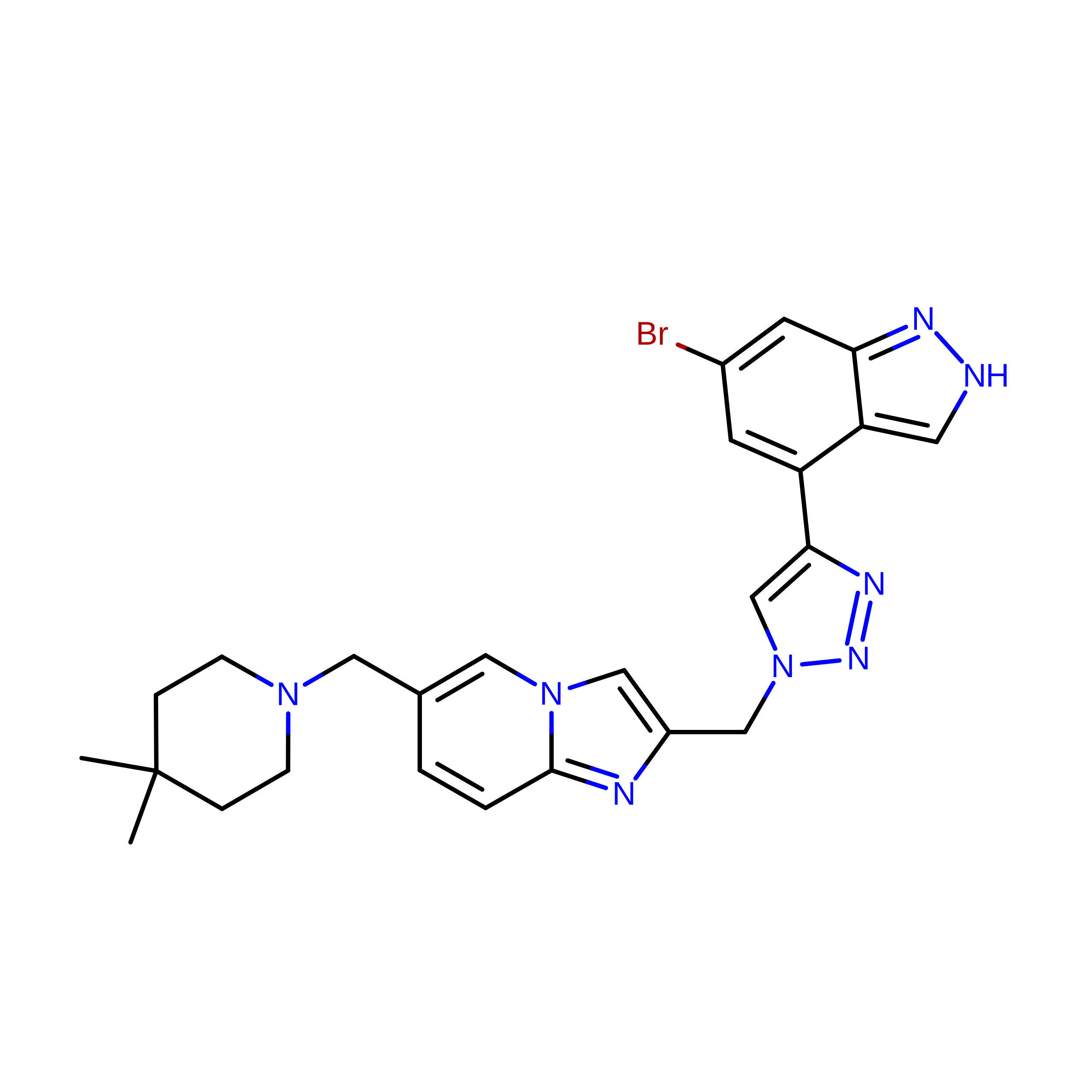
C [auth AAA]2-[[4-(6-bromanyl-2~{H}-indazol-4-yl)-1,2,3-triazol-1-yl]methyl]-6-[(4,4-dimethylpiperidin-1-yl)methyl]imidazo[1,2-a]pyridine
C25 H27 Br N8
RXIOMUYKKTZDFQ-UHFFFAOYSA-N

Experimental Data & Validation

Experimental Data

  • Method: X-RAY DIFFRACTION
  • Resolution: 2.21 Å
  • R-Value Free:  0.244 (Depositor), 0.245 (DCC) 
  • R-Value Work:  0.184 (Depositor), 0.193 (DCC) 
Space Group: P 32 2 1
Unit Cell:
Length ( Å )Angle ( ˚ )
a = 63.97α = 90
b = 63.97β = 90
c = 226.48γ = 120
Software Package:
Software NamePurpose
REFMACrefinement
autoPROCdata reduction
autoPROCdata scaling
PHASERphasing

Structure Validation

View Full Validation Report


Ligand Structure Quality Assessment 


Entry History 

& Funding Information

Deposition Data


Funding OrganizationLocationGrant Number
Not funded--

Revision History  (Full details and data files)

  • Version 1.0: 2023-09-20
    Type: Initial release
  • Version 1.1: 2023-10-18
    Changes: Database references
  • Version 1.2: 2024-11-06
    Changes: Structure summary
  • Version 1.3: 2026-03-04
    Changes: Refinement description