Download Mendeley
Allosteric changes in protein stability and dynamics as pathogenic mechanism for calmodulin variants not affecting Ca 2+ coordinating residues.
Holler, C.V., Petersson, N.M., Brohus, M., Niemela, M.A., Iversen, E.D., Overgaard, M.T., Iwai, H., Wimmer, R.(2023) Cell Calcium 117: 102831-102831
- PubMed: 37995470 Search on PubMed
- DOI: https://doi.org/10.1016/j.ceca.2023.102831
- Primary Citation Related Structures:
8BD2, 8BFG - PubMed Abstract:
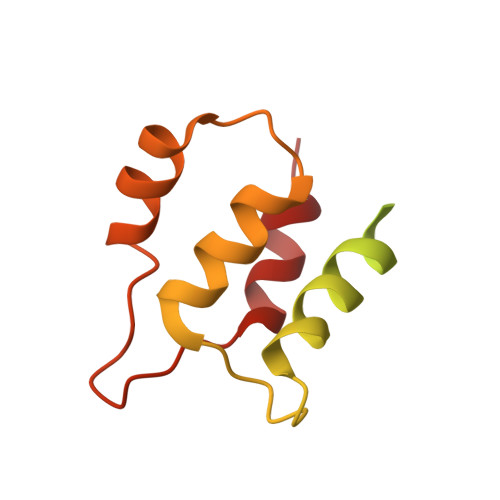
Mutations in the small, calcium-sensing, protein calmodulin cause cardiac arrhythmia and can ultimately prove lethal. Here, we report the impact of the G113R variant on the structure and dynamics of the calmodulin molecule, both in the presence and in the absence of calcium. We show that the mutation introduces minor changes into the structure of calmodulin and that it changes the thermostability and thus the degree of foldedness at human body temperature. The mutation also severely impacts the intramolecular mobility of calmodulin, especially in the apo form. Glycine 113 acts as an alpha-helical C-capping residue in both apo/ - and Ca 2+ /calmodulin, but its exchange to arginine has very different effects on the apo and Ca 2+ forms. The majority of arrhythmogenic calmodulin variants identified affects residues in the Ca 2+ coordinating loops of the two C-domain EF-Hands, causing a 'direct impact on Ca 2+ binding'. However, G113R lies outside a Ca 2+ coordinating loop and acts differently and more similar to the previously characterized arrhythmogenic N53I. Therefore, we suggest that altered apo/CaM dynamics may be a novel general disease mechanism, defining low-calcium target affinity - or Ca 2+ binding kinetics - critical for timely coordination of essential ion-channels in the excitation-contraction cycle.
- Department of Chemistry and Bioscience, Aalborg University, Frederik Bajers vej 7H, 9220 Aalborg, Denmark.
Organizational Affiliation: