Download Mendeley
Dimerization of the beta-Hairpin Membrane-Active Cationic Antimicrobial Peptide Capitellacin from Marine Polychaeta: An NMR Structural and Thermodynamic Study.
Mironov, P.A., Paramonov, A.S., Reznikova, O.V., Safronova, V.N., Panteleev, P.V., Bolosov, I.A., Ovchinnikova, T.V., Shenkarev, Z.O.(2024) Biomolecules 14
- PubMed: 38540752 Search on PubMedSearch on PubMed Central
- DOI: https://doi.org/10.3390/biom14030332
- Primary Citation Related Structures:
8B4R, 8B4S - PubMed Abstract:
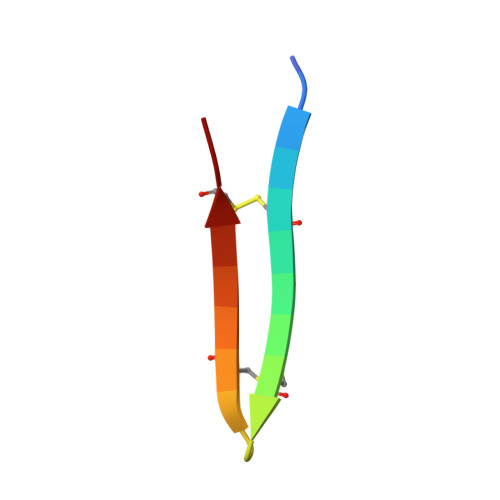
Capitellacin is the β-hairpin membrane-active cationic antimicrobial peptide from the marine polychaeta Capitella teleta . Capitellacin exhibits antibacterial activity, including against drug-resistant strains. To gain insight into the mechanism of capitellacin action, we investigated the structure of the peptide in the membrane-mimicking environment of dodecylphosphocholine (DPC) micelles using high-resolution NMR spectroscopy. In DPC solution, two structural forms of capitellacin were observed: a monomeric β-hairpin was in equilibrium with a dimer formed by the antiparallel association of the N -terminal β-strands and stabilized by intermonomer hydrogen bonds and Van der Waals interactions. The thermodynamics of the enthalpy-driven dimerization process was studied by varying the temperature and molar ratios of the peptide to detergent. Cooling the peptide/detergent system promoted capitellacin dimerization. Paramagnetic relaxation enhancement induced by lipid-soluble 12-doxylstearate showed that monomeric and dimeric capitellacin interacted with the surface of the micelle and did not penetrate into the micelle interior, which is consistent with the "carpet" mode of membrane activity. An analysis of the known structures of β-hairpin AMP dimers showed that their dimerization in a membrane-like environment occurs through the association of polar or weakly hydrophobic surfaces. A comparative analysis of the physicochemical properties of β-hairpin AMPs revealed that dimer stability and hemolytic activity are positively correlated with surface hydrophobicity. An additional positive correlation was observed between hemolytic activity and AMP charge. The data obtained allowed for the provision of a more accurate description of the mechanism of the oligomerization of β-structural peptides in biological membranes.
- M.M. Shemyakin & Yu. A. Ovchinnikov Institute of Bioorganic Chemistry, Russian Academy of Sciences, 117997 Moscow, Russia.
Organizational Affiliation: