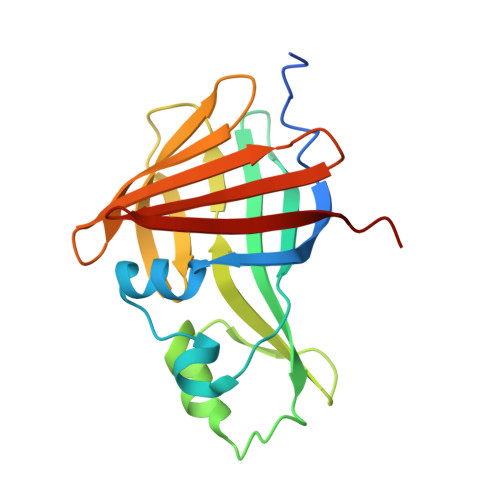
8AQH | pdb_00008aqh

NanoLuc-Y94A luciferase mutant


Experimental Data Snapshot

  • Method: X-RAY DIFFRACTION
  • Resolution: 2.80 Å
  • R-Value Free: 
    0.305 (Depositor), 0.307 (DCC) 
  • R-Value Work: 
    0.261 (Depositor), 0.261 (DCC) 
  • R-Value Observed: 
    0.276 (Depositor) 

Starting Model: experimental
View more details

wwPDB Validation 3D Report Full Report

Validation slider image for 8AQH

This is version 1.2 of the entry. See complete history

Literature

Illuminating the mechanism and allosteric behavior of NanoLuc luciferase.

Nemergut, M.Pluskal, D.Horackova, J.Sustrova, T.Tulis, J.Barta, T.Baatallah, R.Gagnot, G.Novakova, V.Majerova, M.Sedlackova, K.Marques, S.M.Toul, M.Damborsky, J.Prokop, Z.Bednar, D.Janin, Y.L.Marek, M.

(2023) Nat Commun 14: 7864-7864

  • DOI: https://doi.org/10.1038/s41467-023-43403-y
  • Primary Citation Related Structures: 
    8AQ6, 8AQH, 8AQI, 8BO9

  • PubMed Abstract: 

    NanoLuc, a superior β-barrel fold luciferase, was engineered 10 years ago but the nature of its catalysis remains puzzling. Here experimental and computational techniques are combined, revealing that imidazopyrazinone luciferins bind to an intra-barrel catalytic site but also to an allosteric site shaped on the enzyme surface. Structurally, binding to the allosteric site prevents simultaneous binding to the catalytic site, and vice versa, through concerted conformational changes. We demonstrate that restructuration of the allosteric site can boost the luminescent reaction in the remote active site. Mechanistically, an intra-barrel arginine coordinates the imidazopyrazinone component of luciferin, which reacts with O 2 via a radical charge-transfer mechanism, and then it also protonates the resulting excited amide product to form a light-emitting neutral species. Concomitantly, an aspartate, supported by two tyrosines, fine-tunes the blue color emitter to secure a high emission intensity. This information is critical to engineering the next-generation of ultrasensitive bioluminescent reporters.


  • Organizational Affiliation
    • Loschmidt Laboratories, Department of Experimental Biology and RECETOX, Faculty of Science, Masaryk University, Kamenice 5, Bld. C13, 625 00, Brno, Czech Republic.

Macromolecule Content 

  • Total Structure Weight: 40.59 kDa 
  • Atom Count: 2,702 
  • Modeled Residue Count: 342 
  • Deposited Residue Count: 362 
  • Unique protein chains: 1

Macromolecules

Find similar proteins by:|  3D Structure
Entity ID: 1
MoleculeChains  Sequence LengthOrganismDetailsImage
NanoLuc luciferase
A, B
181Oplophorus gracilirostrisMutation(s): 17 
EC: 1.13.12.13
UniProt
Find proteins for Q9GV45 (Oplophorus gracilirostris)
Explore Q9GV45 
Go to UniProtKB:  Q9GV45
Entity Groups
Sequence Clusters30% Identity50% Identity70% Identity90% Identity95% Identity100% Identity
UniProt GroupQ9GV45
Sequence Annotations
Expand
Reference Sequence

Experimental Data & Validation

Experimental Data

  • Method: X-RAY DIFFRACTION
  • Resolution: 2.80 Å
  • R-Value Free:  0.305 (Depositor), 0.307 (DCC) 
  • R-Value Work:  0.261 (Depositor), 0.261 (DCC) 
  • R-Value Observed: 0.276 (Depositor) 
Space Group: C 2 2 2
Unit Cell:
Length ( Å )Angle ( ˚ )
a = 86.449α = 90
b = 86.473β = 90
c = 96.237γ = 90
Software Package:
Software NamePurpose
XDSdata reduction
Aimlessdata scaling
PHASERphasing
PHENIXrefinement
PDB_EXTRACTdata extraction

Structure Validation

View Full Validation Report


Entry History 

& Funding Information

Deposition Data


Funding OrganizationLocationGrant Number
Czech Science FoundationCzech Republic22-09853S

Revision History  (Full details and data files)

  • Version 1.0: 2023-08-23
    Type: Initial release
  • Version 1.1: 2023-12-27
    Changes: Database references
  • Version 1.2: 2026-03-04
    Changes: Refinement description, Structure summary